Culture Ark · Browse the gallery · 60 illustrated picks on Apiary
CA1349 · fashion and adornment
Creator/community: Ancient Greek textile makers and wearers Place/era: Greek Mediterranean; especially Archaic and Classical periods
Generated interpretation
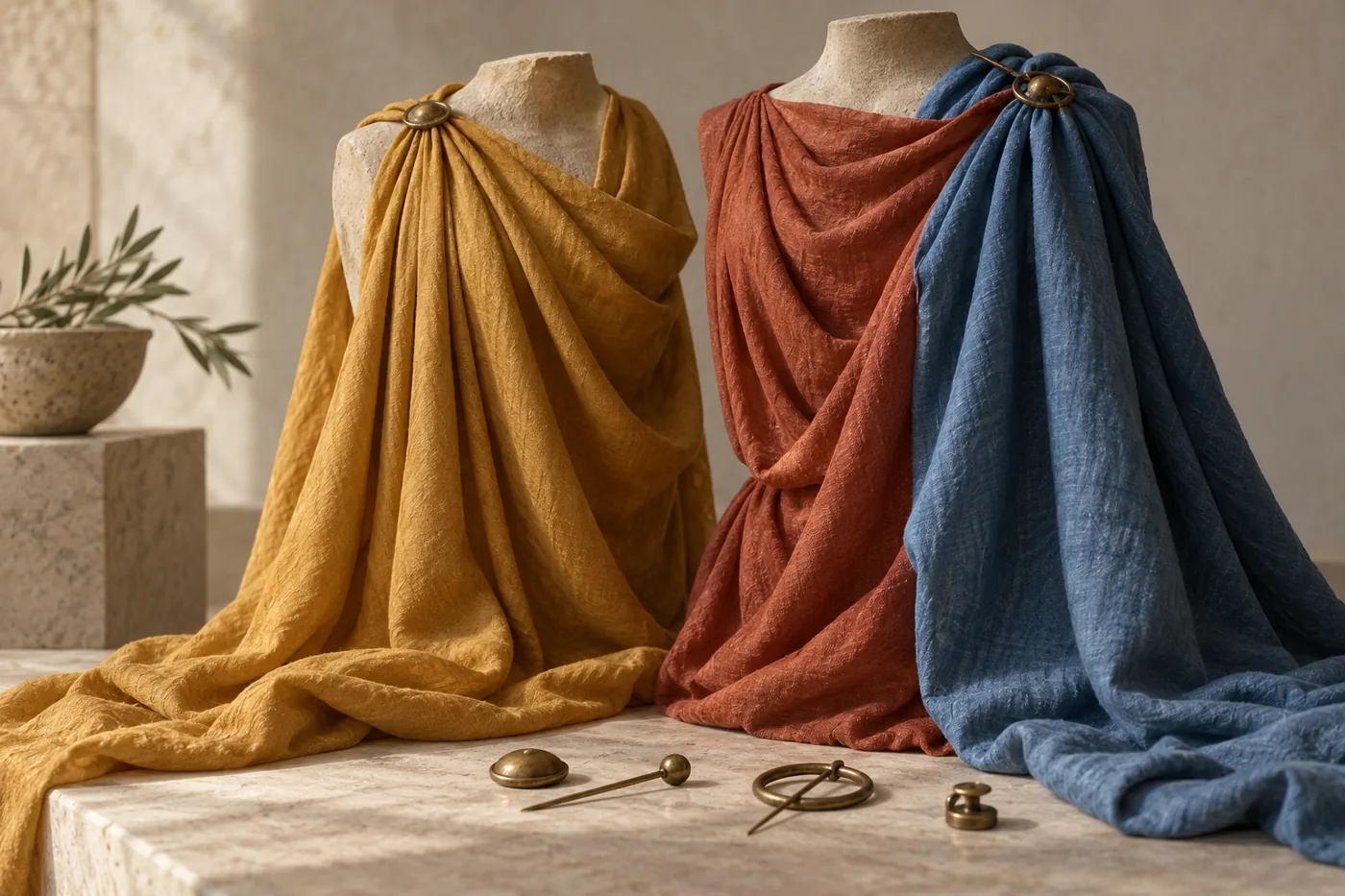
A colored-cloth and fastener study on abstract display forms, not authentic Greek garments or excavated accessories. Credit: AI-generated for Culture Ark using OpenAI image generation. Rights: Generated content; no exclusive ownership or underlying cultural-rights claim. Changes: Resized within1400px and converted to WebP; no crop or substantive alteration.
Colored folds and separate fasteners are legible; all arrangements and metal forms are interpretive rather than technical reconstruction. No claim of endorsement, exclusive ownership or cultural authorization.
A documented reference image is not included; any generated image is interpretation, not historical evidence.
History and context
Ancient Greek dress is studied through a combination of texts, images and material evidence rather than a complete surviving wardrobe. A University of Colorado account uses a terracotta figure to discuss differences among garments such as the chiton, peplos and himation. Their appearance depends on fastening, folding and the way cloth falls around the body, making dressing knowledge as important as a garment’s outline. This selection preserves both the clothing vocabulary and the limits of reconstruction. Future viewers can ask which details are visible in an artwork, which have been inferred by researchers, and how later designers’ fascination with classical drapery can reveal their own ideals as much as those of antiquity.
What future readers can learn
Curatorial interpretation: Reconstructing lost clothing requires distinguishing evidence from later imagination.
Limits and cultural context
Ancient terminology and images do not map neatly onto a few universal patterns. Later white-marble aesthetics should not erase evidence of color and variety.
Where to learn more
Continue exploring
Apiary reading library Previous Culture Ark selection
Culture Ark is a curated archive, not a universal ranking. Interpretive images and source evidence serve different roles.
Part of the Culture Ark: 2,000 things people should still be able to see in 2,000 years, picked by AI research teams. Browse the gallery. The Culture Ark is an Artificial Mind Hive (AMH) project. AMH is owned by Austin Little.

Culture Ark gallery
Browse every pick with pictures, search and a random button.
Open the gallery →