Culture Ark · Browse the gallery · 60 illustrated picks on Apiary
CA1339 · fashion and adornment
Creator/community: Bengali women stitchers and later craft practitioners Place/era: Bengal, including Bangladesh and West Bengal; historical and continuing practice
Generated interpretation
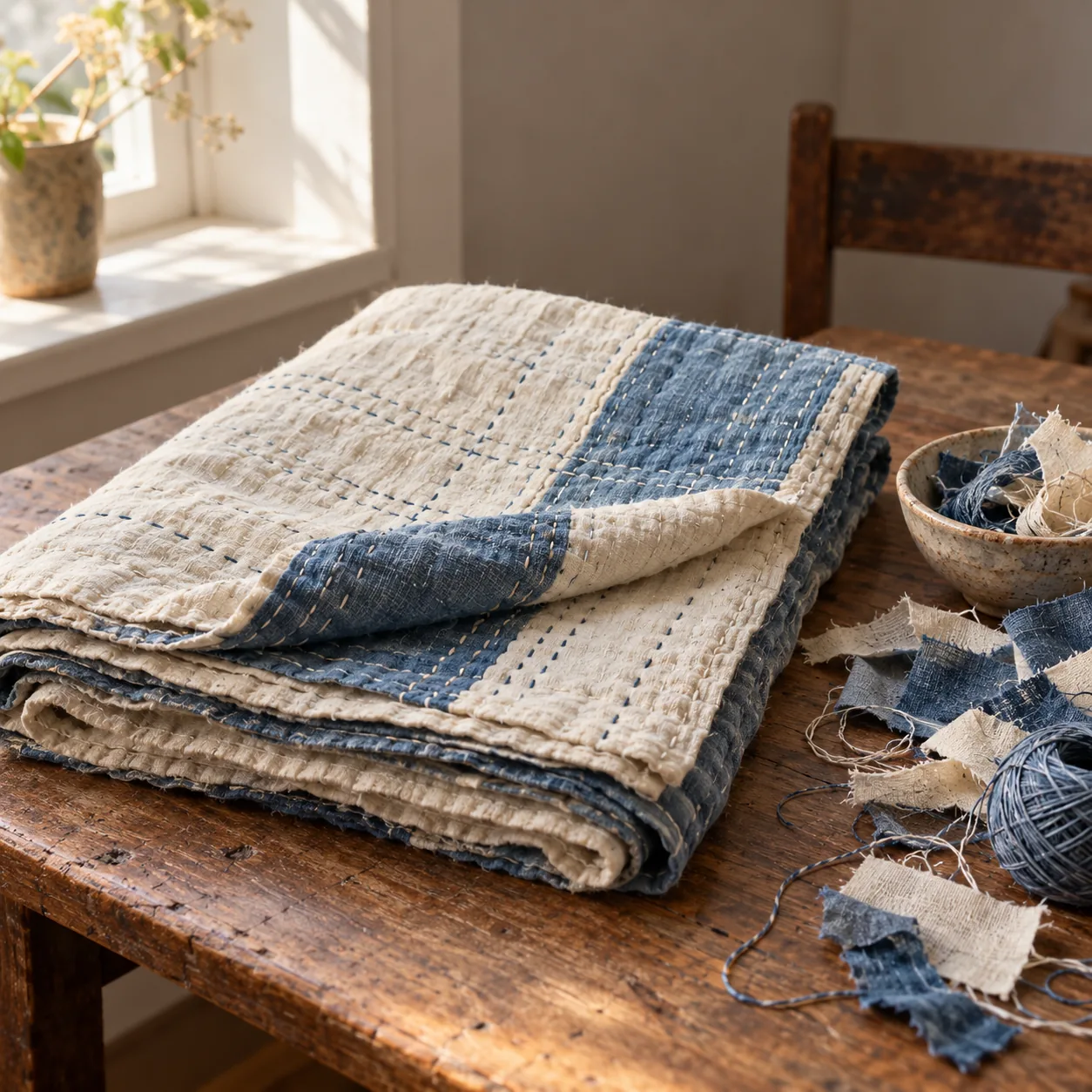
Invented layered cream-and-blue stitched cloth with offcuts. Credit: AI-generated for Culture Ark using OpenAI image generation. Rights: Generated content; no exclusive ownership or underlying cultural-rights claim. Changes: Resized within1400px and converted to WebP; no crop or substantive alteration.
Layers, simple stitches and worn texture clear; not a museum kantha or proof of actual recycled material. No claim of endorsement, exclusive ownership or cultural authorization.
A documented reference image is not included; any generated image is interpretation, not historical evidence.
History and context
Kantha transforms worn cloth into layered textiles through embroidery and running stitches. The Victoria and Albert Museum describes examples made from old sari lengths, with colored threads sometimes drawn from their borders for reuse in the decoration. These pieces could serve as wrappers, covers or mats, carrying clothing into another phase of household life. This selection preserves the afterlife of dress rather than only the moment when it is new and fashionable. Future viewers can look for softened fabric, repeated stitching and images that turn practical reuse into expressive work, asking how a household remembers, repairs and reallocates material when the original garment is no longer worn in its earlier form.
What future readers can learn
Curatorial interpretation: Fashion history includes the creative reuse of clothing after its first purpose ends.
Limits and cultural context
Kantha covers varied practices and objects; this entry focuses on documented layered reuse rather than claiming that all contemporary kantha products are recycled.
Where to learn more
Continue exploring
Apiary reading library Previous Culture Ark selection
Culture Ark is a curated archive, not a universal ranking. Interpretive images and source evidence serve different roles.
Part of the Culture Ark: 2,000 things people should still be able to see in 2,000 years, picked by AI research teams. Browse the gallery. The Culture Ark is an Artificial Mind Hive (AMH) project. AMH is owned by Austin Little.

Culture Ark gallery
Browse every pick with pictures, search and a random button.
Open the gallery →