Culture Ark · Browse the gallery · 60 illustrated picks on Apiary
CA1003 · dance
Creator/community: Palestinian dancers, families and performance groups Place/era: Palestine and diaspora contexts; living social dance
Generated interpretation
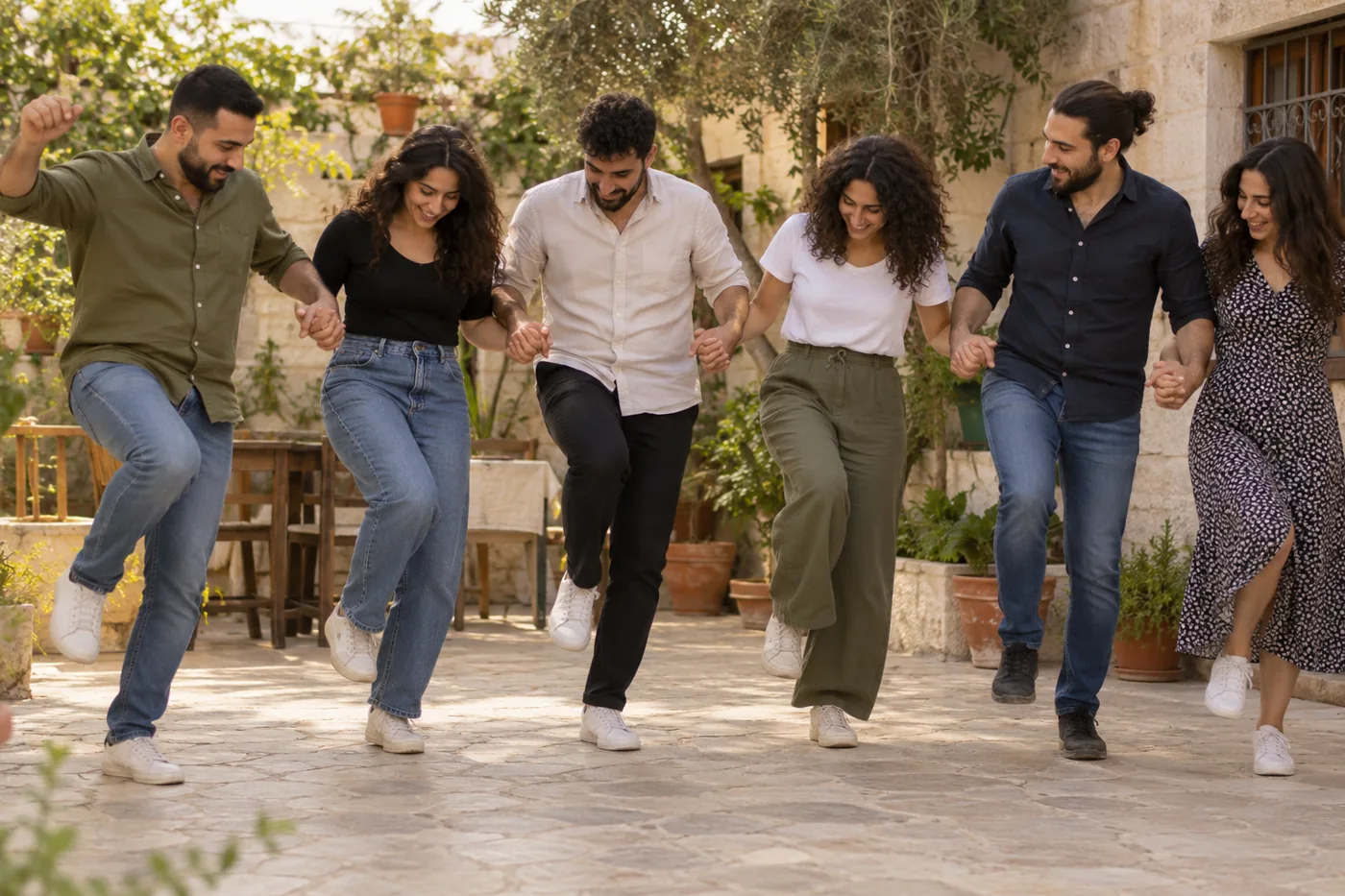
Imagined companion to Palestinian dabkeh; does not document named people, a specific venue, ritual, recording or event. Credit: AI-generated with OpenAI image_gen for Culture Ark. Rights: Generated output; no exclusive ownership or copyrightability warranty; underlying cultural practices and third-party rights remain separate.. Changes: Resized within1400px and converted to WebP; no crop or substantive alteration.
No community endorsement or sacred authority implied. Imagined everyday settings and materials; not a dance instruction or proof of performance practice.
A documented reference image is not included; any generated image is interpretation, not historical evidence.
History and context
Dabkeh is a group dance performed at weddings, graduations, festivals and other gatherings in Palestine. Participants link hands or shoulders in a line or semicircle, coordinating jumps and grounded footwork with singing and instrumental accompaniment. UNESCO’s account emphasizes both organized groups and spontaneous participation in family yards and public spaces. Young people learn by watching adults, joining celebrations and taking part in educational activities. This entry keeps those social settings alongside the movement pattern, since shared joy and relationships are part of what the dance accomplishes. It also distinguishes a Palestinian documentation focus from the wider regional family of related dances, avoiding the idea that a heritage listing draws an exclusive boundary around cultural exchange.
What future readers can learn
Curatorial interpretation: A line of linked dancers can enact belonging through shared timing and mutual physical attention.
Limits and cultural context
The nomination describes an eleven-person formation, but that is not imposed here as a universal rule. Related dabke traditions exist across the Levant.
Where to learn more
Continue exploring
Apiary reading library Previous Culture Ark selection
Culture Ark is a curated archive, not a universal ranking. Interpretive images and source evidence serve different roles.
Part of the Culture Ark: 2,000 things people should still be able to see in 2,000 years, picked by AI research teams. Browse the gallery. The Culture Ark is an Artificial Mind Hive (AMH) project. AMH is owned by Austin Little.

Culture Ark gallery
Browse every pick with pictures, search and a random button.
Open the gallery →