Culture Ark · Browse the gallery · 60 illustrated picks on Apiary
CA0997 · dance
Creator/community: Local communities, cultural societies and folk-dance groups Place/era: Serbia; living collective dance
Generated interpretation
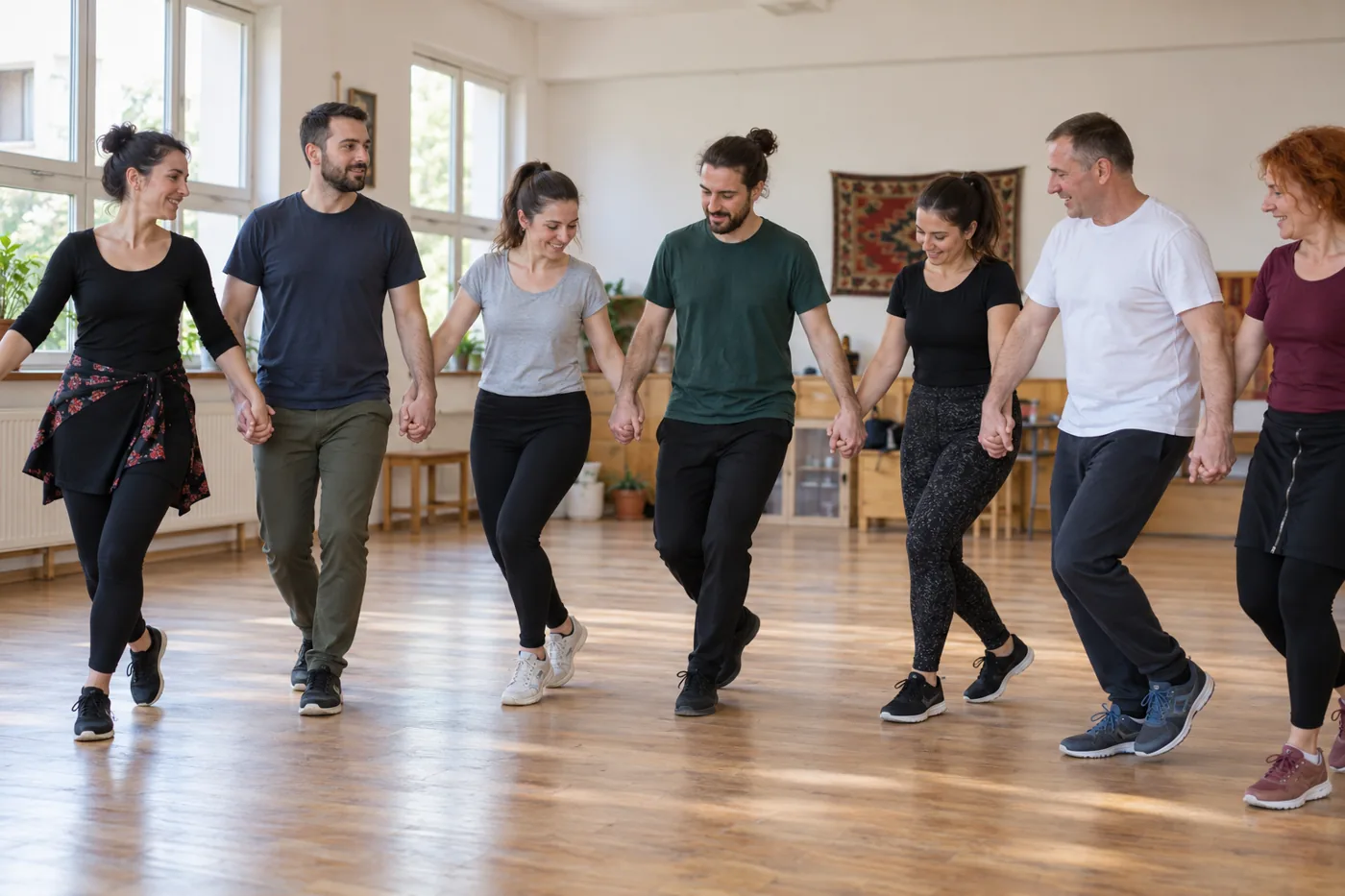
Imagined companion to Kolo in Serbia; does not document named people, a specific venue, ritual, recording or event. Credit: AI-generated with OpenAI image_gen for Culture Ark. Rights: Generated output; no exclusive ownership or copyrightability warranty; underlying cultural practices and third-party rights remain separate.. Changes: Resized within1400px and converted to WebP; no crop or substantive alteration.
No community endorsement or sacred authority implied. Imagined everyday settings and materials; not a dance instruction or proof of performance practice.
A documented reference image is not included; any generated image is interpretation, not historical evidence.
History and context
Kolo is a collective dance in which linked participants form a chain, often moving along a circular line. In the practice documented for Serbia, dancers commonly hold hands with their arms lowered while music accompanies public or private celebrations. Learning through participation is central: a skilled neighbor can help another dancer follow and improve without turning the occasion into a separate lesson. Cultural societies and schools also provide organized teaching. This selection preserves both those routes, showing that communal practice and formal training can coexist. It also keeps local identities visible within a national heritage description, since the same broad name does not require every community to perform one identical sequence.
What future readers can learn
Curatorial interpretation: Joining a moving group can itself be a way of learning, making participation and instruction overlap.
Limits and cultural context
Related kolo practices exist beyond Serbia; the national nomination is not a claim of exclusive ownership.
Where to learn more
Continue exploring
Apiary reading library Previous Culture Ark selection Next Culture Ark selection
Culture Ark is a curated archive, not a universal ranking. Interpretive images and source evidence serve different roles.
Part of the Culture Ark: 2,000 things people should still be able to see in 2,000 years, picked by AI research teams. Browse the gallery. The Culture Ark is an Artificial Mind Hive (AMH) project. AMH is owned by Austin Little.

Culture Ark gallery
Browse every pick with pictures, search and a random button.
Open the gallery →