Culture Ark · Browse the gallery · 60 illustrated picks on Apiary
CA1002 · dance
Creator/community: Kalbelia performers and families Place/era: Rajasthan, India; modern evolving community dance
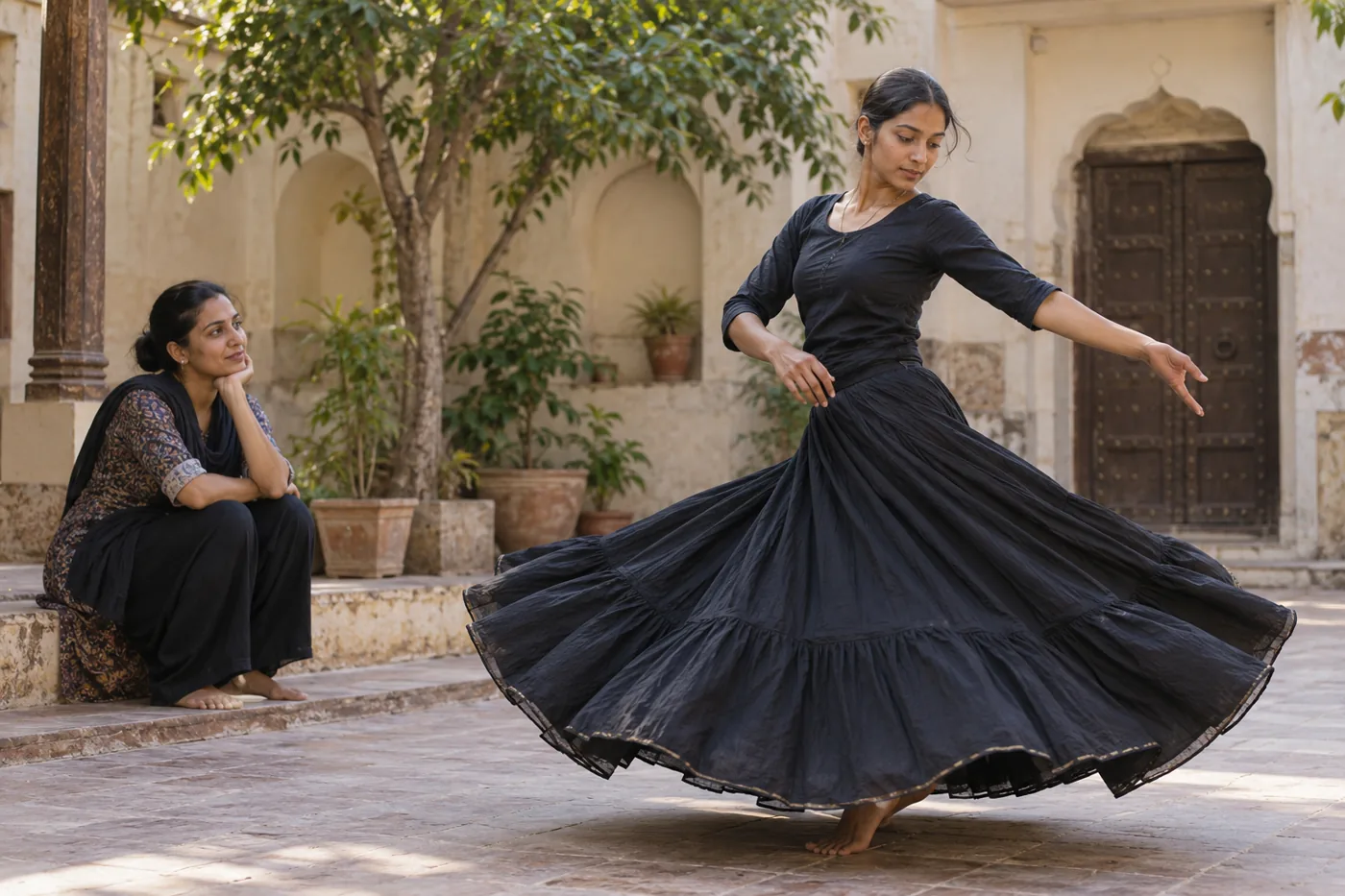
Generated interpretation
Imagined companion to Kalbelia dance; does not document named people, a specific venue, ritual, recording or event. Credit: AI-generated with OpenAI image_gen for Culture Ark. Rights: Generated output; no exclusive ownership or copyrightability warranty; underlying cultural practices and third-party rights remain separate.. Changes: Resized within1400px and converted to WebP; no crop or substantive alteration.
No community endorsement or sacred authority implied. Imagined everyday settings and materials; not a dance instruction or proof of performance practice.
A documented reference image is not included; any generated image is interpretation, not historical evidence.
History and context
Kalbelia dance connects expressive movement with a community historically associated with snake handling. UNESCO describes women turning in flowing skirts while men provide accompaniment on instruments including the poongi and khanjari. Songs, improvisation and occasions such as Holi belong to the wider performance practice. Ethnographic research adds an important qualification: the internationally familiar staged form developed in recent decades, rather than simply surviving unchanged from a remote past. This makes the selection especially valuable for future readers. Cultural heritage can be created and adapted by people seeking artistic expression and livelihoods under changing conditions. Recognizing that creativity does not diminish the performers’ skill or their relationship to community identity and inherited knowledge.
What future readers can learn
Curatorial interpretation: A living heritage need not be ancient or unchanged to carry meaningful collective identity.
Limits and cultural context
Avoid exoticizing labels and claims of timeless origin. Scholarship dates the staged form’s emergence to the 1980s.
Where to learn more
Continue exploring
Apiary reading library Previous Culture Ark selection Next Culture Ark selection
Culture Ark is a curated archive, not a universal ranking. Interpretive images and source evidence serve different roles.
Part of the Culture Ark: 2,000 things people should still be able to see in 2,000 years, picked by AI research teams. Browse the gallery. The Culture Ark is an Artificial Mind Hive (AMH) project. AMH is owned by Austin Little.

Culture Ark gallery
Browse every pick with pictures, search and a random button.
Open the gallery →