

Culture Ark · Browse the gallery · Tango of Argentina and Uruguay in the gallery · 60 illustrated picks on Apiary
CA0004 · dance
Creator/community: Río de la Plata musicians, dancers, poets, composers and teachers Place/era: Buenos Aires and Montevideo; urban tradition continuing into the present
Generated interpretation
Invented dance-shoe still life interpreting tango partnership; no actual venue, dancers or universal gender/footwear rule is depicted. Credit: AI-generated for Culture Ark using OpenAI image_gen, 2026-11-01. Rights: AI-generated output; no exclusive ownership or guaranteed copyrightability claimed. Changes: Resized within1400px and converted to WebP; no crop or substantive alteration.
Interpretive presentation artwork, not documentary evidence. Underlying music, film, brands and personality rights remain separate.
Documented reference / existing artwork
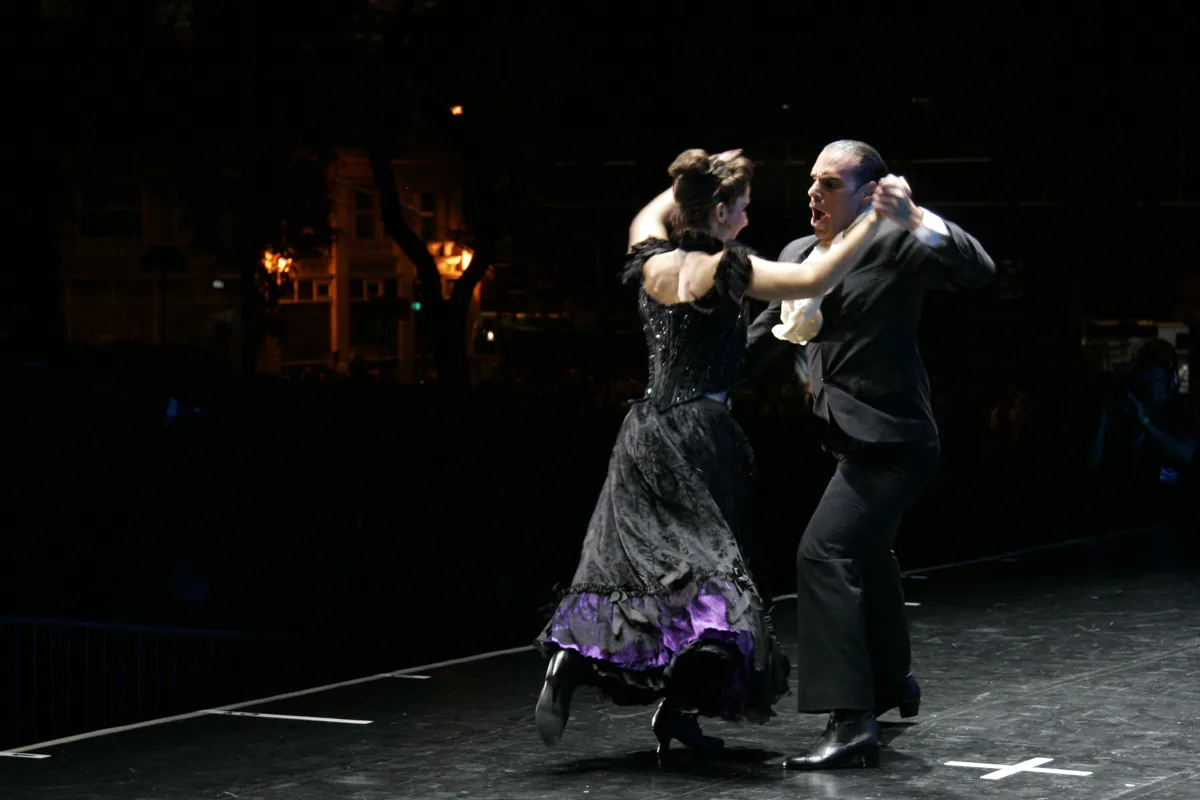
Tango performance in Buenos Aires, 2011. Credit: Gobierno de la Ciudad de Buenos Aires. Rights: CC BY 2.0. Changes: Resized within1400px and converted to WebP; no crop or substantive alteration. Image source Image licence
License applies to this photograph only. No endorsement or personality-rights clearance implied. Preserve attribution and applicable share-alike terms.
History and context
Tango brings music, dance and poetry into a shared urban tradition of Argentina and Uruguay. UNESCO locates its formation among popular communities in Buenos Aires and Montevideo, where European migrants, descendants of enslaved Africans and local-born populations lived together. It is therefore better understood as a cultural meeting and continuing practice than as the invention of one person. Social dance settings known as milongas are part of that story, alongside professional performance, teaching and composition. The catalog preserves both countries in the title because a border-only label would obscure the connected Río de la Plata world in which the tradition developed and continues to be renewed.
What future readers can learn
Curatorial interpretation: tango can help future readers examine migration, mixed cultural inheritance, urban sociability and the difference between dancing with others and performing for spectators.
Limits and cultural context
Do not reduce tango to a single stage pose or treat one choreography as universal. Its histories include African-descended communities. UNESCO inscription in 2009 is not its origin date.
Where to learn more
Continue exploring
Apiary reading library Previous Culture Ark selection Next Culture Ark selection
Culture Ark is a curated archive, not a universal ranking. Interpretive images and source evidence serve different roles.
Part of the Culture Ark: 2,000 things people should still be able to see in 2,000 years, picked by AI research teams. Browse the gallery. The Culture Ark is an Artificial Mind Hive (AMH) project. AMH is owned by Austin Little.

Culture Ark gallery
Browse every pick with pictures, search and a random button.
Open the gallery →