Culture Ark · Browse the gallery · 60 illustrated picks on Apiary
CA0947 · ordinary life
Creator/community: Zhang family workshop Place/era: China; 13th–14th century, Jin or Yuan dynasty
Generated interpretation
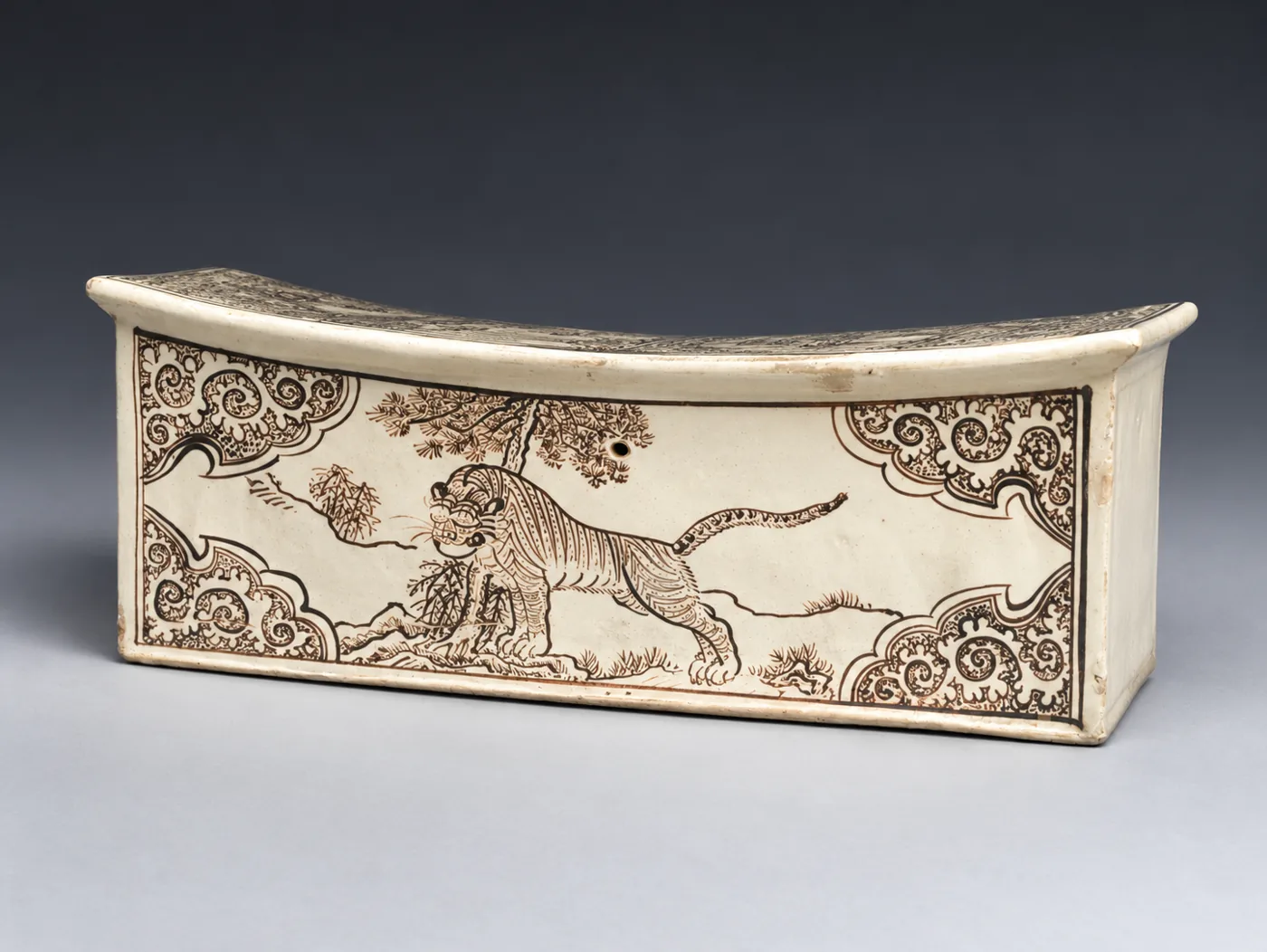
AI-created three-quarter presentation guided by the photographed tiger-decorated side of the ceramic pillow. It does not invent the unseen scenes or claim to show how an owner slept. Credit: AI-generated for Culture Ark using OpenAI image_gen; public-domain reference credited below. Rights: AI-generated output; no exclusive ownership or guaranteed copyrightability claimed. Changes: Resized within1400px and converted to WebP; no crop or substantive alteration. Image source
Generated thematic illustration, not documentary evidence, an actual performance, or technical instruction. Cultural knowledge, underlying works, names and personality rights remain separate.
Documented reference / existing artwork
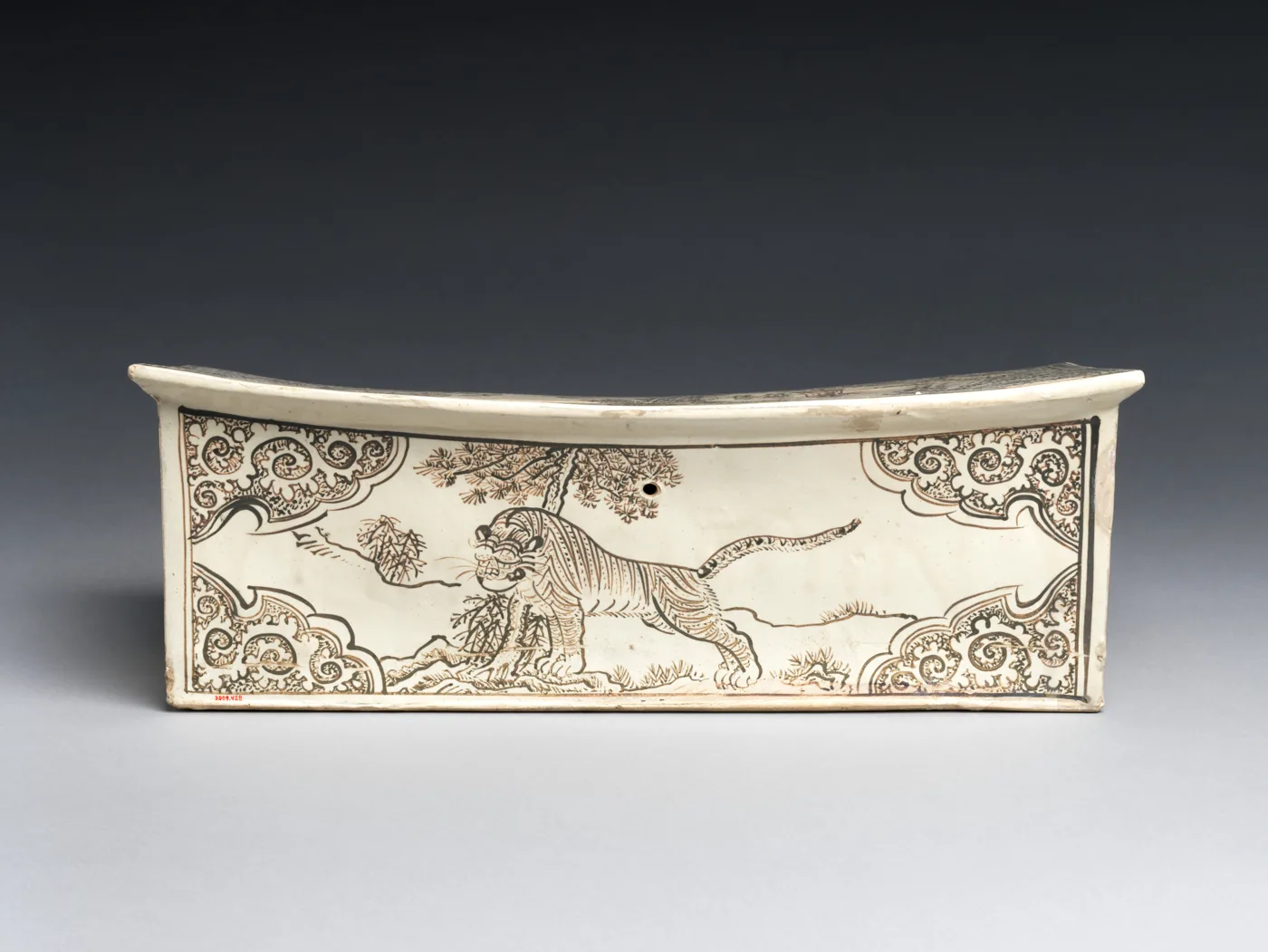
Pillow with landscapes featuring Daoist figures and a tiger. 13th–14th century. The Metropolitan Museum of Art, 2009.428. This view shows the tiger-decorated side, not every painted surface. Credit: Zhang family workshop / The Metropolitan Museum of Art. Purchase, Friends of Asian Art Gifts, 2009. Rights: Public domain; Met Open Access. Changes: Resized within1400px and converted to WebP; no crop or substantive alteration. Image source Image licence
Met API explicitly marks isPublicDomain=true. Image reuse permission does not transfer ownership of the object or resolve cultural permissions, sacred significance, provenance or restitution questions. Retain the catalog context.
History and context
A stoneware pillow attributed to the Zhang family workshop carries painted landscapes with Daoist figures and a tiger. The Met dates it broadly to the 13th or 14th century and classifies it as Cizhou ware. Dark decoration appears over a pale slip beneath clear glaze, making the sleeping support a surface for lively imagery. Its substantial length, about 43.5 centimetres, challenges an assumption that a pillow must be a soft textile cushion. The selection brings together bodily rest, ceramics and visual storytelling, without supposing that the surviving image tells us exactly how its owner dreamed or understood each scene.
What future readers can learn
Curatorial interpretation: Ordinary bodily practices can take materially unfamiliar forms and become places for narrative imagery.
Limits and cultural context
Dynastic attribution spans Jin or Yuan; do not choose one without evidence. The maker designation is a workshop attribution, not a named individual artist.
Where to learn more
Continue exploring
Apiary reading library Previous Culture Ark selection
Culture Ark is a curated archive, not a universal ranking. Interpretive images and source evidence serve different roles.
Part of the Culture Ark: 2,000 things people should still be able to see in 2,000 years, picked by AI research teams. Browse the gallery. The Culture Ark is an Artificial Mind Hive (AMH) project. AMH is owned by Austin Little.

Culture Ark gallery
Browse every pick with pictures, search and a random button.
Open the gallery →