Culture Ark · Browse the gallery · 60 illustrated picks on Apiary
CA0934 · ordinary life
Creator/community: Unidentified Tunisian maker Place/era: Sfax, Tunisia; before 1914
Generated interpretation
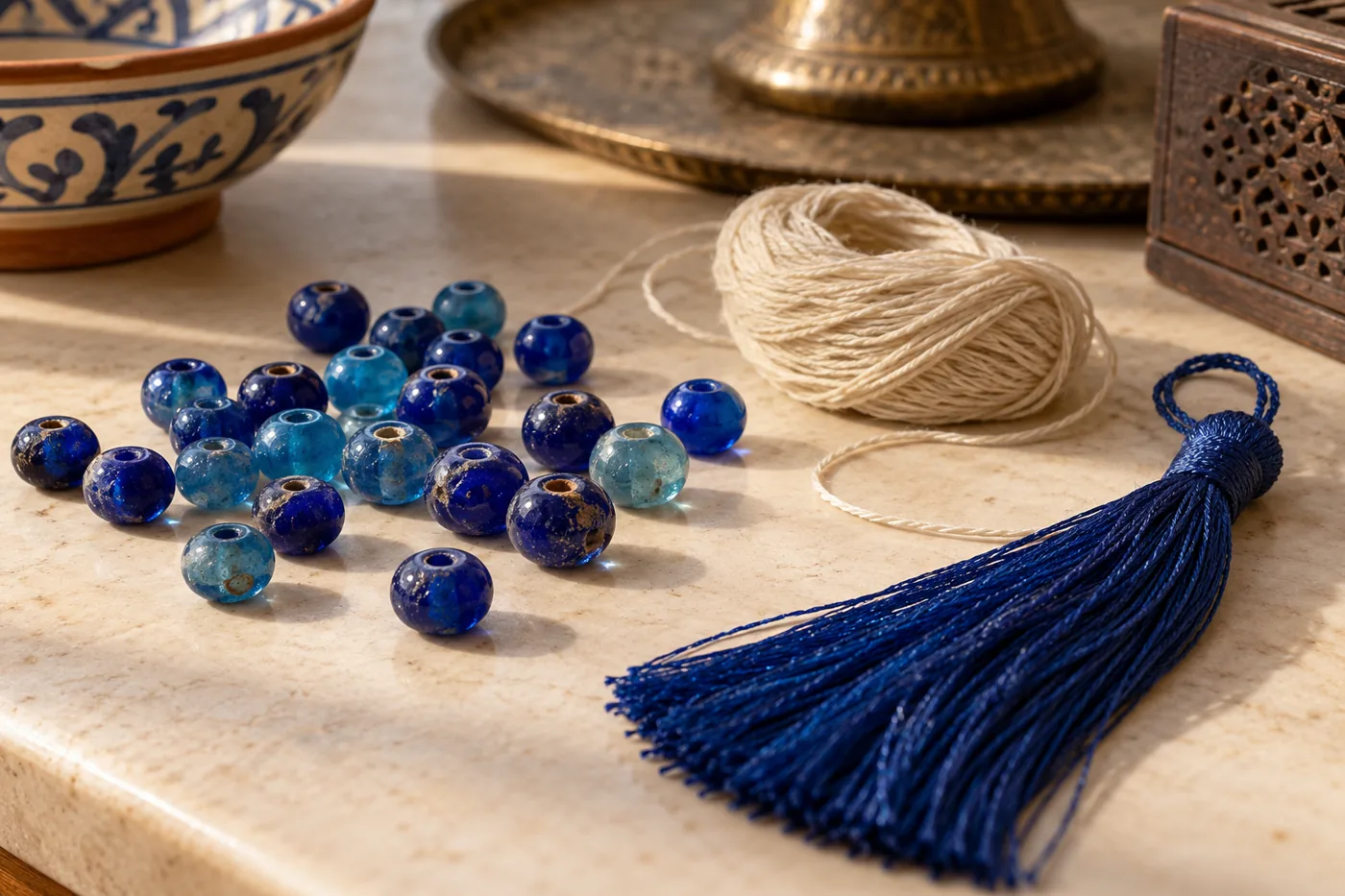
Imagined companion to Prayer beads from Sfax; does not document named people, a specific maker, owner, family, ritual or historical object. Credit: AI-generated with OpenAI image_gen for Culture Ark. Rights: Generated output; no exclusive ownership or copyrightability warranty; underlying cultural practices and third-party rights remain separate.. Changes: Resized within1400px and converted to WebP; no crop or substantive alteration.
No community endorsement or sacred authority implied. Imagined everyday settings and materials; not a functional construction guide or authenticated historical object.
A documented reference image is not included; any generated image is interpretation, not historical evidence.
History and context
A set of prayer beads associated with Sfax is preserved in Vienna's Weltmuseum as inventory 90692. The record identifies glass beads with cotton and silk and gives a length of 39.4 centimetres without the tassel. Alfred Weidholz donated the object in 1914, providing a latest date for its existence rather than an exact manufacturing year. Such beads connect devotional repetition with a portable object held close to the body. The selection also asks viewers to attend to collecting history: a Tunisian religious object is now interpreted through a European museum record.
What future readers can learn
Curatorial interpretation: Small portable objects can link bodily rhythm, memory and faith, while museum locations reveal later movements of those objects.
Limits and cultural context
No original owner is identified. Avoid implying that all Muslims use prayer beads or follow a single counting practice.
Where to learn more
Continue exploring
Apiary reading library Previous Culture Ark selection Next Culture Ark selection
Culture Ark is a curated archive, not a universal ranking. Interpretive images and source evidence serve different roles.
Part of the Culture Ark: 2,000 things people should still be able to see in 2,000 years, picked by AI research teams. Browse the gallery. The Culture Ark is an Artificial Mind Hive (AMH) project. AMH is owned by Austin Little.
German memento-mori rosary
Read →Bidri box probably intended for pan
Read →Silver coffee pot associated with Ottoman reception-room display
Read →Zhang workshop ceramic pillow with landscapes
Read →Japanese tobacco pouch and pipe using Dutch embossed leather
Read →Unfinished Moche textile intended as a chuspa
Read →
Culture Ark gallery
Browse every pick with pictures, search and a random button.
Open the gallery →