Culture Ark · Browse the gallery · 60 illustrated picks on Apiary
CA0913 · ordinary life
Creator/community: Honoré Daumier Place/era: Paris, France; dated 186[3?] in the museum record
Generated interpretation
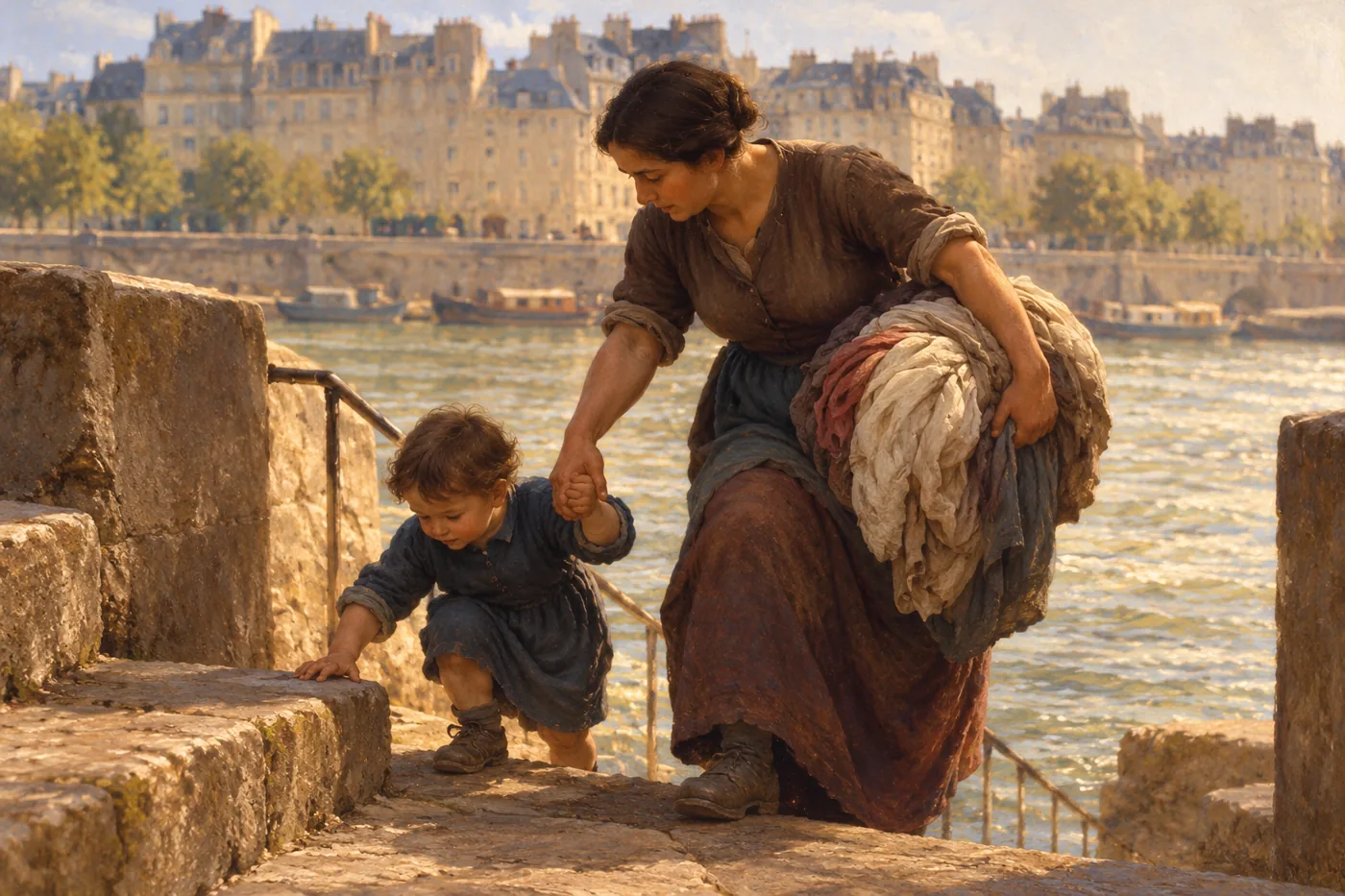
AI-created, mostly realistic reinterpretation of the public-domain Daumier composition. The fictional woman and child are not identified historical people, and this is not a nineteenth-century photograph. Credit: AI-generated for Culture Ark using OpenAI image_gen; public-domain reference credited below. Rights: AI-generated output; no exclusive ownership or guaranteed copyrightability claimed. Changes: Resized within1400px and converted to WebP; no crop or substantive alteration. Image source
Generated thematic illustration, not documentary evidence, an actual performance, or technical instruction. Cultural knowledge, underlying works, names and personality rights remain separate.
Documented reference / existing artwork

The Laundress. 186[3?]. The Metropolitan Museum of Art, 47.122. Credit: Honoré Daumier / The Metropolitan Museum of Art. Bequest of Lillie P. Bliss, 1931. Rights: Public domain; Met Open Access. Changes: Resized within1400px and converted to WebP; no crop or substantive alteration. Image source Image licence
Met API explicitly marks isPublicDomain=true. Image reuse permission does not transfer ownership of the object or resolve cultural permissions, sacred significance, provenance or restitution questions. Retain the catalog context.
History and context
Daumier’s painting shows a woman carrying a large bundle while reaching back to help a child climb steps. The museum connects the subject to laundresses returning from boats on the Seine, visible from the artist’s Paris studio. Her burden and the child’s movement bring paid labor and care into the same composition. The selection is included as an artist’s representation of ordinary work, not as an unmediated photograph of a named worker. It is one of three painted versions; damaged pigments make the final digit of the date uncertain, although an 1893 record read it as 1863. That small uncertainty belongs in the preserved account.
What future readers can learn
Curatorial interpretation: Images of work can reveal how care and earning a living overlap, while artistic framing shapes whose labor appears important.
Limits and cultural context
The scene is constructed by an artist and cannot establish an individual woman’s biography. Preserve the museum’s date uncertainty and distinguish this version from others.
Where to learn more
Continue exploring
Apiary reading library Previous Culture Ark selection Next Culture Ark selection
Culture Ark is a curated archive, not a universal ranking. Interpretive images and source evidence serve different roles.
Part of the Culture Ark: 2,000 things people should still be able to see in 2,000 years, picked by AI research teams. Browse the gallery. The Culture Ark is an Artificial Mind Hive (AMH) project. AMH is owned by Austin Little.

Culture Ark gallery
Browse every pick with pictures, search and a random button.
Open the gallery →