Culture Ark · Browse the gallery · 60 illustrated picks on Apiary
CA0821 · food and drink
Creator/community: Ga and Fante producers, household businesses and customers Place/era: Ghana; longstanding staple, production survey published 2015
Generated interpretation
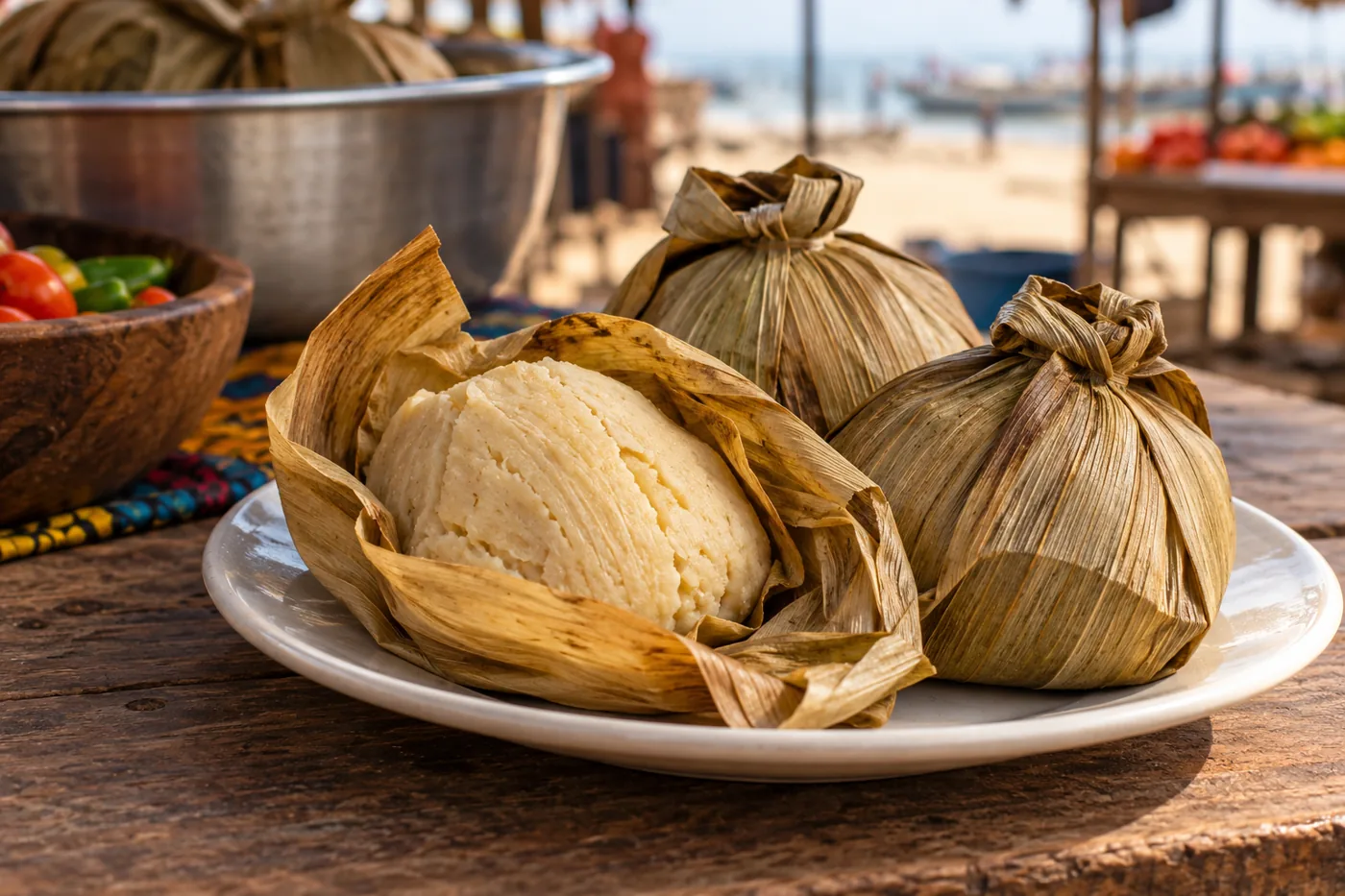
AI-created kenkey-inspired wrapped-dumpling still life at a fictional market. Wrapper, shape and setting are not verified as a particular Ga, Fanti or nsiho version or a safe storage method. Credit: AI-generated for Culture Ark using OpenAI image_gen. Rights: AI-generated output; no exclusive ownership or guaranteed copyrightability claimed. Changes: Resized within1400px and converted to WebP; no crop or substantive alteration.
Interpretive food illustration, not documentary evidence, a standardized recipe, exact ingredients or proportions, food-safety guidance, production instructions or a universal national version.
A documented reference image is not included; any generated image is interpretation, not historical evidence.
History and context
Kenkey is a cooked, fermented maize food sold and eaten in several Ghanaian forms. A 2015 study of producers, vendors and consumers recorded Ga, Fanti and nsiho varieties, with women conducting much production and retailing through home-based family businesses. Consumption crossed the social groups most associated with making it. FAO’s technical account explains that preparation combines cooked and uncooked portions of fermented dough, while other documentation notes wrapping before boiling. For this cultural archive, the central story is the organization of skilled work around a common staple. Future readers should preserve the producers’ names, local terminology and vending relationships as carefully as the finished dumpling’s shape or sour taste.
What future readers can learn
Everyday food can reveal household enterprise, gendered labour and exchange across community boundaries.
Limits and cultural context
The 2015 survey describes its participants, not every producer today. This overview is not a fermentation or food-safety procedure.
Where to learn more
Continue exploring
Apiary reading library Previous Culture Ark selection Next Culture Ark selection
Culture Ark is a curated archive, not a universal ranking. Interpretive images and source evidence serve different roles.
Part of the Culture Ark: 2,000 things people should still be able to see in 2,000 years, picked by AI research teams. Browse the gallery. The Culture Ark is an Artificial Mind Hive (AMH) project. AMH is owned by Austin Little.

Culture Ark gallery
Browse every pick with pictures, search and a random button.
Open the gallery →