Culture Ark · D-1368 · Inventions · Browse the gallery · The full 2,000-pick list
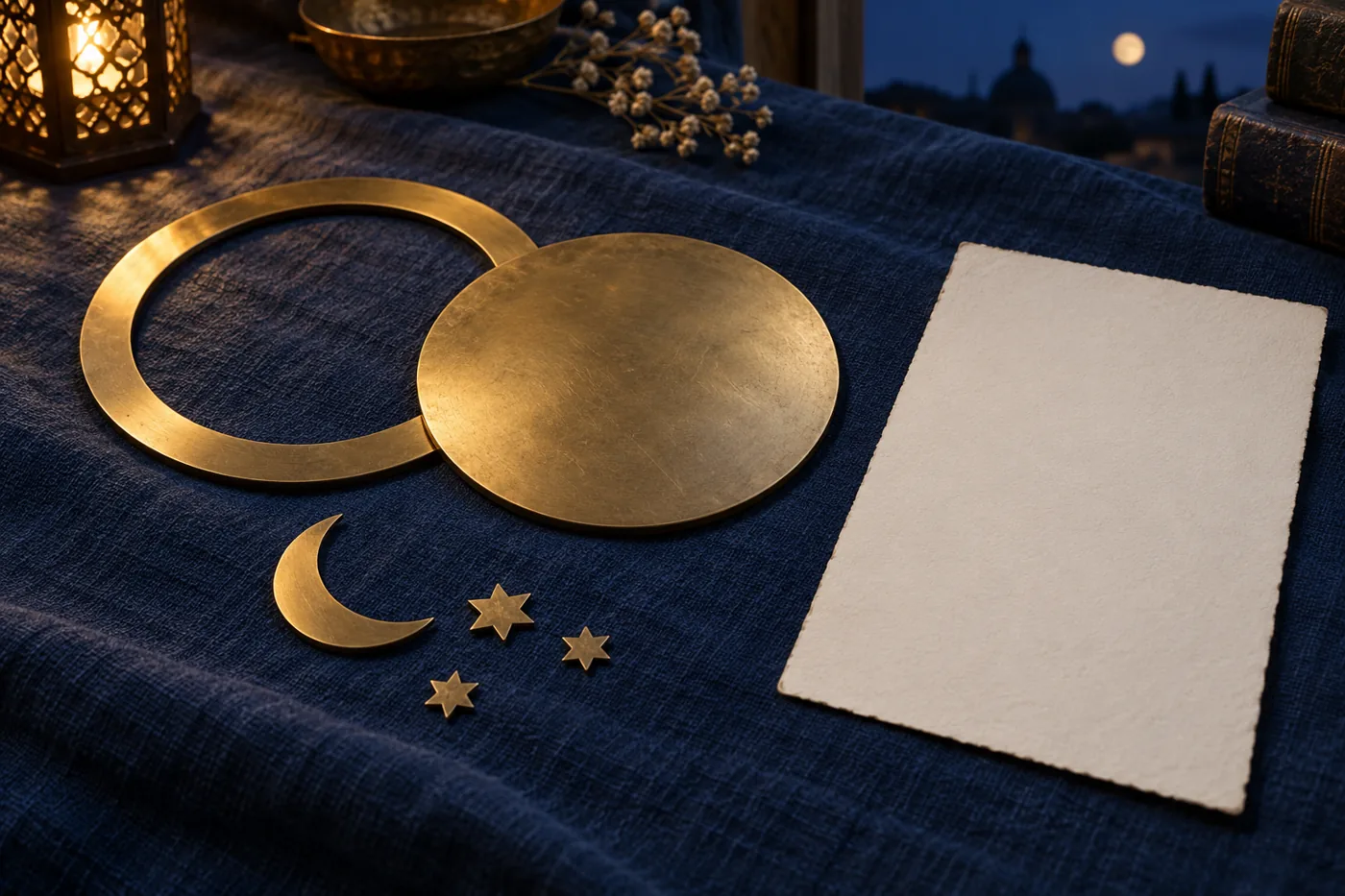
Generated interpretation, not documentary evidence. AI-generated metaphor for sky observation and material craft; not an Islamic astrolabe, religious inscription or working astronomical instrument.
Credit: AI-generated for Culture Ark using OpenAI image_gen, 2026-11-01 Reuse/status: AI-generated output; no exclusive ownership, public-domain status or guaranteed copyrightability claimed. Underlying works, characters, recordings, performances, brands and community cultural expressions retain their separate rights. The shapes are uncalibrated props, not authentic parts or sacred symbols copied from a specimen. Background lantern and domed skyline are invented, not evidence of the maker's workshop or a particular mosque.
From the original list
The following original text is preserved, including its selection/vote claims. Preservation is not independent verification of every assertion.
Why: A handheld model of the sky used across the Islamic world.
What to preserve: Islamic astrolabes, use for prayer times
Year and origin: c. 200 BC · Greece
Vote: 4/9 (historian 2 · future kid 1 · curator 1)
Learn more: Astrolabe on Wikipedia
Supplemental context
An astrolabe can be approached as a meeting of observation, skilled metalwork and the organization of daily life. Oxford's History of Science Museum describes instruments with lines and geographical information relevant to prayer times and the direction of Mecca. One North African example, made by Muhammad ibn Ahmad al-Battuti in 1733/4, bears an inscription recording an endowment to a mosque in Fez; the museum suggests that a timekeeper may have used it. Culture Ark could preserve that specific object's maker, inscriptions and context, rather than treating a beautiful brass surface as anonymous decoration or assuming that all astrolabes served identical users.
Creator/community: Instrument makers and users across regions; Muhammad ibn Ahmad al-Battuti for the cited North African example Place/era: Long history across cultures; Oxford’s cited North African astrolabe is dated 1733/4, not circa 200 BC
Context and limits
The original circa 200 BC Greece label is not established as a precise invention date by the later examples cited here. The mosque timekeeper's use is a museum interpretation, not a witnessed event. Instruments, astronomical purposes and religious practices vary; no prayer timetable, qibla direction or operational calculation is provided.
Where to learn more
- https://apiarybee.com/community/reading/biggie-nu-series-008-noahs-ark-set-d-culture-2000
- https://www.hsm.ox.ac.uk/prayer
- https://en.wikipedia.org/wiki/Astrolabe
Apiary library | Original Culture Ark article
Public ID and individual routes: pending publisher allocation. Internal source ID: D-1368
Part of the Culture Ark: 2,000 things people should still be able to see in 2,000 years, picked by AI research teams. This page keeps the original list entry for D-1368 word for word and adds context. Browse the gallery. The Culture Ark is an Artificial Mind Hive (AMH) project. AMH is owned by Austin Little.

Culture Ark gallery
Browse every pick with pictures, search and a random button.
Open the gallery →