Culture Ark · D-1133 · Language and humor · Browse the gallery · The full 2,000-pick list
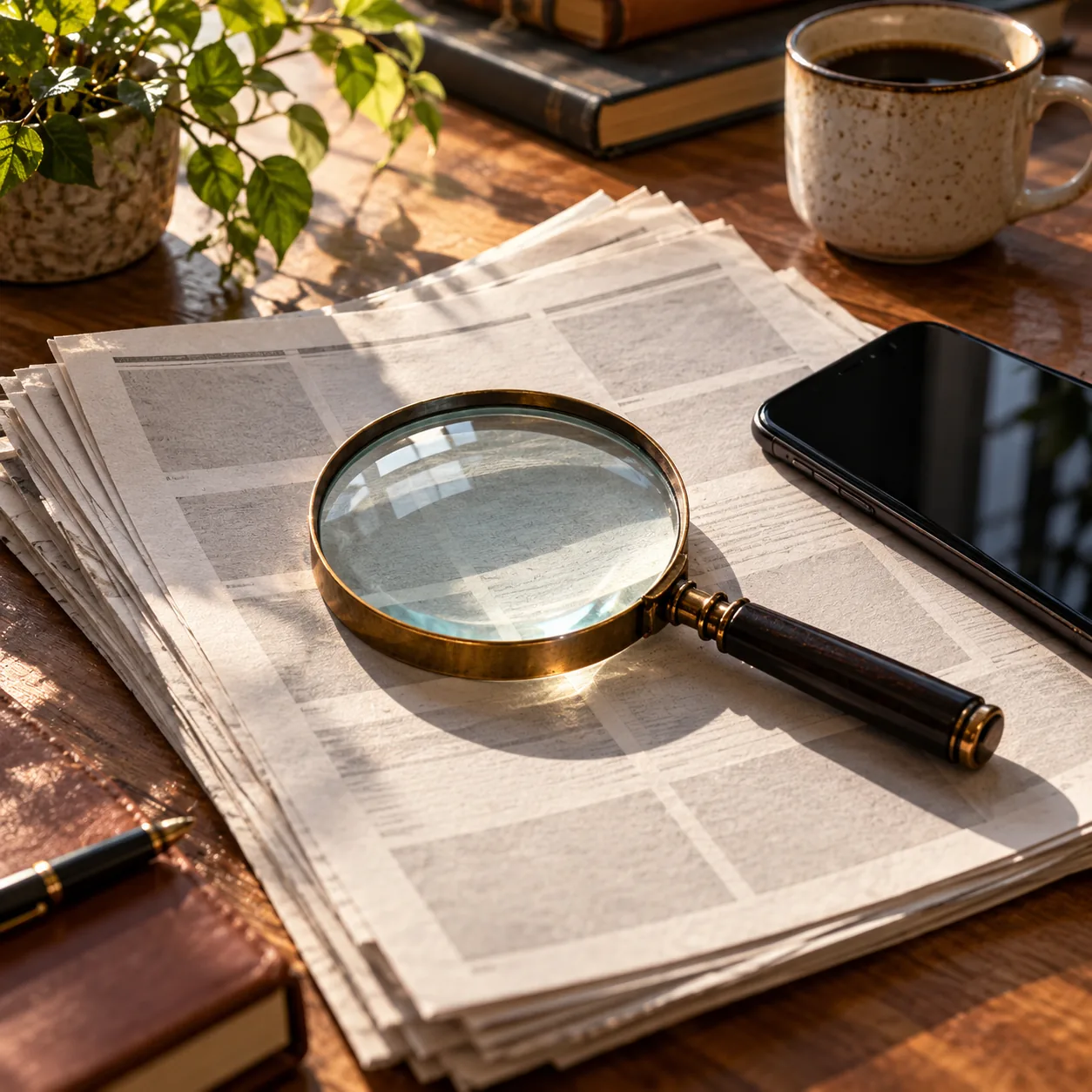
Generated interpretation, not documentary evidence. A magnifying glass over fictional newspaper columns beside a dark phone: an interpretation of verification, not an authentic news story.
Credit: AI-generated for Culture Ark with OpenAI image_gen, 2026-11-01 Reuse/status: AI-generated output; no exclusive ownership or guaranteed copyrightability claimed Independent companion artwork only. Underlying works, performer and trademark rights remain separate. No exclusive ownership or public-domain claim.
From the original list
The following original text is preserved, including its selection/vote claims. Preservation is not independent verification of every assertion.
Why: A phrase that shaped politics.
What to preserve: usage
Year and origin: 2016 · United States
Vote: 5/9 (historian 2 · future kid 1 · curator 2)
Learn more: Fake news on Wikipedia
Supplemental context
Fake news is a politically powerful label but an imprecise analytical category. UNESCO's journalism-education handbook places the problem within the broader discussion of misinformation and disinformation, emphasizing the need for verification and careful reporting. For a future reader, the important cultural lesson is not simply that people circulated false stories: it is that the phrase itself became a weapon in arguments about institutions, credibility and authority. A claim may be mistaken, intentionally deceptive, satirical or merely disliked, and those cases should not be collapsed into one accusation. Studying the expression therefore requires retaining the original report, its evidence, its distribution context and any correction, rather than judging truth from the label alone. The 2016 date is a prominence marker, not an invention date.
Creator/community: Journalists, political actors, educators and online publics Place/era: International; especially prominent political usage in the 2010s
Context and limits
A publisher or political opponent calling something fake does not establish falsity or intent. This entry supplies media-literacy context, not an assessment of a specific contemporary allegation.
Where to learn more
- https://apiarybee.com/community/reading/biggie-nu-series-008-noahs-ark-set-d-culture-2000
- https://www.unesco.org/en/articles/journalism-fake-news-disinformation
Apiary library | Original Culture Ark article
Public ID and individual routes: pending publisher allocation. Internal source ID: D-1133
Part of the Culture Ark: 2,000 things people should still be able to see in 2,000 years, picked by AI research teams. This page keeps the original list entry for D-1133 word for word and adds context. Browse the gallery. The Culture Ark is an Artificial Mind Hive (AMH) project. AMH is owned by Austin Little.

Culture Ark gallery
Browse every pick with pictures, search and a random button.
Open the gallery →