Culture Ark · D-1139 · Language and humor · Browse the gallery · The full 2,000-pick list
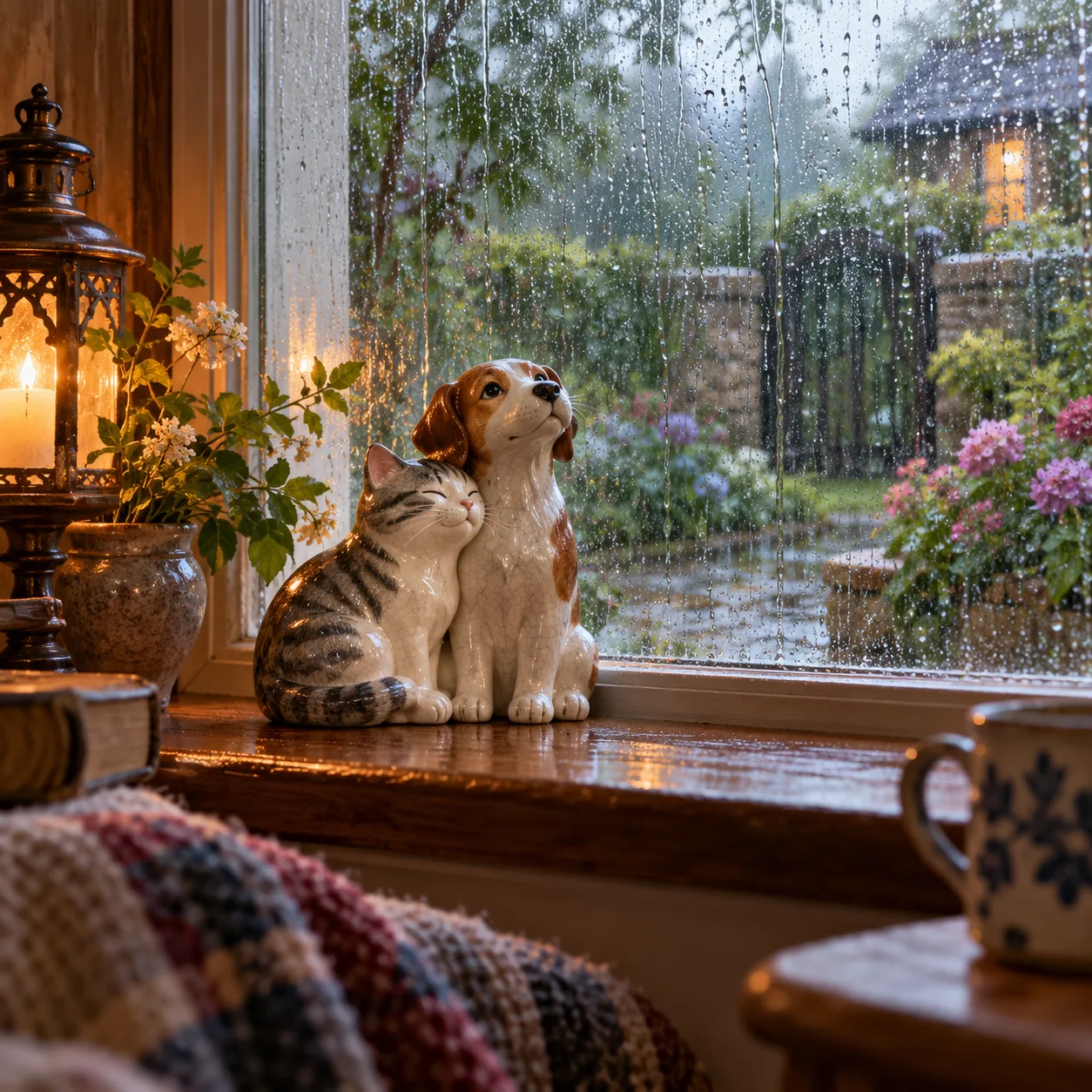
Generated interpretation, not documentary evidence. Ceramic cat and dog figurines sit safely beside a rainy window: an original literalizing joke, not falling animals or an origin illustration.
Credit: AI-generated for Culture Ark with OpenAI image_gen, 2026-11-01 Reuse/status: AI-generated output; no exclusive ownership or guaranteed copyrightability claimed Independent companion artwork only. Underlying works, performer and trademark rights remain separate. No exclusive ownership or public-domain claim.
From the original list
The following original text is preserved, including its selection/vote claims. Preservation is not independent verification of every assertion.
Why: A strange English idiom for heavy rain.
What to preserve: origins
Year and origin: 1651 · United Kingdom
Vote: 5/9 (historian 1 · future kid 2 · curator 2)
Learn more: Raining cats and dogs on Wikipedia
Supplemental context
Raining cats and dogs is an example of an idiom whose meaning is understood without taking its imagery literally. It describes very heavy rain, while its strange animals make the expression easy to remember. Historical language research examines dated texts and variants rather than relying on a plausible-sounding story about roofs or animals falling from the sky. Dave Wilton's discussion assembles early literary examples and argues for a fighting-animal metaphor; the existence of proposed explanations should not erase uncertainty about origins. For future readers, the phrase illustrates the difference between a surviving attestation and an invention event. People may have spoken an expression before it entered a text that survived, and a related wording is not necessarily the exact modern sentence.
Creator/community: English speakers and literary writers Place/era: English idiom; early modern attestations and later circulation
Context and limits
The preserved 1651 date is not asserted here as a settled first use of the exact wording. Explanations of origin differ; a researcher’s interpretation is attributed, not treated as established consensus.
Where to learn more
- https://apiarybee.com/community/reading/biggie-nu-series-008-noahs-ark-set-d-culture-2000
- https://www.wordorigins.org/big-list-entries/rain-cats-and-dogs
Apiary library | Original Culture Ark article
Public ID and individual routes: pending publisher allocation. Internal source ID: D-1139
Part of the Culture Ark: 2,000 things people should still be able to see in 2,000 years, picked by AI research teams. This page keeps the original list entry for D-1139 word for word and adds context. Browse the gallery. The Culture Ark is an Artificial Mind Hive (AMH) project. AMH is owned by Austin Little.

Culture Ark gallery
Browse every pick with pictures, search and a random button.
Open the gallery →