Culture Ark · D-1132 · Language and humor · Browse the gallery · The full 2,000-pick list
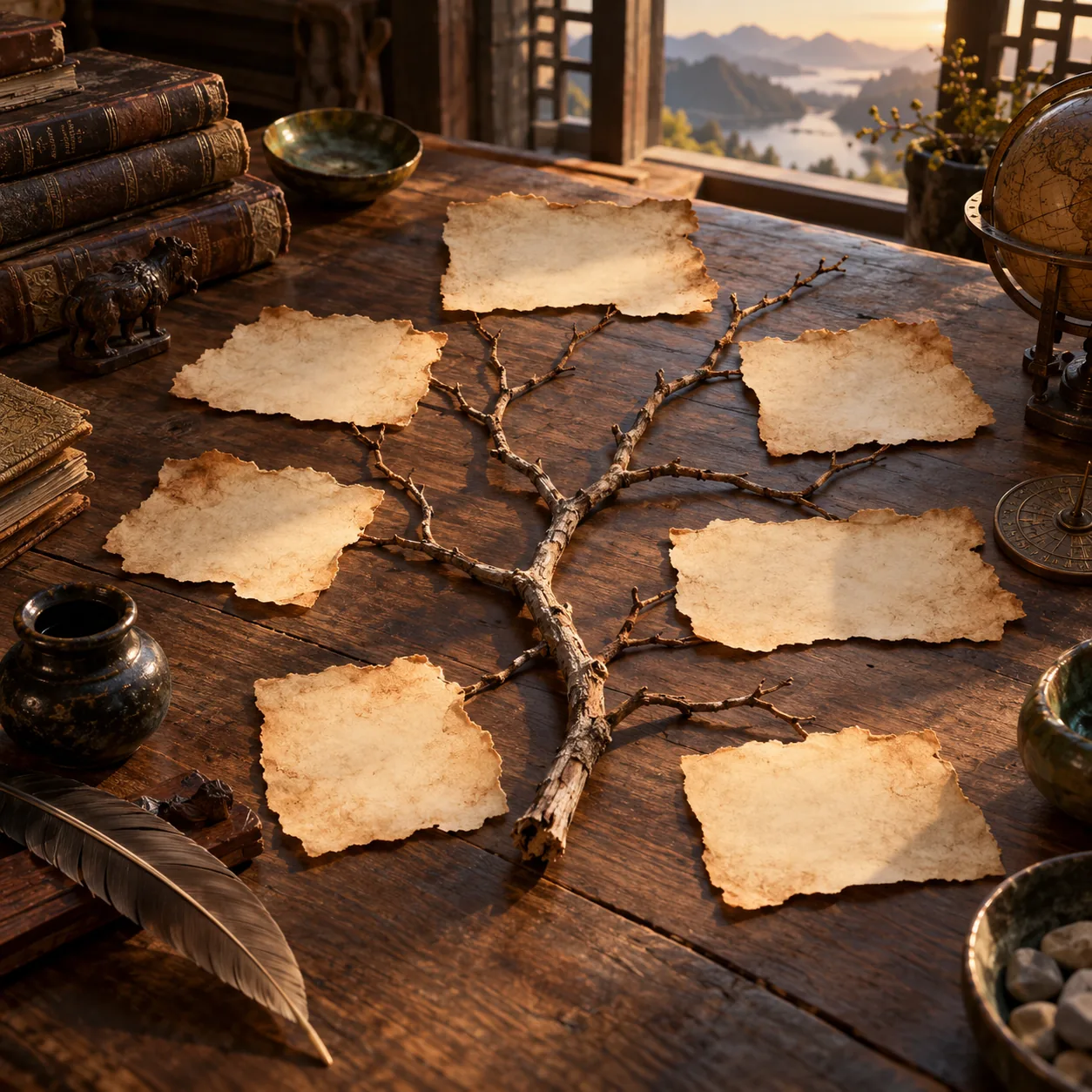
Generated interpretation, not documentary evidence. Blank parchment fragments and a branching twig symbolize comparison; not Proto-Indo-European writing or a validated family tree.
Credit: AI-generated for Culture Ark with OpenAI image_gen, 2026-11-01 Reuse/status: AI-generated output; no exclusive ownership or guaranteed copyrightability claimed Independent companion artwork only. Underlying works, performer and trademark rights remain separate. No exclusive ownership or public-domain claim.
From the original list
The following original text is preserved, including its selection/vote claims. Preservation is not independent verification of every assertion.
Why: The reconstructed ancestor of half the world's languages.
What to preserve: reconstructions, Schleicher's fable
Year and origin: 4000 BC · Eurasia
Vote: 5/9 (historian 2 · future kid 1 · curator 2)
Learn more: Proto-Indo-European language on Wikipedia
Supplemental context
Proto-Indo-European is a reconstructed ancestral language, inferred by comparing related languages rather than recovered from an audio recording or an original manuscript. The University of Texas Linguistics Research Center explains the comparative work behind its Indo-European lexicon, including the importance of relationships among forms and the need to distinguish inherited similarities from other connections. Reconstructions are scholarly models that can change when evidence or analysis changes. This makes the selection useful for future readers interested in how knowledge can be built from incomplete traces. A reconstructed form is not a quotation from an identifiable prehistoric speaker. The family also should not be confused with all human languages, and the number of languages in a family is different from the number of people speaking them.
Creator/community: Comparative historical linguists; prehistoric speech communities reconstructed indirectly Place/era: Prehistoric Eurasia; chronology and homeland remain research questions
Context and limits
The preserved claim about half the world’s languages is not endorsed. A precise 4000 BCE date and single homeland are not established here. Reconstructed stories are modern exercises, not recovered ancient texts.
Where to learn more
- https://apiarybee.com/community/reading/biggie-nu-series-008-noahs-ark-set-d-culture-2000
- https://lrc.la.utexas.edu/guides/lex_user
Apiary library | Original Culture Ark article
Public ID and individual routes: pending publisher allocation. Internal source ID: D-1132
Part of the Culture Ark: 2,000 things people should still be able to see in 2,000 years, picked by AI research teams. This page keeps the original list entry for D-1132 word for word and adds context. Browse the gallery. The Culture Ark is an Artificial Mind Hive (AMH) project. AMH is owned by Austin Little.

Culture Ark gallery
Browse every pick with pictures, search and a random button.
Open the gallery →