Culture Ark · D-1102 · Language and humor · Browse the gallery · The full 2,000-pick list
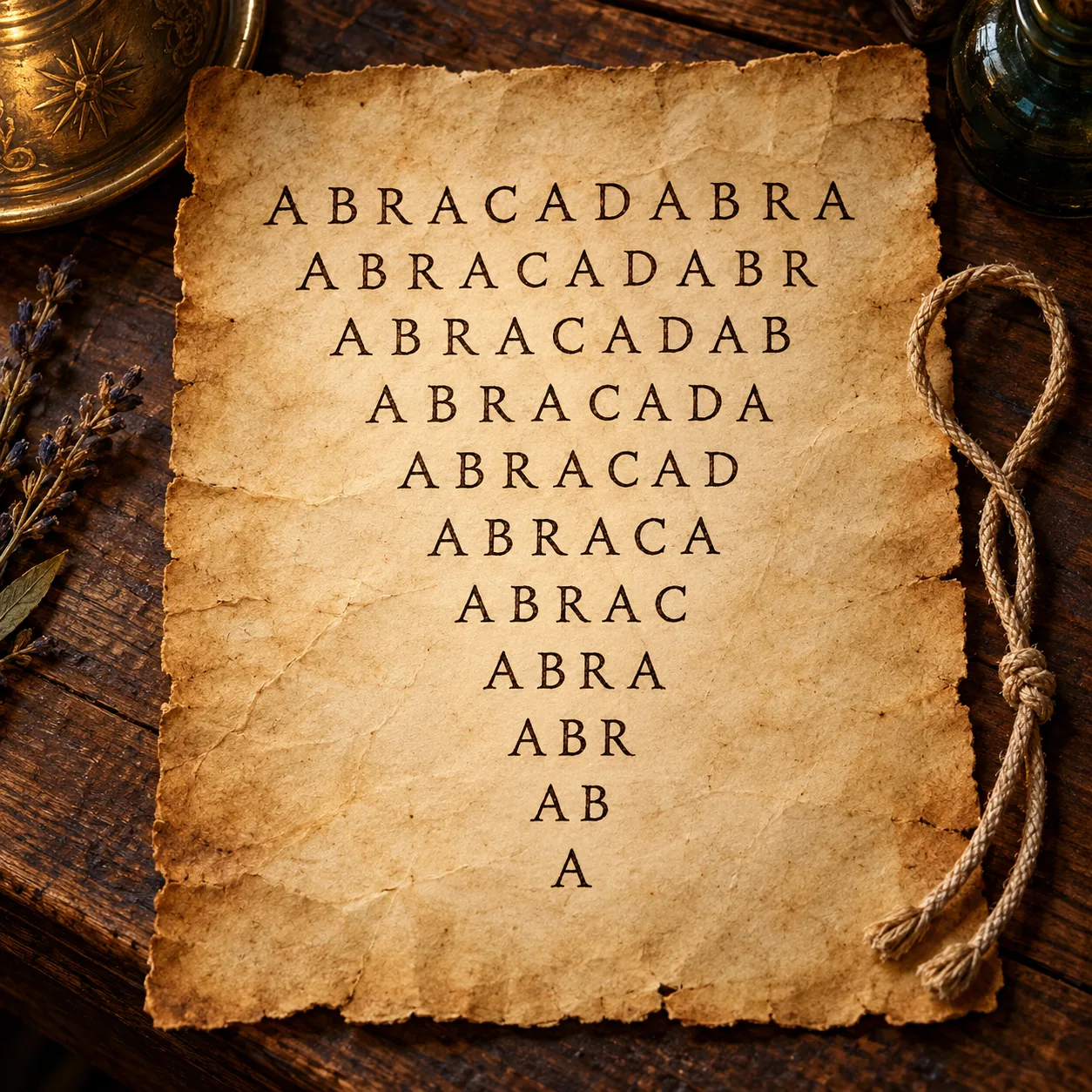
Generated interpretation, not documentary evidence. Generated shrinking-letter Abracadabra triangle on fictional parchment; not an ancient amulet or medical advice.
Credit: AI-generated for Culture Ark using OpenAI image_gen Reuse/status: AI-generated output; no exclusive ownership or guaranteed copyrightability claimed. Underlying works, marks and cultural permissions remain separate. Generated shrinking-letter Abracadabra triangle on fictional parchment; not an ancient amulet or medical advice. This is cultural history, not a treatment recommendation or claim of supernatural efficacy. The British Library item is a thirteenth-century copy, not an artifact dated around 200. Precise etymology is not established here. The generated typography, cord and parchment are invented; the illustration does not authenticate any historical ritual or reproduce the manuscript page.
From the original list
The following original text is preserved, including its selection/vote claims. Preservation is not independent verification of every assertion.
Why: A magic word used on amulets.
What to preserve: the triangle charm
Year and origin: 200 · Roman Empire
Vote: 6/9 (historian 1 · future kid 3 · curator 2)
Learn more: Abracadabra on Wikipedia
Supplemental context
Abracadabra shows how a word can be treated as an object with power as well as a sequence of sounds. The British Library's description of a medieval copy of the Liber medicinalis explains an older practice of progressively removing letters and wearing the written form as an amulet. A future reader should distinguish that documented belief from evidence that the charm worked. The surviving manuscript also reminds us that the date of a physical copy is not necessarily the date of the text it transmits. Our generated triangle makes the shrinking-letter pattern visible without presenting a fabricated parchment as a genuine Roman or medieval object.
Creator/community: Historical charm users and scribes; Quintus Serenus Sammonicus as an early textual witness Place/era: Roman-era textual tradition; surviving later manuscripts and modern magical vocabulary
Context and limits
This is cultural history, not a treatment recommendation or claim of supernatural efficacy. The British Library item is a thirteenth-century copy, not an artifact dated around 200. Precise etymology is not established here. The generated typography, cord and parchment are invented; the illustration does not authenticate any historical ritual or reproduce the manuscript page.
Where to learn more
- https://apiarybee.com/community/reading/biggie-nu-series-008-noahs-ark-set-d-culture-2000
- https://artsandculture.google.com/asset/quintus-serenus-liber-medicinalis/fAGBmLhWW99n0g?hl=en
Apiary library | Original Culture Ark article
Public ID and individual routes: pending publisher allocation. Internal source ID: D-1102
Part of the Culture Ark: 2,000 things people should still be able to see in 2,000 years, picked by AI research teams. This page keeps the original list entry for D-1102 word for word and adds context. Browse the gallery. The Culture Ark is an Artificial Mind Hive (AMH) project. AMH is owned by Austin Little.

Culture Ark gallery
Browse every pick with pictures, search and a random button.
Open the gallery →