Culture Ark · D-1098 · Language and humor · Browse the gallery · The full 2,000-pick list
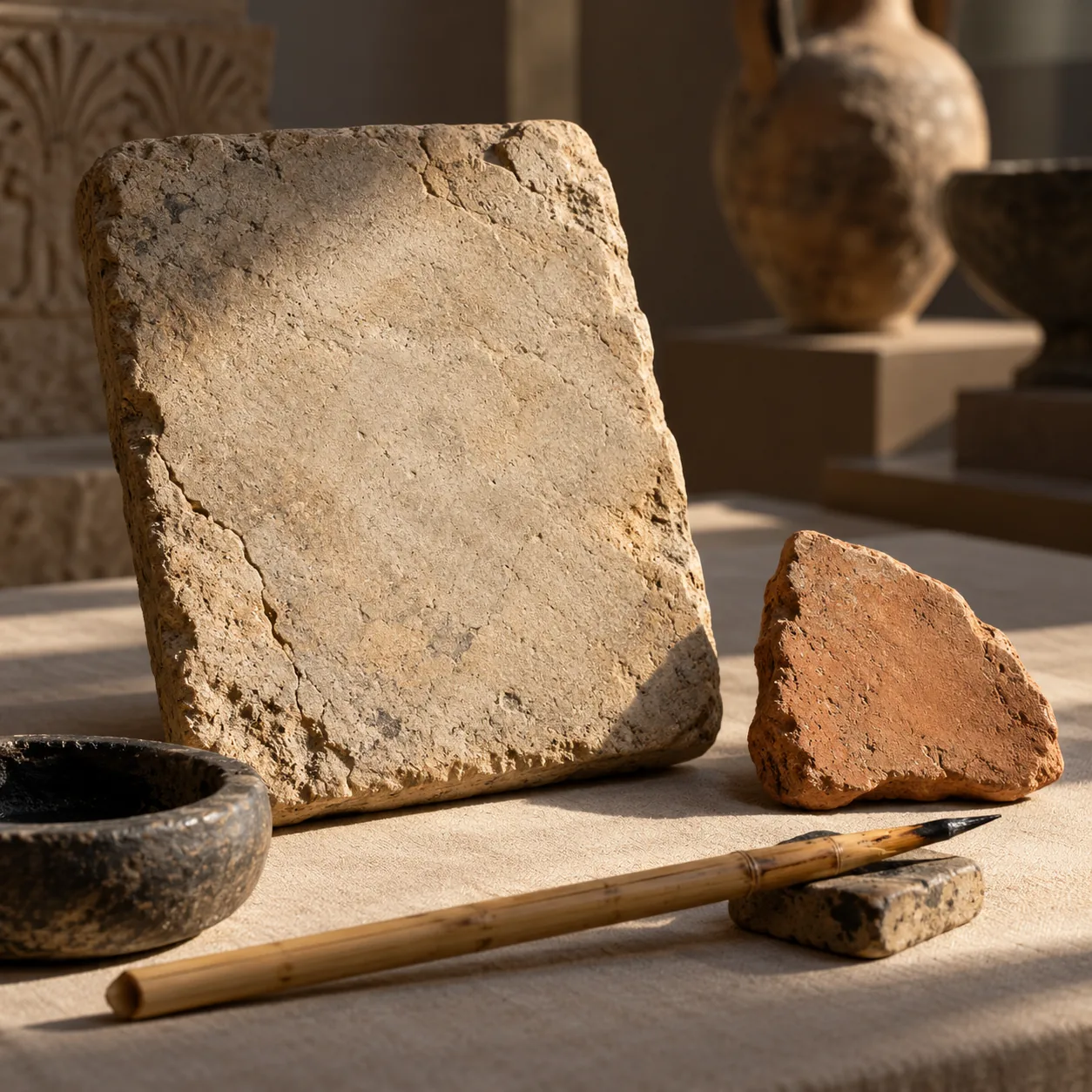
Generated interpretation, not documentary evidence. An invented blank stone tablet, clay fragment and reed-like pen form a writing-history metaphor; not an excavated inscription or verified Phoenician toolkit.
Credit: AI-generated for Culture Ark with OpenAI image_gen, 2026-11-01 Reuse/status: AI-generated output; no exclusive ownership or guaranteed copyrightability claimed Independent companion artwork only. Underlying works, performer and trademark rights remain separate. No exclusive ownership or public-domain claim.
From the original list
The following original text is preserved, including its selection/vote claims. Preservation is not independent verification of every assertion.
Why: The alphabet behind Greek, Latin, Arabic and Hebrew writing.
What to preserve: letters
Year and origin: 1050 BC · Lebanon
Vote: 6/9 (historian 3 · future kid 1 · curator 2)
Learn more: Phoenician alphabet on Wikipedia
Supplemental context
The Phoenician alphabet belongs to a longer history of adapting marks to represent language. The Metropolitan Museum’s account traces earlier alphabetic experiments and explains how Phoenician writing circulated across the Mediterranean and was adopted and modified by other communities, including Greeks and Etruscans. This history is not a simple relay in which one unchanged alphabet passes intact from country to country. Changes in sounds, writing habits and social use matter. For future readers, inscriptions can reveal contact as well as language, but a precise object and transcription are needed to study actual letter forms. The companion still life therefore leaves its tablet blank rather than supplying plausible-looking invented characters that might be mistaken for evidence.
Creator/community: Phoenician writers and interacting Mediterranean communities Place/era: Ancient eastern Mediterranean; first-millennium BCE use and adaptation
Context and limits
The preserved 1050 BC Lebanon label is a rough marker, not an exact invention event or a complete map of ancient communities. Alphabetic writing predates standardized Phoenician forms. The original lineage claim compresses multiple intermediary histories; no fake inscription, translation or direct four-script family chart is supplied.
Where to learn more
- https://apiarybee.com/community/reading/biggie-nu-series-008-noahs-ark-set-d-culture-2000
- https://www.metmuseum.org/exhibitions/listings/2014/assyria-to-iberia/blog/posts/alphabet
Apiary library | Original Culture Ark article
Public ID and individual routes: pending publisher allocation. Internal source ID: D-1098
Part of the Culture Ark: 2,000 things people should still be able to see in 2,000 years, picked by AI research teams. This page keeps the original list entry for D-1098 word for word and adds context. Browse the gallery. The Culture Ark is an Artificial Mind Hive (AMH) project. AMH is owned by Austin Little.

Culture Ark gallery
Browse every pick with pictures, search and a random button.
Open the gallery →