Culture Ark · D-1097 · Language and humor · Browse the gallery · The full 2,000-pick list
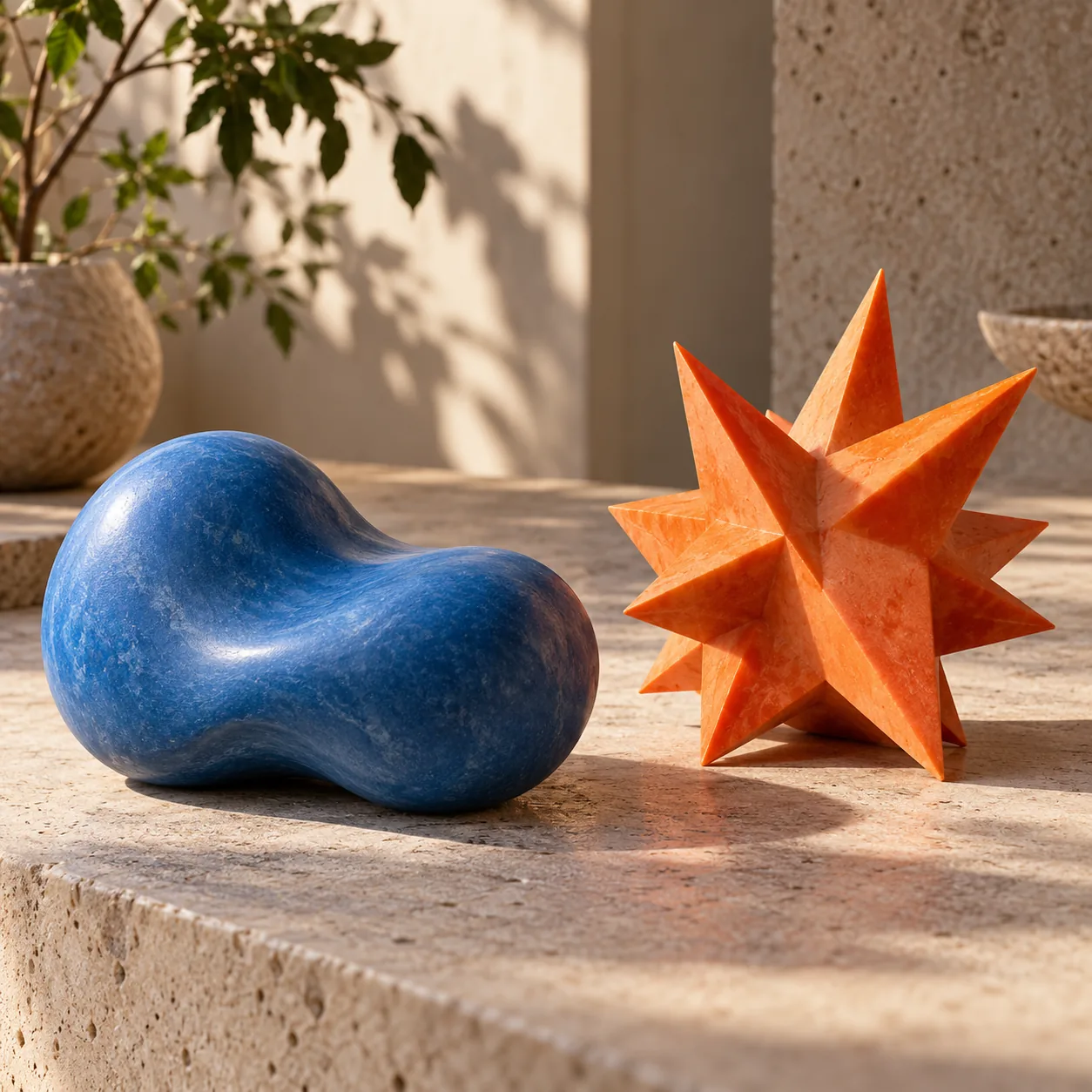
Generated interpretation, not documentary evidence. An original rounded blue sculpture and angular orange sculpture evoke sound-shape association; decorative objects, not validated experimental stimuli.
Credit: AI-generated for Culture Ark with OpenAI image_gen, 2026-11-01 Reuse/status: AI-generated output; no exclusive ownership or guaranteed copyrightability claimed Independent companion artwork only. Underlying works, performer and trademark rights remain separate. No exclusive ownership or public-domain claim.
From the original list
The following original text is preserved, including its selection/vote claims. Preservation is not independent verification of every assertion.
Why: People everywhere match shapes to sounds.
What to preserve: the experiment
Year and origin: 1929 · Germany
Vote: 6/9 (historian 1 · future kid 3 · curator 2)
Learn more: Bouba/kiki effect on Wikipedia
Supplemental context
The bouba/kiki effect concerns a tendency to associate certain speech sounds with rounded or angular shapes. A University of Birmingham account written by members of a research team explains a test involving speakers of twenty-five languages and multiple writing systems. The overall tendency appeared across the sample, but the authors also describe exceptions and questions requiring further investigation. This is more informative than treating the effect as a trick that every person must answer the same way. Future readers can see how a memorable demonstration becomes a research question about perception, language experience and generalization. The blue rounded sculpture and orange pointed sculpture are new illustrations of the contrast, not the study’s original stimuli or evidence.
Creator/community: Psychology and linguistics researchers and participating language communities Place/era: Research tradition from 1929; cross-language study reported in 2021
Context and limits
The original people everywhere wording overstates the finding. The 1929 work used different word labels, so its history should not be collapsed into one unchanged experiment. Colors, textures and three-dimensional form in the art add uncontrolled cues; this card is not a valid replication or diagnostic test.
Where to learn more
- https://apiarybee.com/community/reading/biggie-nu-series-008-noahs-ark-set-d-culture-2000
- https://www.birmingham.ac.uk/news-archive/2021/which-shape-is-the-bouba-and-which-is-the-kiki
Apiary library | Original Culture Ark article
Public ID and individual routes: pending publisher allocation. Internal source ID: D-1097
Part of the Culture Ark: 2,000 things people should still be able to see in 2,000 years, picked by AI research teams. This page keeps the original list entry for D-1097 word for word and adds context. Browse the gallery. The Culture Ark is an Artificial Mind Hive (AMH) project. AMH is owned by Austin Little.

Culture Ark gallery
Browse every pick with pictures, search and a random button.
Open the gallery →