Culture Ark · D-1092 · Language and humor · Browse the gallery · The full 2,000-pick list
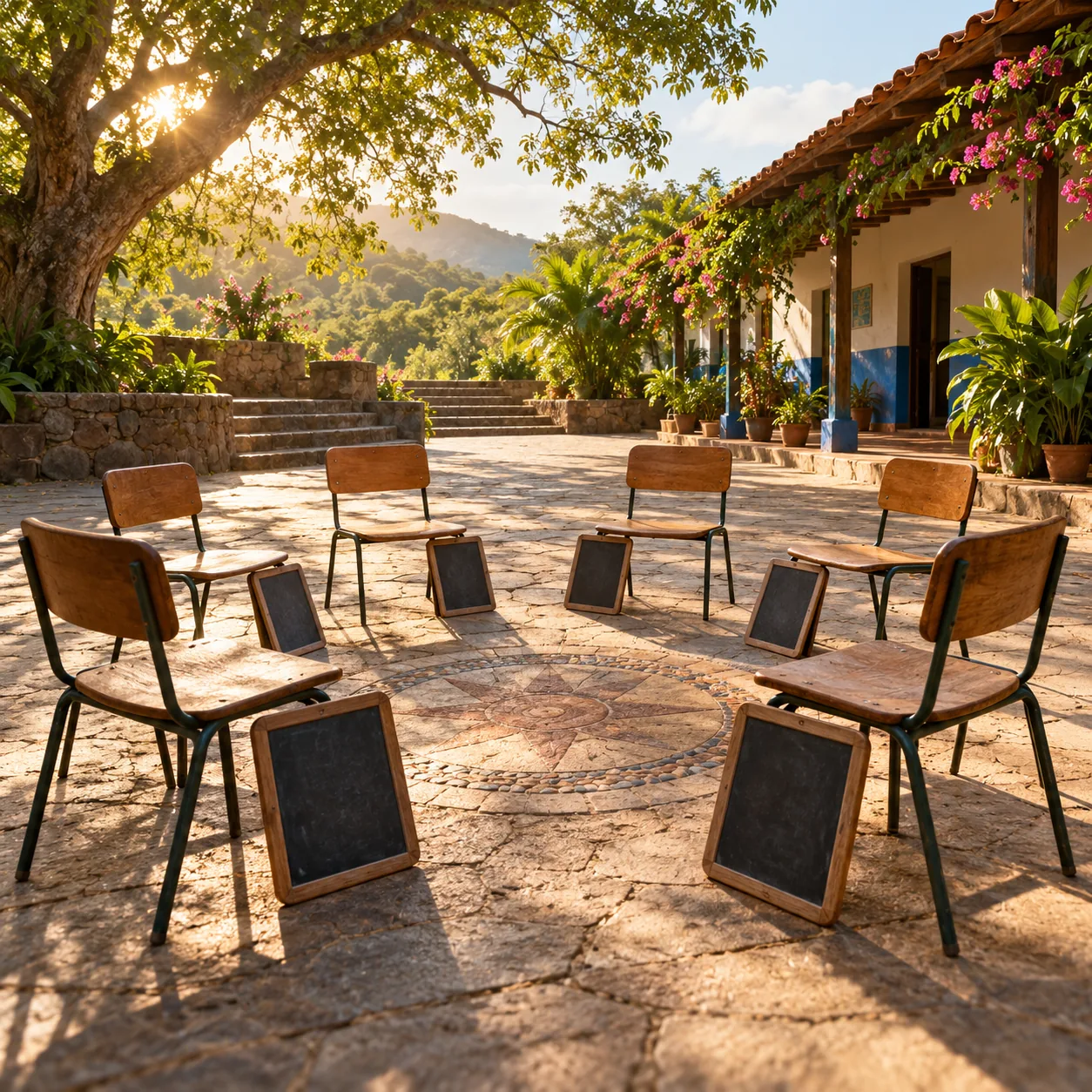
Generated interpretation, not documentary evidence. An imagined school courtyard with a circle of empty chairs and blank slates symbolizes community contact; not a documented Nicaraguan school or language lesson.
Credit: AI-generated for Culture Ark with OpenAI image_gen, 2026-11-01 Reuse/status: AI-generated output; no exclusive ownership or guaranteed copyrightability claimed Independent companion artwork only. Underlying works, performer and trademark rights remain separate. No exclusive ownership or public-domain claim.
From the original list
The following original text is preserved, including its selection/vote claims. Preservation is not independent verification of every assertion.
Why: A language invented by deaf children on their own.
What to preserve: the research
Year and origin: 1980 · Nicaragua
Vote: 6/9 (historian 2 · future kid 2 · curator 2)
Learn more: Nicaraguan Sign Language on Wikipedia
Supplemental context
Nicaraguan Sign Language provides an unusually recent example of a language developing through interaction and transmission within a community. The Max Planck Institute’s record of research by Ann Senghas, Sotaro Kita and Aslı Özyürek describes how successive cohorts of young signers organized complex events into structured expressions. The cultural lesson is not that a language appeared fully formed at a single moment, but that shared use and new learners helped shape its development. Accounts of this history must keep the signers themselves visible as people building relationships, not only as subjects of an experiment. The imagined courtyard evokes opportunities to gather while intentionally avoiding invented gestures, actual children’s likenesses or an unsupported reconstruction of a particular school.
Creator/community: Deaf children, adolescents and the Nicaraguan signing community Place/era: Managua and later wider community use; emergence from the late 1970s onward
Context and limits
The original 1980 marker is approximate, and invented on their own oversimplifies a community process with earlier homesigning and changing social opportunities. Research findings describe samples and periods, not every signer. The PMC temporal-language page returned a browser challenge; the opened Max Planck research record supplies the principal evidence.
Where to learn more
- https://apiarybee.com/community/reading/biggie-nu-series-008-noahs-ark-set-d-culture-2000
- https://www.mpi.nl/publications/item59126/children-creating-core-properties-language-evidence-emerging-sign-language
Apiary library | Original Culture Ark article
Public ID and individual routes: pending publisher allocation. Internal source ID: D-1092
Part of the Culture Ark: 2,000 things people should still be able to see in 2,000 years, picked by AI research teams. This page keeps the original list entry for D-1092 word for word and adds context. Browse the gallery. The Culture Ark is an Artificial Mind Hive (AMH) project. AMH is owned by Austin Little.

Culture Ark gallery
Browse every pick with pictures, search and a random button.
Open the gallery →