Culture Ark · D-1059 · Language and humor · Browse the gallery · The full 2,000-pick list
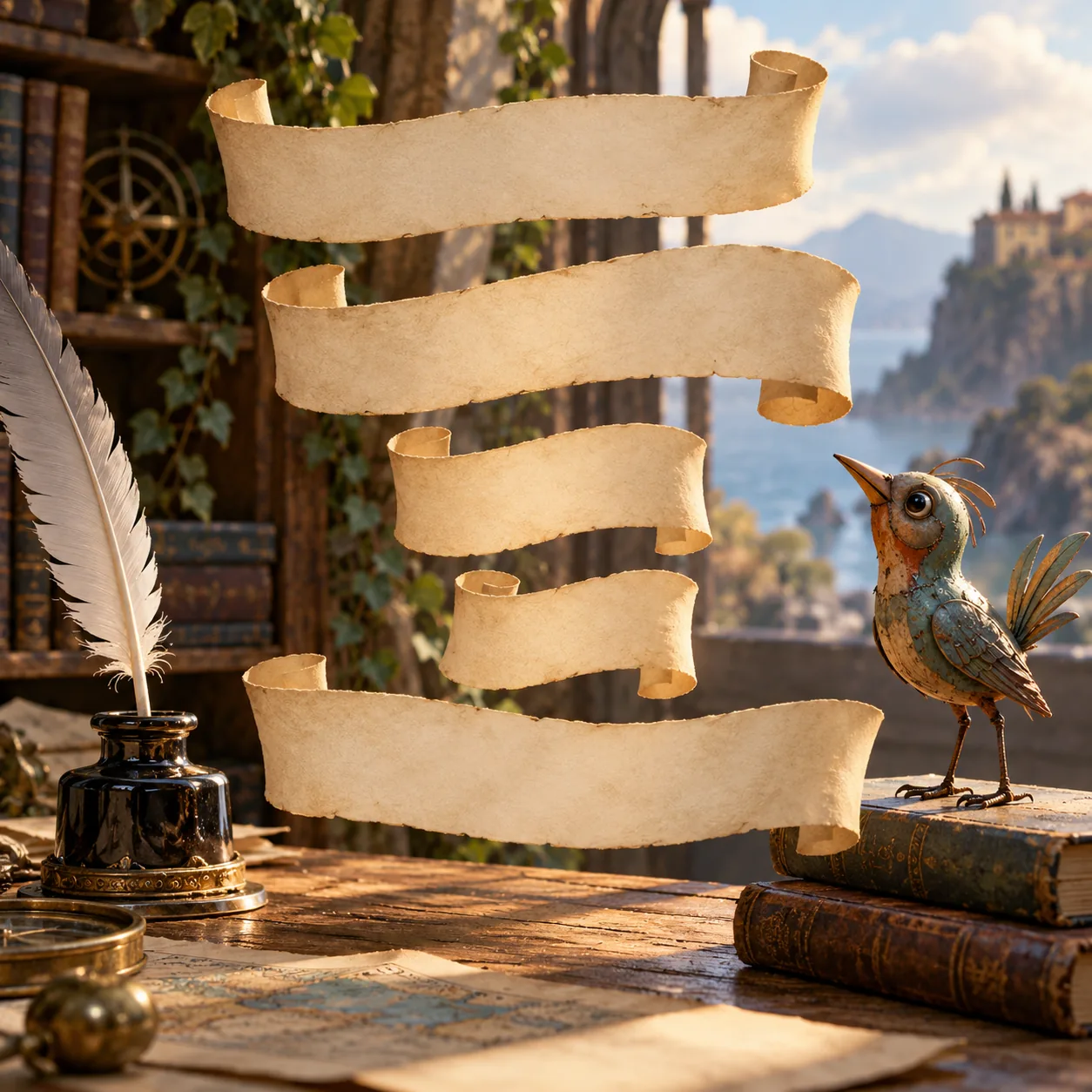
Generated interpretation, not documentary evidence. Five floating blank ribbons in a long-long-short-short-long arrangement, a quill and an imaginary bird sculpture suggest verse structure; not Lear’s artwork or manuscript.
Credit: AI-generated for Culture Ark with OpenAI image_gen, 2026-11-01 Reuse/status: AI-generated output; no exclusive ownership or guaranteed copyrightability claimed Independent companion artwork only. Underlying works, performer and trademark rights remain separate. No exclusive ownership or public-domain claim.
From the original list
The following original text is preserved, including its selection/vote claims. Preservation is not independent verification of every assertion.
Why: A five-line comic verse form popularized by Edward Lear.
What to preserve: Lear's Book of Nonsense, the rhyme scheme
Year and origin: 1846 · United Kingdom
Vote: 6/9 (historian 2 · future kid 2 · curator 2)
Learn more: Limerick (poetry) on Wikipedia
Supplemental context
The limerick combines a compact verse shape with a rhythm that encourages spoken delivery and memorization. The Academy of American Poets describes five-line patterns in which the first, second and fifth lines rhyme together while the third and fourth share another rhyme. Its account identifies Edward Lear’s illustrated Book of Nonsense of 1846 as an important benchmark rather than a securely documented invention of the form. Preserving the pattern alongside examples allows future readers to see how constraint can generate surprise: a listener anticipates the returning rhyme even before the final line arrives. The companion image translates relative line lengths into five blank ribbons and adds an invented whimsical bird, without fabricating a Lear poem or copying his illustrations.
Creator/community: Verse writers and audiences; Edward Lear as a prominent popularizer Place/era: English-language comic verse; A Book of Nonsense, 1846
Context and limits
The form’s origin is uncertain; 1846 marks Lear’s publication, not the beginning of all limericks. Some examples are bawdy rather than suitable for every audience. The ribbons suggest a common line-length pattern but are not a full metrical notation or mandatory visual layout.
Where to learn more
- https://apiarybee.com/community/reading/biggie-nu-series-008-noahs-ark-set-d-culture-2000
- https://poets.org/glossary/limerick
Apiary library | Original Culture Ark article
Public ID and individual routes: pending publisher allocation. Internal source ID: D-1059
Part of the Culture Ark: 2,000 things people should still be able to see in 2,000 years, picked by AI research teams. This page keeps the original list entry for D-1059 word for word and adds context. Browse the gallery. The Culture Ark is an Artificial Mind Hive (AMH) project. AMH is owned by Austin Little.

Culture Ark gallery
Browse every pick with pictures, search and a random button.
Open the gallery →