Culture Ark · D-1065 · Language and humor · Browse the gallery · The full 2,000-pick list
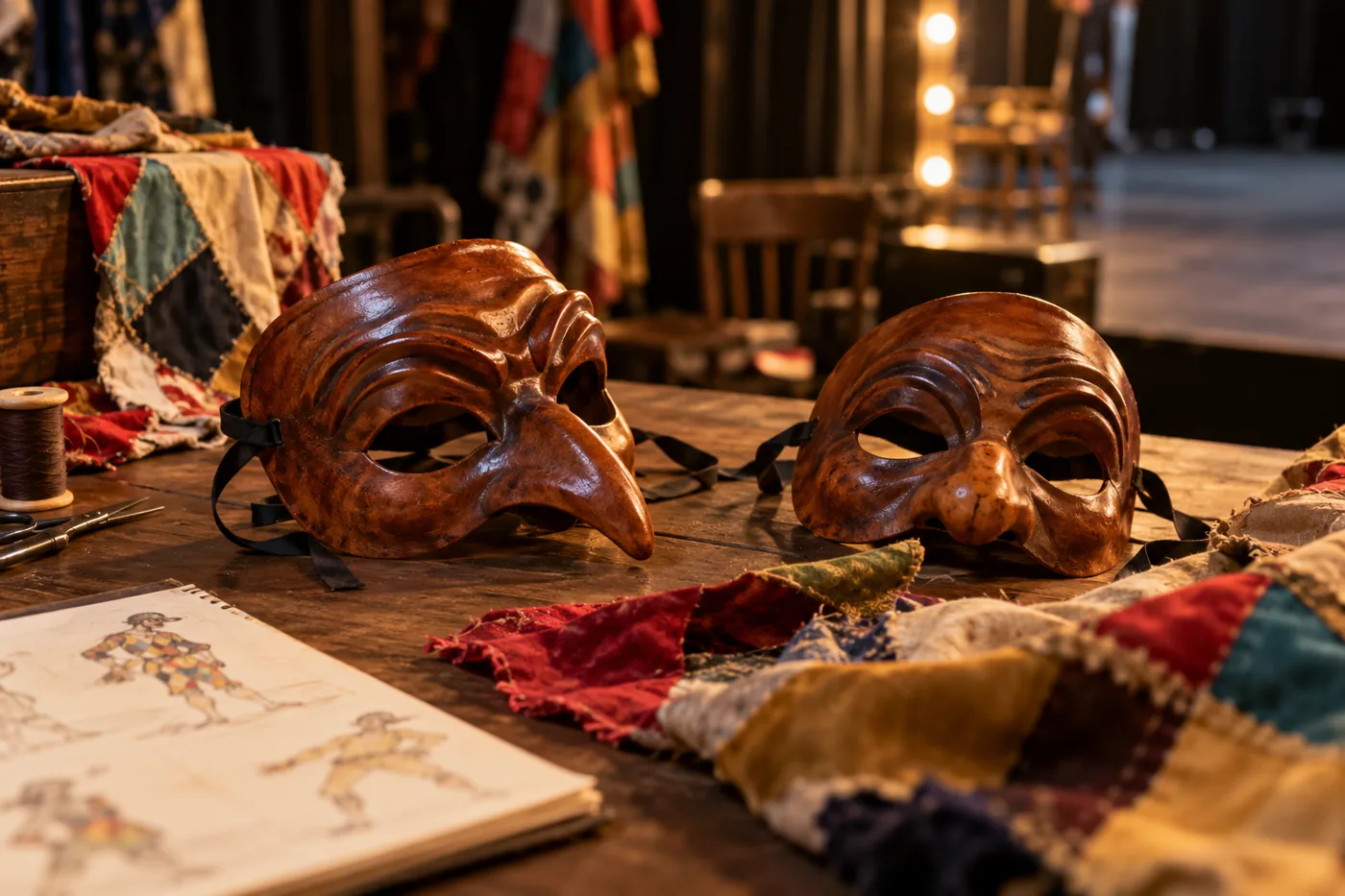
Generated interpretation, not documentary evidence. AI-generated leather-like half masks and patchwork fabric on a rehearsal table, not authenticated commedia artifacts.
Credit: AI-generated for Culture Ark using OpenAI image generation Reuse/status: Generated content; no exclusive ownership or underlying-work rights claimed Two coherent masks, fabric and incidental costume sketches; no exact named-character, museum-object or historical-design certification. No authentic-reference or endorsement claim.
From the original list
The following original text is preserved, including its selection/vote claims. Preservation is not independent verification of every assertion.
Why: Masked Italian comic theater with stock characters.
What to preserve: masks, characters like Harlequin
Year and origin: 1550 · Italy
Vote: 6/9 (historian 2 · future kid 2 · curator 2)
Learn more: Commedia dell'arte on Wikipedia
Supplemental context
Commedia dell'arte combines recognizable character types with performance shaped by improvisation. The Metropolitan Museum describes players working from scenarios rather than a completely fixed spoken script, and notes the importance of dialect and exaggerated gesture when masks limited facial expression. For future readers, this distinction helps explain why preserving only dialogue would miss much of the form. Costume, bodily skill and the expectations attached to a role were also part of the communication. The museum records a company in Padua in 1545, providing a firmer historical point than a single rounded date assigned to the whole tradition.
Creator/community: Professional Italian commedia companies and later performers Place/era: Italy and touring European stages; documented company formation in Padua in 1545
Context and limits
The museum's account discusses development over time, not an exact invention in 1550. Stock characters and costumes changed between performers and places; generated masks are not authenticated types or recovered objects. Historical social stereotypes require context, and a mask alone is not a performance manual.
Where to learn more
- https://apiarybee.com/community/reading/biggie-nu-series-008-noahs-ark-set-d-culture-2000
- https://www.metmuseum.org/essays/commedia-dellarte
Apiary library | Original Culture Ark article
Public ID and individual routes: pending publisher allocation. Internal source ID: D-1065
Part of the Culture Ark: 2,000 things people should still be able to see in 2,000 years, picked by AI research teams. This page keeps the original list entry for D-1065 word for word and adds context. Browse the gallery. The Culture Ark is an Artificial Mind Hive (AMH) project. AMH is owned by Austin Little.

Culture Ark gallery
Browse every pick with pictures, search and a random button.
Open the gallery →