Culture Ark · D-0929 · Internet culture · Browse the gallery · The full 2,000-pick list
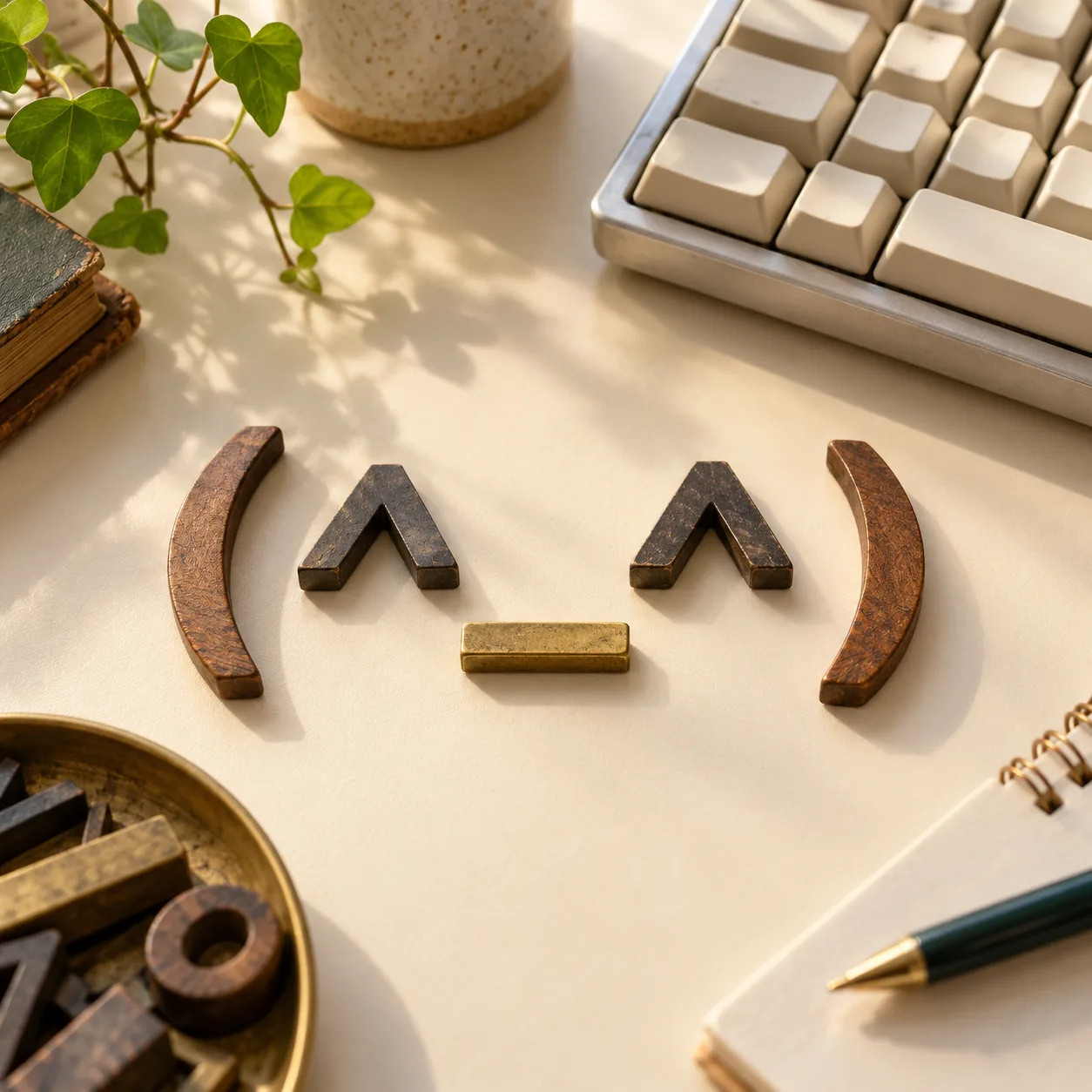
Generated interpretation, not documentary evidence. Invented loose typographic pieces arranged as (^_^) beside a blank-key keyboard; not an archival message, font specimen or universal emotional code.
Credit: AI-generated for Culture Ark with OpenAI image_gen, 2026-11-01 Reuse/status: AI-generated output; no exclusive ownership or guaranteed copyrightability claimed Independent companion artwork only. Underlying works, performer and trademark rights remain separate. No exclusive ownership or public-domain claim.
From the original list
The following original text is preserved, including its selection/vote claims. Preservation is not independent verification of every assertion.
Why: Japan's upright text faces that showed emotion without tilting your head.
What to preserve: common kaomoji, 2channel usage, regional variants
Year and origin: 1986 · Japan
Vote: 4/9 (historian 1 · future kid 2 · curator 1)
Learn more: Kaomoji on Wikipedia
Supplemental context
Kaomoji turn ordinary text characters into upright expressive faces. A 2020 research paper comparing Japanese and Dutch university participants examined how eye and mouth cues contributed to emoticon judgments. It offers a focused way to investigate the original entry's observation that a face can be read without rotating the head, but it is not an origin history. Future readers should preserve actual character sequences and their contexts, since a small substitution can alter a face's apparent expression. Our loose typographic pieces form a simple example as a physical still life. This is an interpretive teaching aid, not a recovered message from an early bulletin board or a representative sample of every community.
Creator/community: Japanese text-face users and wider online communities Place/era: Japan-associated kaomoji traditions with international circulation
Context and limits
The preserved 1986 date and particular 2channel history are not independently verified by this paper. Its limited student samples must not become stereotypes about all Japanese or Dutch people. Kaomoji sequences and single encoded pictorial emoji are related but different forms.
Where to learn more
- https://apiarybee.com/community/reading/biggie-nu-series-008-noahs-ark-set-d-culture-2000
- https://lebs.hbesj.org/index.php/lebs/article/download/lebs.2020.80/283/
Apiary library | Original Culture Ark article
Public ID and individual routes: pending publisher allocation. Internal source ID: D-0929
Part of the Culture Ark: 2,000 things people should still be able to see in 2,000 years, picked by AI research teams. This page keeps the original list entry for D-0929 word for word and adds context. Browse the gallery. The Culture Ark is an Artificial Mind Hive (AMH) project. AMH is owned by Austin Little.

Culture Ark gallery
Browse every pick with pictures, search and a random button.
Open the gallery →