Culture Ark · D-0850 · Internet culture · Browse the gallery · The full 2,000-pick list
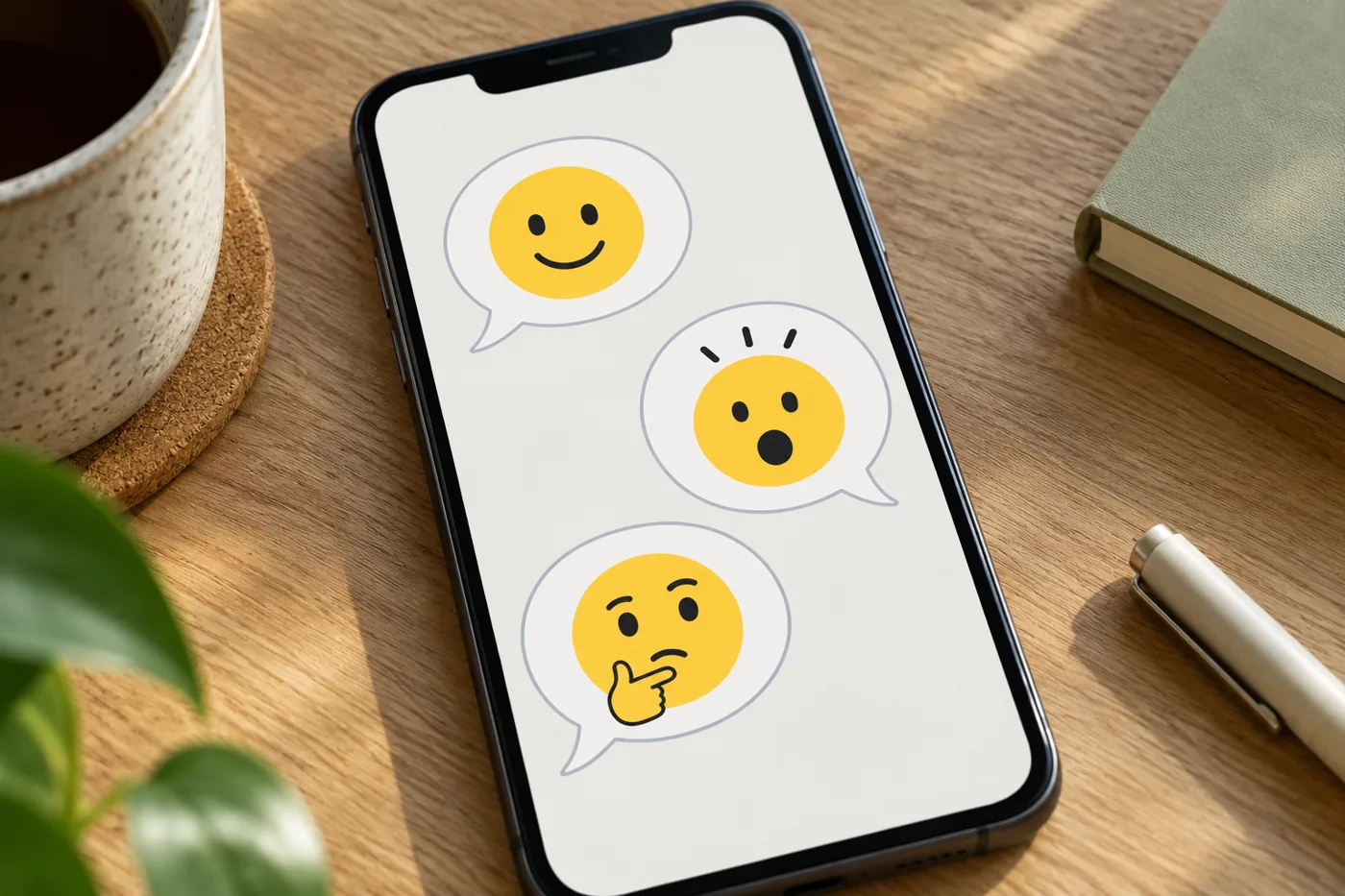
Generated interpretation, not documentary evidence. Imagined smartphone with generic expressive faces in speech bubbles; not the 1999 DOCOMO set, a vendor screenshot or Unicode chart.
Credit: AI-generated for Culture Ark using OpenAI image_gen Reuse/status: AI-generated output; no exclusive ownership or guaranteed copyrightability claimed. Underlying works, marks and cultural permissions remain separate. Imagined smartphone with generic expressive faces in speech bubbles; not the 1999 DOCOMO set, a vendor screenshot or Unicode chart. The museum's 1999 acquisition context does not establish that no earlier pictographic digital systems existed. The original usage claim is not independently quantified here. This reused generated image is not the original 176-character set, an actual vendor interface or a Unicode chart. Meanings and visual designs vary; no exclusive rights in emoji characters are claimed.
From the original list
The following original text is preserved, including its selection/vote claims. Preservation is not independent verification of every assertion.
Why: A picture alphabet that billions used every day to add tone and feeling to text.
What to preserve: the original 176 DoCoMo set, Unicode emoji charts, usage statistics
Year and origin: 1999 · Japan
Vote: 9/9 (historian 3 · future kid 3 · curator 3)
Learn more: Emoji on Wikipedia
Supplemental context
Emoji connect small graphic forms with the social work of communicating tone, feeling and intention. The Museum of Modern Art documents Shigetaka Kurita's 1999 set for NTT DOCOMO as 176 compact pictograms, including more than facial expressions. Unicode's guidance adds an essential distinction: a standardized character does not impose one fixed meaning or an identical drawing on every platform. Future readers can therefore study emoji as a negotiation between technical coordination and everyday interpretation. The same compact sign may be read differently across conversations and communities. The smartphone illustration represents that broader practice, rather than substituting modern yellow faces for a faithful display of the historical Japanese set.
Creator/community: Shigetaka Kurita and NTT DOCOMO designers; Unicode participants, vendors and everyday users Place/era: Japan, 1999 DOCOMO set; later international standardized digital communication
Context and limits
The museum's 1999 acquisition context does not establish that no earlier pictographic digital systems existed. The original usage claim is not independently quantified here. This reused generated image is not the original 176-character set, an actual vendor interface or a Unicode chart. Meanings and visual designs vary; no exclusive rights in emoji characters are claimed.
Where to learn more
- https://apiarybee.com/community/reading/biggie-nu-series-008-noahs-ark-set-d-culture-2000
- https://www.moma.org/calendar/exhibitions/3639?locale=en
- https://www.unicode.org/faq/emoji_dingbats.html
- https://www.unicode.org/reports/tr51/
Apiary library | Original Culture Ark article
Public ID and individual routes: pending publisher allocation. Internal source ID: D-0850
Part of the Culture Ark: 2,000 things people should still be able to see in 2,000 years, picked by AI research teams. This page keeps the original list entry for D-0850 word for word and adds context. Browse the gallery. The Culture Ark is an Artificial Mind Hive (AMH) project. AMH is owned by Austin Little.

Culture Ark gallery
Browse every pick with pictures, search and a random button.
Open the gallery →