Culture Ark · D-0848 · Food · Browse the gallery · The full 2,000-pick list
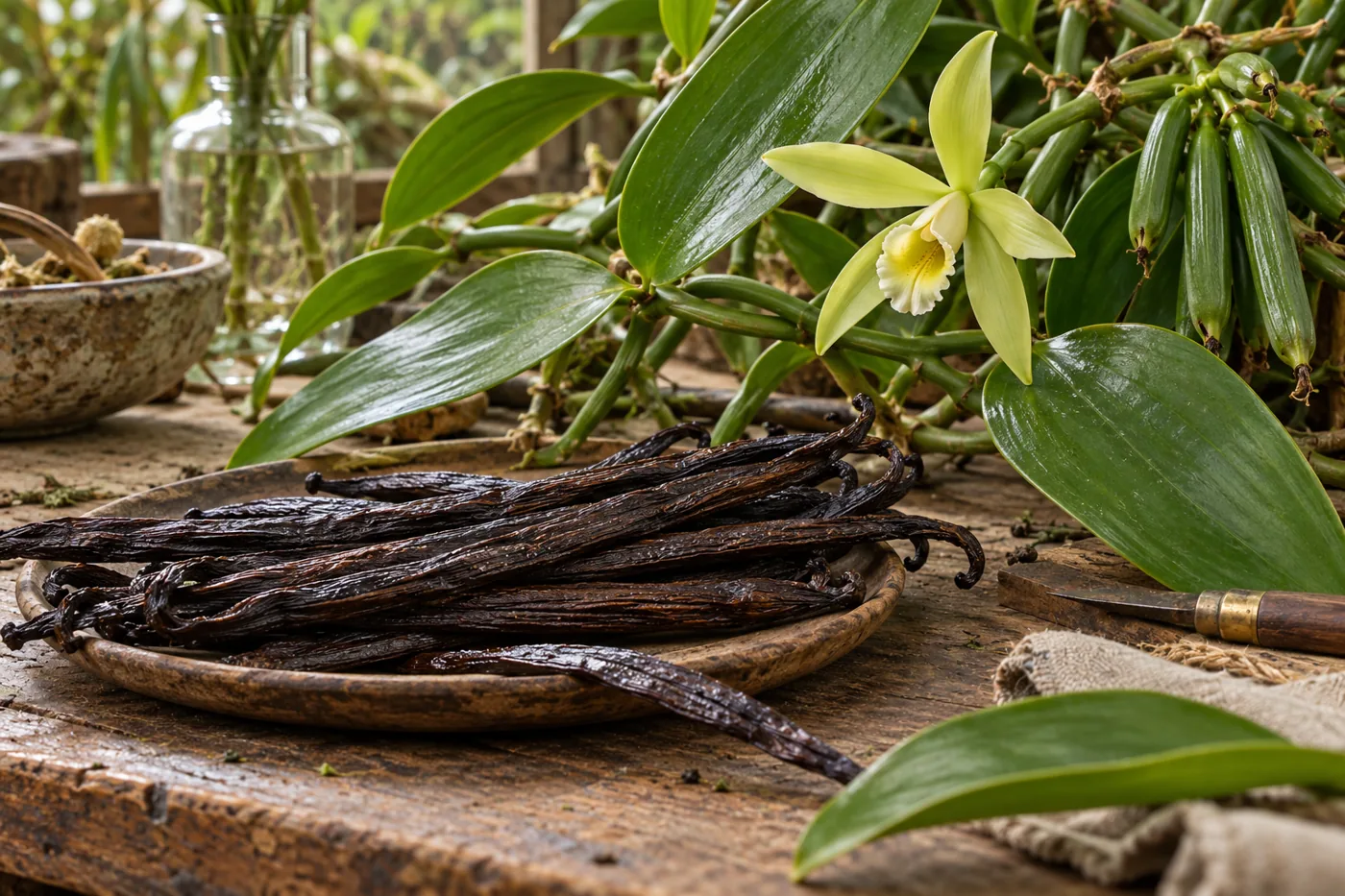
Generated interpretation, not documentary evidence. Imagined vanilla pods with orchid foliage and a pale flower; not a historical artifact, exact botanical plate or production guide.
Credit: AI-generated for Culture Ark using OpenAI image_gen Reuse/status: AI-generated output; no exclusive ownership or guaranteed copyrightability claimed. Underlying works, marks and cultural permissions remain separate. Imagined vanilla pods with orchid foliage and a pale flower; not a historical artifact, exact botanical plate or production guide. The original Totonac attribution is retained but not independently resolved by these particular opened pages. The sources support Albius's contribution, not a single-person history of vanilla. Some broad botanical and chronological claims in the popular accounts are not repeated. The generated flower and pods are illustrative, not a diagnostic botanical plate or cultivation instructions.
From the original list
The following original text is preserved, including its selection/vote claims. Preservation is not independent verification of every assertion.
Why: Flavor from orchids.
What to preserve: Process, Edmond Albius
Year and origin: pre-Columbian · Mexico (Totonac)
Vote: 3/9 (historian 1 · future kid 1 · curator 1)
Learn more: Vanilla on Wikipedia
Supplemental context
Vanilla makes a familiar flavor an entry point into unequal histories of knowledge and reward. The Linnean Society describes vanilla as an orchid fruit associated with Mexico and explains how Edmond Albius, an enslaved twelve-year-old on Réunion, developed a practical hand-pollination method in 1841. Kew also recognizes his contribution. His achievement should not be confused with inventing vanilla itself or erasing the earlier knowledge of people who used and cultivated it in the Americas. Future readers can ask why a profitable commodity may circulate globally while the workers and innovators behind it receive little recognition. The still life keeps attention on the plant material without inventing a portrait or plantation scene.
Creator/community: Mexican vanilla-growing traditions; Edmond Albius and later plantation and agricultural workers Place/era: Mexico and wider cultivation networks; Albius’s pollination contribution on Réunion in 1841
Context and limits
The original Totonac attribution is retained but not independently resolved by these particular opened pages. The sources support Albius's contribution, not a single-person history of vanilla. Some broad botanical and chronological claims in the popular accounts are not repeated. The generated flower and pods are illustrative, not a diagnostic botanical plate or cultivation instructions.
Where to learn more
- https://apiarybee.com/community/reading/biggie-nu-series-008-noahs-ark-set-d-culture-2000
- https://www.linnean.org/news/2019/10/16/edmond-albius
- https://www.kew.org/read-and-watch/vanilla-digitisation
Apiary library | Original Culture Ark article
Public ID and individual routes: pending publisher allocation. Internal source ID: D-0848
Part of the Culture Ark: 2,000 things people should still be able to see in 2,000 years, picked by AI research teams. This page keeps the original list entry for D-0848 word for word and adds context. Browse the gallery. The Culture Ark is an Artificial Mind Hive (AMH) project. AMH is owned by Austin Little.

Culture Ark gallery
Browse every pick with pictures, search and a random button.
Open the gallery →