Culture Ark · D-0843 · Food · Browse the gallery · The full 2,000-pick list
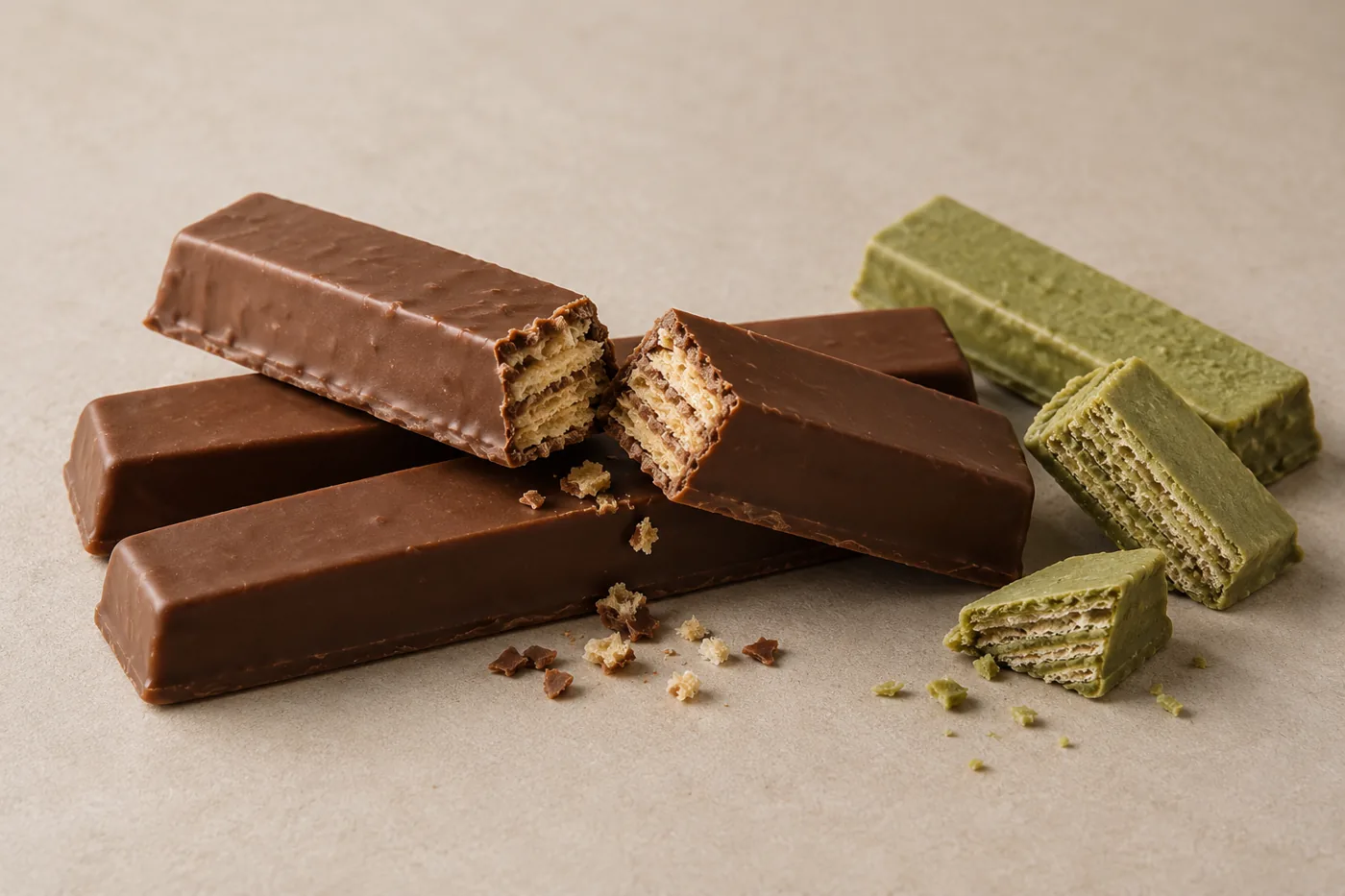
Generated interpretation, not documentary evidence. Imagined chocolate-coated wafer fingers and green-coated variations; not branded Kit Kat packaging or an exact product reproduction.
Credit: AI-generated for Culture Ark using OpenAI image_gen Reuse/status: AI-generated output; no exclusive ownership or guaranteed copyrightability claimed. Underlying works, marks and cultural permissions remain separate. Imagined chocolate-coated wafer fingers and green-coated variations; not branded Kit Kat packaging or an exact product reproduction. The source is a corporate retrospective. Its promotional claims and current sales totals are not treated as independent cultural rankings. The green pieces are an illustrative flavor contrast, not proof of a particular marketed variety. Product recipes, owners and packaging vary by market; the image is not an official product photograph.
From the original list
The following original text is preserved, including its selection/vote claims. Preservation is not independent verification of every assertion.
Why: A wafer bar with Japanese flavors.
What to preserve: Bar
Year and origin: 1935 · United Kingdom
Vote: 3/9 (historian 1 · future kid 1 · curator 1)
Learn more: KitKat on Wikipedia
Supplemental context
Kit Kat makes the industrial snack useful as evidence of both standardization and local adaptation. Nestlé's anniversary history traces the product to York in 1935 under the name Chocolate Crisp, with the Kit Kat name following in 1937. It also discusses later Japanese flavors, showing how a recognizable wafer format can become a setting for experimentation rather than a single immutable taste. Future readers can ask how portion shape, the idea of taking a break and regional marketing work together to create familiarity. The illustration deliberately concentrates on chocolate-coated wafer forms and a contrasting color, leaving actual packaging and the precise composition of named commercial products to the linked sources.
Creator/community: Rowntree confectionery makers in York; later Nestlé and regional product-development teams Place/era: York, United Kingdom, 1935; later international and Japanese adaptations
Context and limits
The source is a corporate retrospective. Its promotional claims and current sales totals are not treated as independent cultural rankings. The green pieces are an illustrative flavor contrast, not proof of a particular marketed variety. Product recipes, owners and packaging vary by market; the image is not an official product photograph.
Where to learn more
- https://apiarybee.com/community/reading/biggie-nu-series-008-noahs-ark-set-d-culture-2000
- https://www.nestle.com/media/news/90-years-chocolate-kitkat-breaks
Apiary library | Original Culture Ark article
Public ID and individual routes: pending publisher allocation. Internal source ID: D-0843
Part of the Culture Ark: 2,000 things people should still be able to see in 2,000 years, picked by AI research teams. This page keeps the original list entry for D-0843 word for word and adds context. Browse the gallery. The Culture Ark is an Artificial Mind Hive (AMH) project. AMH is owned by Austin Little.

Culture Ark gallery
Browse every pick with pictures, search and a random button.
Open the gallery →