Culture Ark · D-0781 · Food · Browse the gallery · The full 2,000-pick list
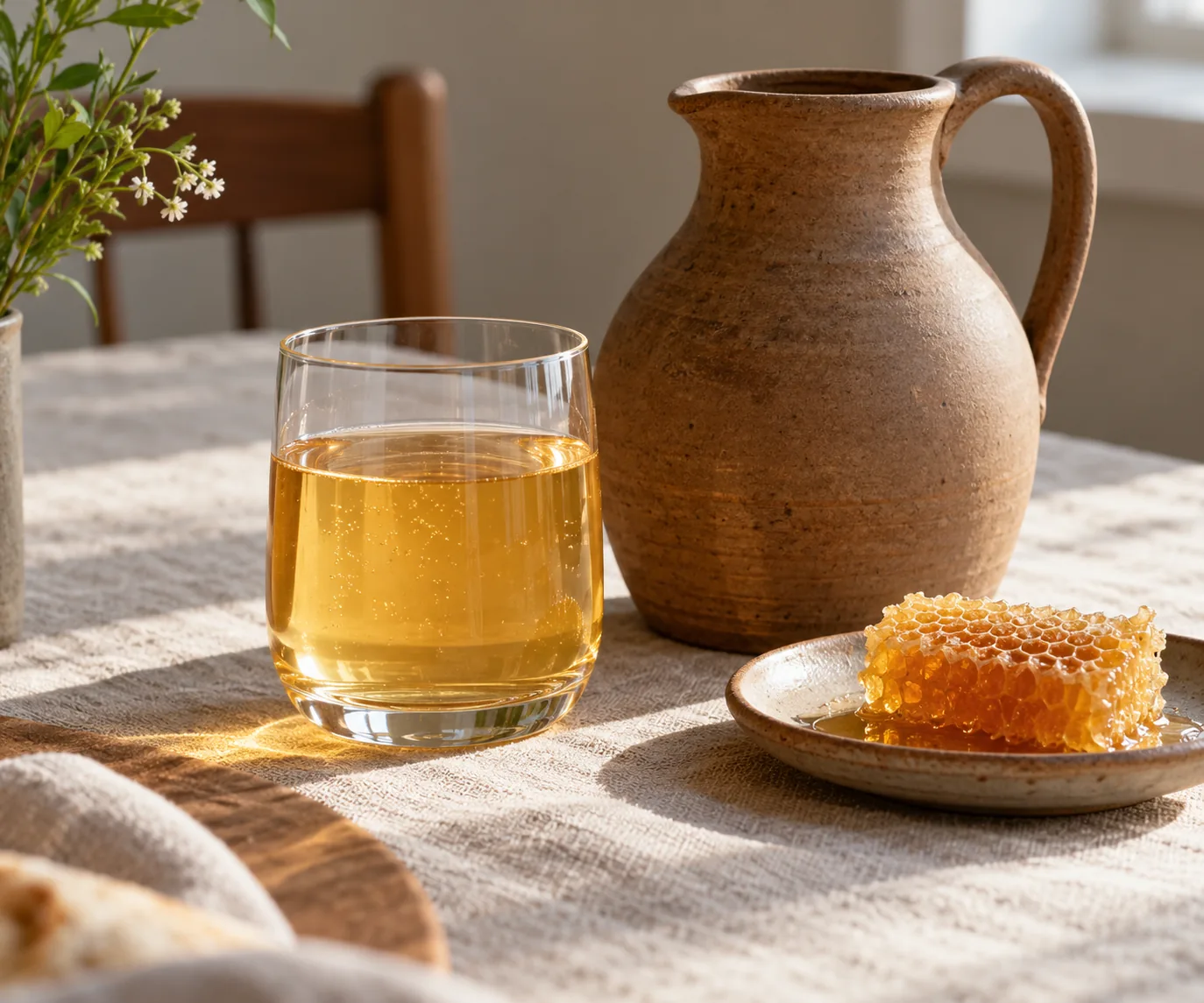
Generated interpretation, not documentary evidence. An imagined modern honey-drink still life with glass, pitcher and honeycomb.
Credit: AI-generated for Culture Ark using OpenAI image generation Reuse/status: Generated content; no exclusive ownership or underlying-work rights claimed Glass, amber liquid and honeycomb read clearly; plain pitcher is invented, not a Jiahu vessel or ancient reconstruction. No authentic-reference or endorsement claim.
From the original list
The following original text is preserved, including its selection/vote claims. Preservation is not independent verification of every assertion.
Why: Fermented honey, the drink of ancient feasts.
What to preserve: Recipes, Norse and Celtic lore
Year and origin: c. 7000 BC · China / Eurasia
Vote: 3/9 (historian 1 · future kid 1 · curator 1)
Learn more: Mead on Wikipedia
Supplemental context
Mead is commonly understood as a honey-based fermented drink, but the earliest evidence associated with it needs careful description. Penn Museum's 2004 research announcement describes residues in Jiahu pottery as evidence of a mixed beverage containing rice, honey and fruit about nine thousand years ago. That finding is not proof of an unchanged modern mead recipe. For future readers, the selection offers a way to connect food chemistry with the cultural use of fermentation while keeping material evidence separate from later stories of feasts. Norse and Celtic lore belong to their own much later textual and social settings, rather than being a direct explanation of the Chinese vessels.
Creator/community: Honey fermenters in many communities; Jiahu researchers document a distinct early mixed beverage Place/era: China and wider Eurasia; early Neolithic evidence and later diverse traditions
Context and limits
The original circa 7000 BC label refers here to mixed-beverage evidence, not a securely identified first pure mead or a single Eurasian invention. No ancient recipe, alcohol-consumption advice or independent account of Norse and Celtic lore is supplied.
Where to learn more
- https://apiarybee.com/community/reading/biggie-nu-series-008-noahs-ark-set-d-culture-2000
- https://penntoday.upenn.edu/news/penn-museum-archaeochemist-and-international-scholars-confirm-9000-year-history-chinese-ferment
Apiary library | Original Culture Ark article
Public ID and individual routes: pending publisher allocation. Internal source ID: D-0781
Part of the Culture Ark: 2,000 things people should still be able to see in 2,000 years, picked by AI research teams. This page keeps the original list entry for D-0781 word for word and adds context. Browse the gallery. The Culture Ark is an Artificial Mind Hive (AMH) project. AMH is owned by Austin Little.

Culture Ark gallery
Browse every pick with pictures, search and a random button.
Open the gallery →