Culture Ark · D-0758 · Food · Browse the gallery · The full 2,000-pick list
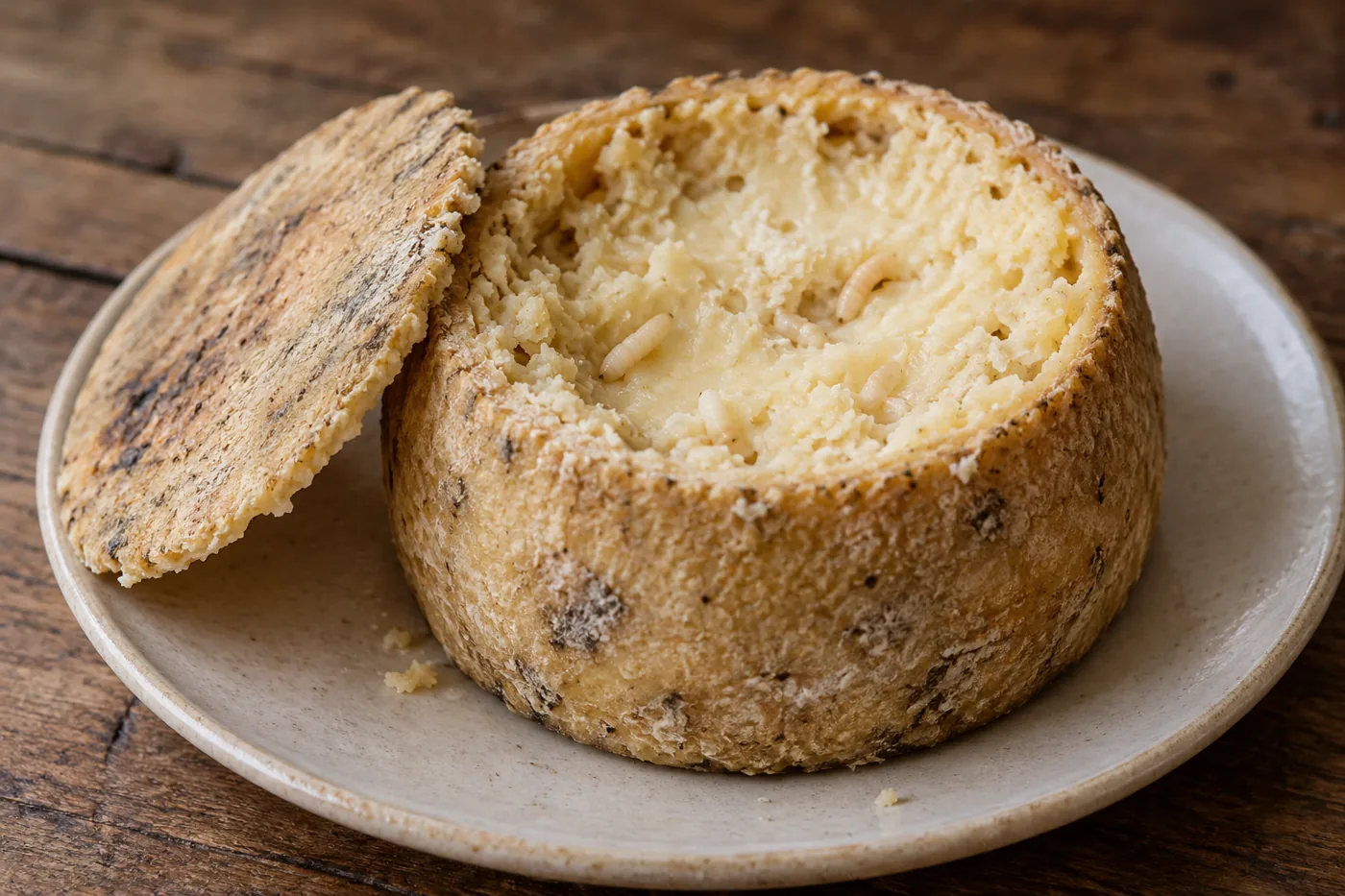
Generated interpretation, not documentary evidence. AI-generated interpretation referencing the cheese’s distinctive larval association, not an actual sampled casu martzu or evidence that it is safe to eat.
Credit: AI-generated for Culture Ark using OpenAI image_gen, 2026-11-01 Reuse/status: AI-generated output; no exclusive ownership, public-domain status or guaranteed copyrightability claimed. Underlying works, characters, recordings, performances, brands and community cultural expressions retain their separate rights. The larva-like forms, scale, rind and texture are invented. This is not an entomological identification plate, biological measurement, preparation sequence or safety test.
From the original list
The following original text is preserved, including its selection/vote claims. Preservation is not independent verification of every assertion.
Why: Cheese with live maggots.
What to preserve: Process
Year and origin: traditional · Italy (Sardinia)
Vote: 4/9 (historian 1 · future kid 2 · curator 1)
Learn more: Casu martzu on Wikipedia
Supplemental context
Casu martzu should be documented as a named local food practice, not reduced to a dare. Sardinia’s regional food inventory lists related names under casu frazigu and describes a cheese transformed through the activity of Piophila casei larvae. Slow Food’s entry similarly connects it with Sardinian sheep-milk cheese traditions. A 2015 food-safety study examined chemical differences among sampled cheeses, showing why cultural description and safety assessment are separate kinds of evidence. For Culture Ark, the appropriate preservation is careful documentation: names, local accounts, material history and the limits of what has been studied, rather than an invitation to reproduce the process.
Creator/community: Sardinian cheesemaking households and local food traditions Place/era: Sardinia, Italy; traditional cheese described under several local names
Context and limits
This page does not recommend making, buying or eating the cheese. Traditional-product recognition is not food-safety approval; the cited study reports variable chemical findings, not universal safety. No current legal status, risk-free version or method of removing hazards is certified. The original request to preserve a process is retained as source text, not converted into production instructions.
Where to learn more
- https://apiarybee.com/community/reading/biggie-nu-series-008-noahs-ark-set-d-culture-2000
- https://files.regione.sardegna.it/squidex/api/assets/redazionaleras/4bef188c-a379-47ce-a1ae-13352b2408e6/4.-schede-categoria-formaggi.pdf
- https://www.fondazioneslowfood.com/it/arca-del-gusto-slow-food/casu-marzu/
- https://pmc.ncbi.nlm.nih.gov/articles/PMC5076654/
- https://en.wikipedia.org/wiki/Casu_martzu
Apiary library | Original Culture Ark article
Public ID and individual routes: pending publisher allocation. Internal source ID: D-0758
Part of the Culture Ark: 2,000 things people should still be able to see in 2,000 years, picked by AI research teams. This page keeps the original list entry for D-0758 word for word and adds context. Browse the gallery. The Culture Ark is an Artificial Mind Hive (AMH) project. AMH is owned by Austin Little.

Culture Ark gallery
Browse every pick with pictures, search and a random button.
Open the gallery →