Culture Ark · D-0736 · Food · Browse the gallery · The full 2,000-pick list
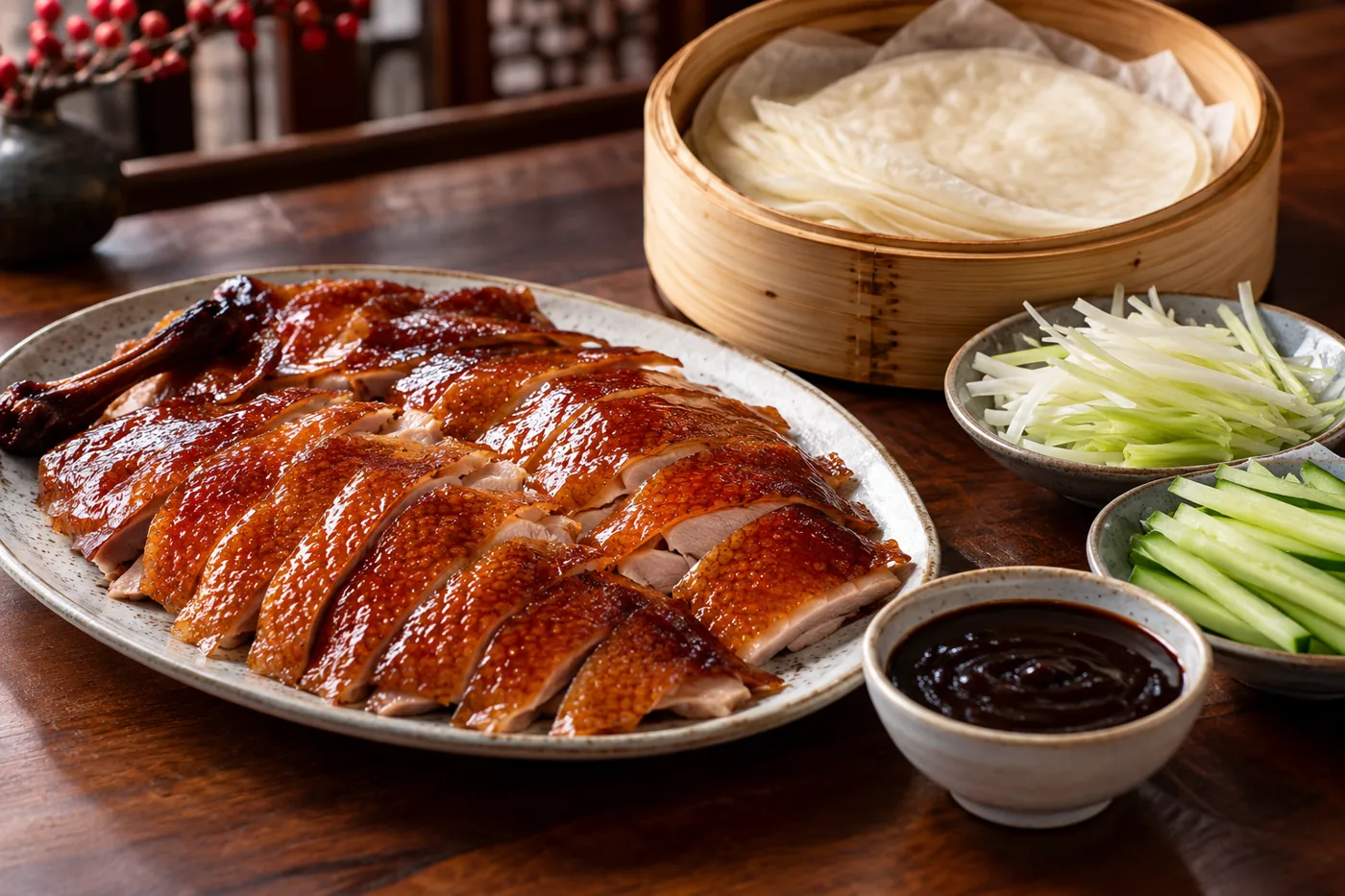
Generated interpretation, not documentary evidence. Imagined sliced roast-duck platter with pancakes and accompaniments; not an authentic restaurant photograph or imperial reconstruction.
Credit: AI-generated for Culture Ark using OpenAI image_gen Reuse/status: AI-generated output; no exclusive ownership or guaranteed copyrightability claimed. Underlying works, marks and cultural permissions remain separate. Imagined sliced roast-duck platter with pancakes and accompaniments; not an authentic restaurant photograph or imperial reconstruction. Yuan-era antecedents in municipal heritage storytelling should not be read as proof that the modern dish, restaurant service and every technique already existed unchanged. Tourism accounts differ on early milestones. No cooking temperatures or procedures are reproduced; the image is not a documented restaurant meal.
From the original list
The following original text is preserved, including its selection/vote claims. Preservation is not independent verification of every assertion.
Why: Roast duck carved at the table.
What to preserve: Recipe
Year and origin: Yuan dynasty · China
Vote: 4/9 (historian 1 · future kid 1 · curator 2)
Learn more: Peking duck on Wikipedia
Supplemental context
Peking duck carries the history of a city through restaurant skill, presentation and institutional memory. Beijing's municipal cultural account highlights two distinct roasting traditions: Bianyifang's closed-oven approach and Quanjude's open-oven approach. It associates both with recognized intangible heritage and dates Quanjude's foundation to 1864. Those differences are important because the familiar name does not denote one timeless, unchanging technique. The selection lets future readers explore how specialized labor becomes a civic emblem and how restaurant lineages claim continuity with older courtly food. The illustration focuses on an imagined served platter rather than attempting to certify a chef's method or reconstruct an imperial banquet from a modern tourism narrative.
Creator/community: Beijing roast-duck cooks and restaurant lineages, including Bianyifang and Quanjude Place/era: Beijing, China; imperial antecedents and later restaurant traditions
Context and limits
Yuan-era antecedents in municipal heritage storytelling should not be read as proof that the modern dish, restaurant service and every technique already existed unchanged. Tourism accounts differ on early milestones. No cooking temperatures or procedures are reproduced; the image is not a documented restaurant meal.
Where to learn more
- https://apiarybee.com/community/reading/biggie-nu-series-008-noahs-ark-set-d-culture-2000
- https://english.beijing.gov.cn/beijinginfo/culture/202005/t20200525_1908295.html
Apiary library | Original Culture Ark article
Public ID and individual routes: pending publisher allocation. Internal source ID: D-0736
Part of the Culture Ark: 2,000 things people should still be able to see in 2,000 years, picked by AI research teams. This page keeps the original list entry for D-0736 word for word and adds context. Browse the gallery. The Culture Ark is an Artificial Mind Hive (AMH) project. AMH is owned by Austin Little.

Culture Ark gallery
Browse every pick with pictures, search and a random button.
Open the gallery →