Culture Ark · D-0737 · Food · Browse the gallery · The full 2,000-pick list
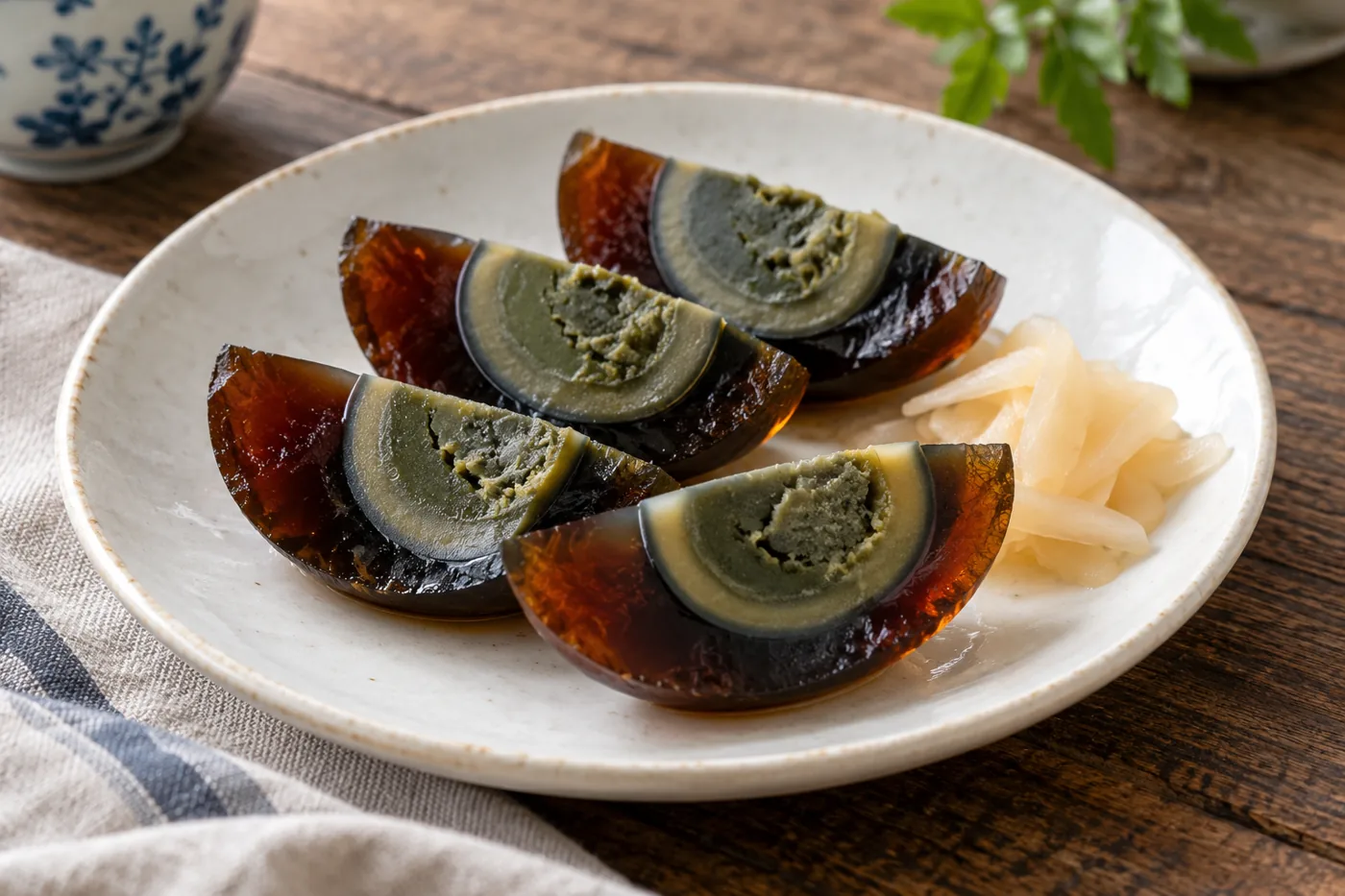
Generated interpretation, not documentary evidence. Imagined century-egg slices with dark translucent whites and gray-green yolks; not a safety test or preservation guide.
Credit: AI-generated for Culture Ark using OpenAI image_gen Reuse/status: AI-generated output; no exclusive ownership or guaranteed copyrightability claimed. Underlying works, marks and cultural permissions remain separate. Imagined century-egg slices with dark translucent whites and gray-green yolks; not a safety test or preservation guide. The checked sources establish terminology and production category, not the original date or inventor; the original word ancient remains unverified. The 2013 notice is historical, not a current assurance about any product. The generated egg slices are illustrative only. No preservation recipe, chemical proportions or food-safety determination is provided.
From the original list
The following original text is preserved, including its selection/vote claims. Preservation is not independent verification of every assertion.
Why: Preserved eggs, dark and pungent.
What to preserve: Process
Year and origin: ancient · China
Vote: 4/9 (historian 1 · future kid 2 · curator 1)
Learn more: Century egg on Wikipedia
Supplemental context
Century eggs demonstrate how names, appearances and expectations shape the experience of food. The familiar English name belongs to a preserved-egg category rather than serving as a literal age certificate. Hong Kong's Centre for Food Safety distinguishes alkaline-treated pidan from salted egg products in its food-category guidance. Its separate 2013 discussion of lime-preserved eggs also shows that traditional products exist within modern systems of production oversight and public concern. For future readers, the cultural lesson is not that unfamiliar colors imply decay, nor that tradition guarantees safety. It is that learned tastes and preservation practices need to be understood alongside the institutions that define and monitor commercial food.
Creator/community: Chinese preserved-egg producers and food communities Place/era: China and wider Chinese food cultures; historical practice with modern regulated production
Context and limits
The checked sources establish terminology and production category, not the original date or inventor; the original word ancient remains unverified. The 2013 notice is historical, not a current assurance about any product. The generated egg slices are illustrative only. No preservation recipe, chemical proportions or food-safety determination is provided.
Where to learn more
- https://apiarybee.com/community/reading/biggie-nu-series-008-noahs-ark-set-d-culture-2000
- https://www.cfs.gov.hk/english/whatsnew/whatsnew_fstr/files/Preservatives_and_Antioxidants_12_2024_en.pdf
- https://www.cfs.gov.hk/english/multimedia/multimedia_pub/multimedia_pub_fsf_84_04.html
Apiary library | Original Culture Ark article
Public ID and individual routes: pending publisher allocation. Internal source ID: D-0737
Part of the Culture Ark: 2,000 things people should still be able to see in 2,000 years, picked by AI research teams. This page keeps the original list entry for D-0737 word for word and adds context. Browse the gallery. The Culture Ark is an Artificial Mind Hive (AMH) project. AMH is owned by Austin Little.

Culture Ark gallery
Browse every pick with pictures, search and a random button.
Open the gallery →