Culture Ark · D-0704 · Food · Browse the gallery · The full 2,000-pick list
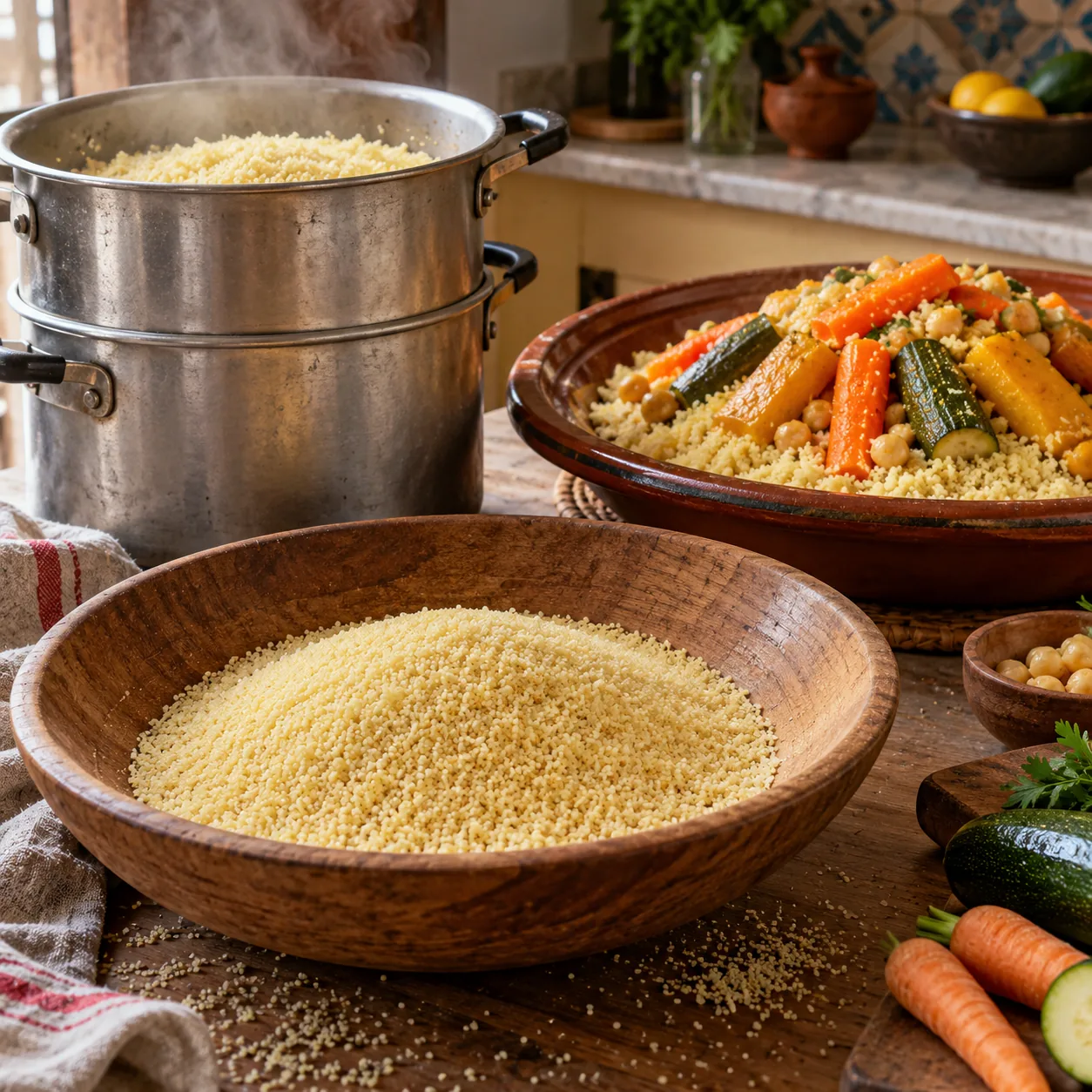
Generated interpretation, not documentary evidence. Imagined couscous grains, steaming vessel and vegetable serving; contextual reuse, not an authenticated kitchen or recipe.
Credit: AI-generated for Culture Ark using OpenAI image generation Reuse/status: Generated content; no exclusive ownership or underlying cultural-rights claim Independent companion artwork only. Underlying works, performer and trademark rights remain separate. No exclusive ownership or public-domain claim.
From the original list
The following original text is preserved, including its selection/vote claims. Preservation is not independent verification of every assertion.
Why: Steamed semolina granules.
What to preserve: Process, UNESCO listing
Year and origin: 11th century · Maghreb (Berber)
Vote: 5/9 (historian 2 · future kid 1 · curator 2)
Learn more: Couscous on Wikipedia
Supplemental context
UNESCO’s 2020 account records a joint inscription concerning the knowledge and practices surrounding couscous, submitted by Algeria, Mauritania, Morocco and Tunisia. The focus is not merely a finished plate: it includes skills, utensils, transmission and social occasions. This helps future readers understand why a familiar food can be an important form of living heritage. Family and regional variations should not be collapsed into a single approved recipe. The original selection’s attention to process is therefore useful, provided the record also preserves who teaches, prepares and shares the food. The reused illustration depicts an imagined preparation setting and grains, rather than presenting itself as a documentary photograph or technical reconstruction.
Creator/community: Couscous-making and sharing communities Place/era: Algeria, Mauritania, Morocco, Tunisia and wider communities
Context and limits
UNESCO recognition dates the inscription, not the invention of couscous. The original eleventh-century attribution is not independently confirmed here. Modern borders do not exhaust the food’s communities.
Where to learn more
- https://apiarybee.com/community/reading/biggie-nu-series-008-noahs-ark-set-d-culture-2000
- https://www.unesco.org/en/articles/unescos-inscription-couscous-traditions-example-international-cultural-cooperation
Apiary library | Original Culture Ark article
Public ID and individual routes: pending publisher allocation. Internal source ID: D-0704
Part of the Culture Ark: 2,000 things people should still be able to see in 2,000 years, picked by AI research teams. This page keeps the original list entry for D-0704 word for word and adds context. Browse the gallery. The Culture Ark is an Artificial Mind Hive (AMH) project. AMH is owned by Austin Little.

Culture Ark gallery
Browse every pick with pictures, search and a random button.
Open the gallery →