Culture Ark · D-0700 · Food · Browse the gallery · The full 2,000-pick list
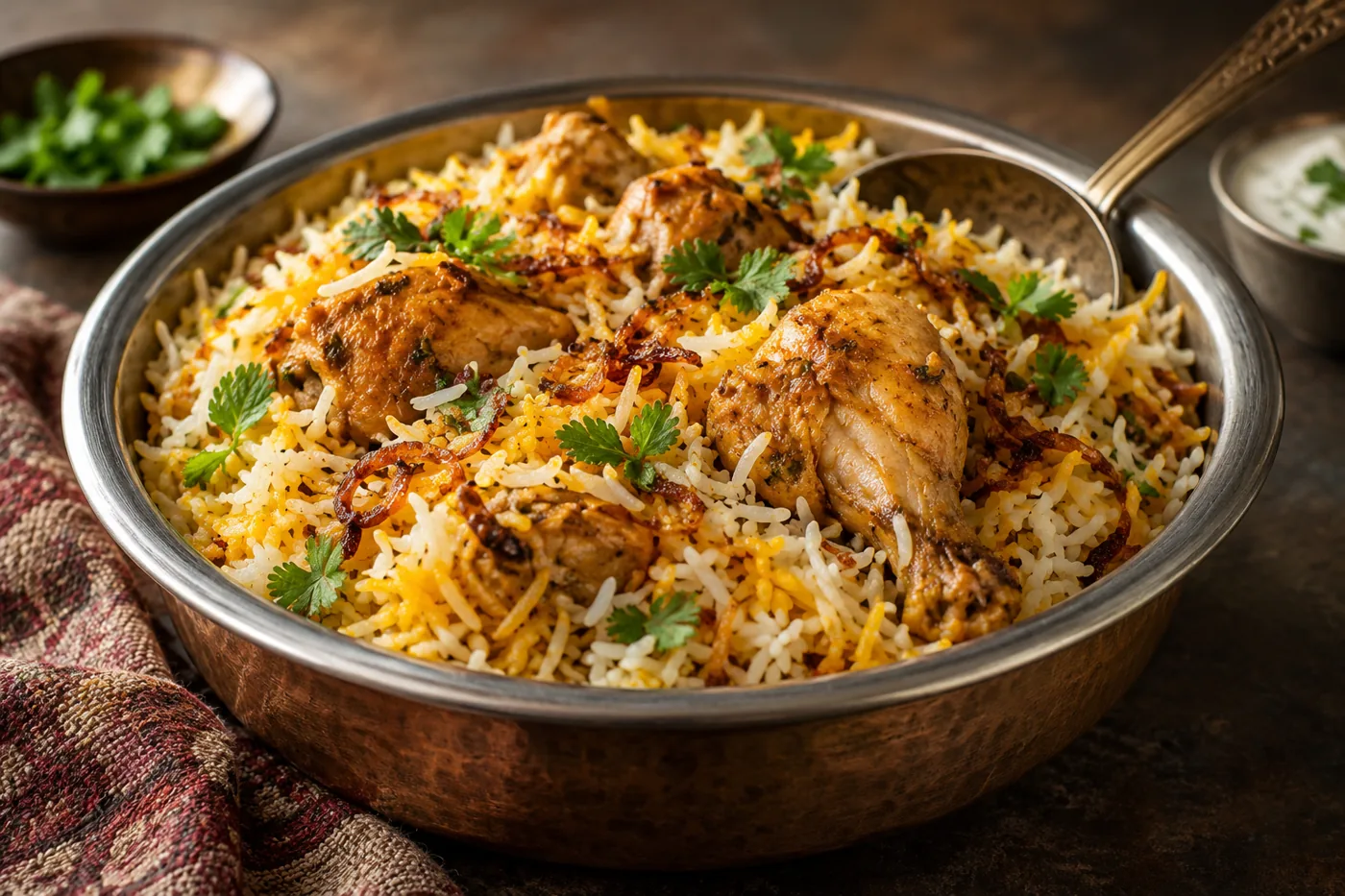
Generated interpretation, not documentary evidence. Imagined chicken biryani-style rice serving; not the single authentic form or a reconstruction of a Mughal meal.
Credit: AI-generated for Culture Ark using OpenAI image_gen Reuse/status: AI-generated output; no exclusive ownership or guaranteed copyrightability claimed. Underlying works, marks and cultural permissions remain separate. Imagined chicken biryani-style rice serving; not the single authentic form or a reconstruction of a Mughal meal. The preserved Mughal-era attribution is broad and should not imply that all biryani variants share one documented invention. Rice types, meats, vegetables and methods vary, and Hyderabad does not represent all South Asia. The generated chicken-rice serving is one imagined interpretation, not a recipe, ingredient guarantee or authenticity certificate.
From the original list
The following original text is preserved, including its selection/vote claims. Preservation is not independent verification of every assertion.
Why: Layered rice and meat.
What to preserve: Recipes
Year and origin: Mughal era · India
Vote: 5/9 (historian 2 · future kid 1 · curator 2)
Learn more: Biryani on Wikipedia
Supplemental context
Biryani is better understood as a family of locally meaningful rice dishes than as one recipe with a universally agreed beginning. India's official tourism account presents Hyderabadi biryani within a cuisine shaped by Mughlai, Telugu and Marathwada traditions and describes its fragrant rice and meat. That is a useful regional example, not the boundary of the whole food. Future readers could investigate how cooks make a shared name distinctive through technique, seasoning and occasion. Its cultural value lies partly in the strong claims people make for a familiar version, connecting a meal to place, hospitality and inherited knowledge.
Creator/community: South Asian cooks, households and dining communities; many regional biryani traditions Place/era: South Asia and diaspora; varied histories, with Hyderabad as one documented regional example
Context and limits
The preserved Mughal-era attribution is broad and should not imply that all biryani variants share one documented invention. Rice types, meats, vegetables and methods vary, and Hyderabad does not represent all South Asia. The generated chicken-rice serving is one imagined interpretation, not a recipe, ingredient guarantee or authenticity certificate.
Where to learn more
- https://apiarybee.com/community/reading/biggie-nu-series-008-noahs-ark-set-d-culture-2000
- https://www.incredibleindia.gov.in/en/telangana/hyderabad/embark-on-an-extravagant-culinary-journey-in-hyderabad
Apiary library | Original Culture Ark article
Public ID and individual routes: pending publisher allocation. Internal source ID: D-0700
Part of the Culture Ark: 2,000 things people should still be able to see in 2,000 years, picked by AI research teams. This page keeps the original list entry for D-0700 word for word and adds context. Browse the gallery. The Culture Ark is an Artificial Mind Hive (AMH) project. AMH is owned by Austin Little.

Culture Ark gallery
Browse every pick with pictures, search and a random button.
Open the gallery →