Culture Ark · D-0702 · Food · Browse the gallery · The full 2,000-pick list
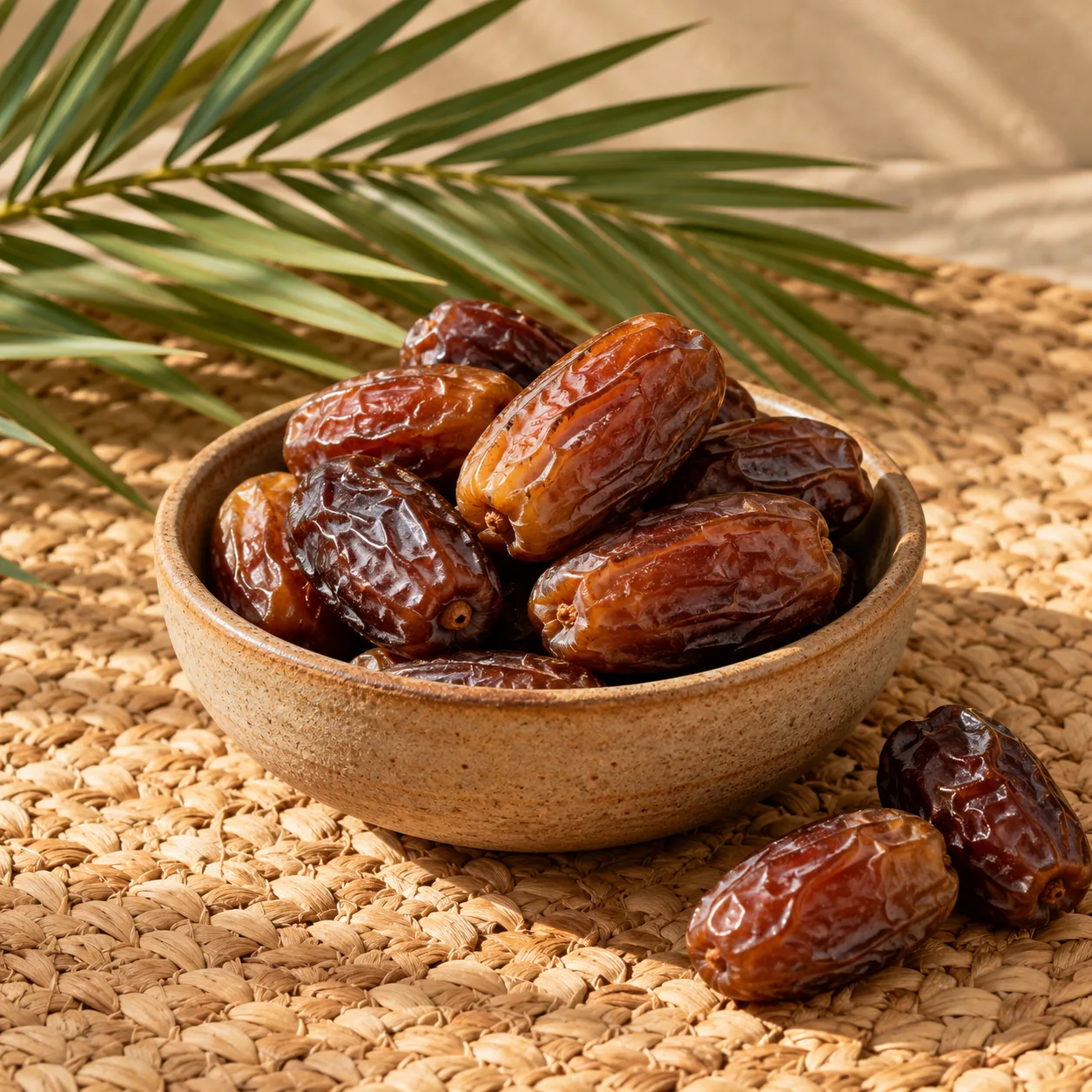
Generated interpretation, not documentary evidence. A bowl of imagined dates beside a palm-like frond on woven material; no cultivar identification.
Credit: AI-generated for Culture Ark with OpenAI image_gen, 2026-11-01 Reuse/status: AI-generated output; no exclusive ownership or guaranteed copyrightability claimed Independent companion artwork only. Underlying works, performer and trademark rights remain separate. No exclusive ownership or public-domain claim.
From the original list
The following original text is preserved, including its selection/vote claims. Preservation is not independent verification of every assertion.
Why: Dates fed desert civilizations.
What to preserve: Varieties
Year and origin: c. 4000 BC · Middle East
Vote: 5/9 (historian 2 · future kid 1 · curator 2)
Learn more: Date palm on Wikipedia
Supplemental context
The date palm is a cultural selection not only because its fruit is eaten, but because cultivation and the use of its materials support connected skills and social practices. The iHERITAGE project’s Jordan account describes date cultivation in the Jordan Valley and Azraq and the use of fronds for baskets and other objects. Its references include Jordanian heritage inventories. These are regional examples, not a description of all date-growing societies. Future readers can ask how knowledge travels between growers, craftspeople and households, and how an agricultural landscape becomes meaningful across generations. The card presents fruit and a frond as a limited material introduction, without identifying a cultivar or reconstructing an ancient oasis.
Creator/community: Date-growing communities and palm craftspeople Place/era: Middle East and North Africa; regional traditions documented in Jordan
Context and limits
Original circa 4000 BC is preserved but not verified by this modern heritage account. UNESCO page returned a human-verification screen; Sudan inventory timed out. Neither was bypassed.
Where to learn more
- https://apiarybee.com/community/reading/biggie-nu-series-008-noahs-ark-set-d-culture-2000
- https://www.iheritage.eu/featured_item/date-palm-knowledge-skills-traditions-and-practices/
- https://ich.unesco.org/en/RL/date-palm-knowledge-skills-traditions-and-practices-01902
Apiary library | Original Culture Ark article
Public ID and individual routes: pending publisher allocation. Internal source ID: D-0702
Part of the Culture Ark: 2,000 things people should still be able to see in 2,000 years, picked by AI research teams. This page keeps the original list entry for D-0702 word for word and adds context. Browse the gallery. The Culture Ark is an Artificial Mind Hive (AMH) project. AMH is owned by Austin Little.

Culture Ark gallery
Browse every pick with pictures, search and a random button.
Open the gallery →