Culture Ark · D-0651 · Food · Browse the gallery · The full 2,000-pick list
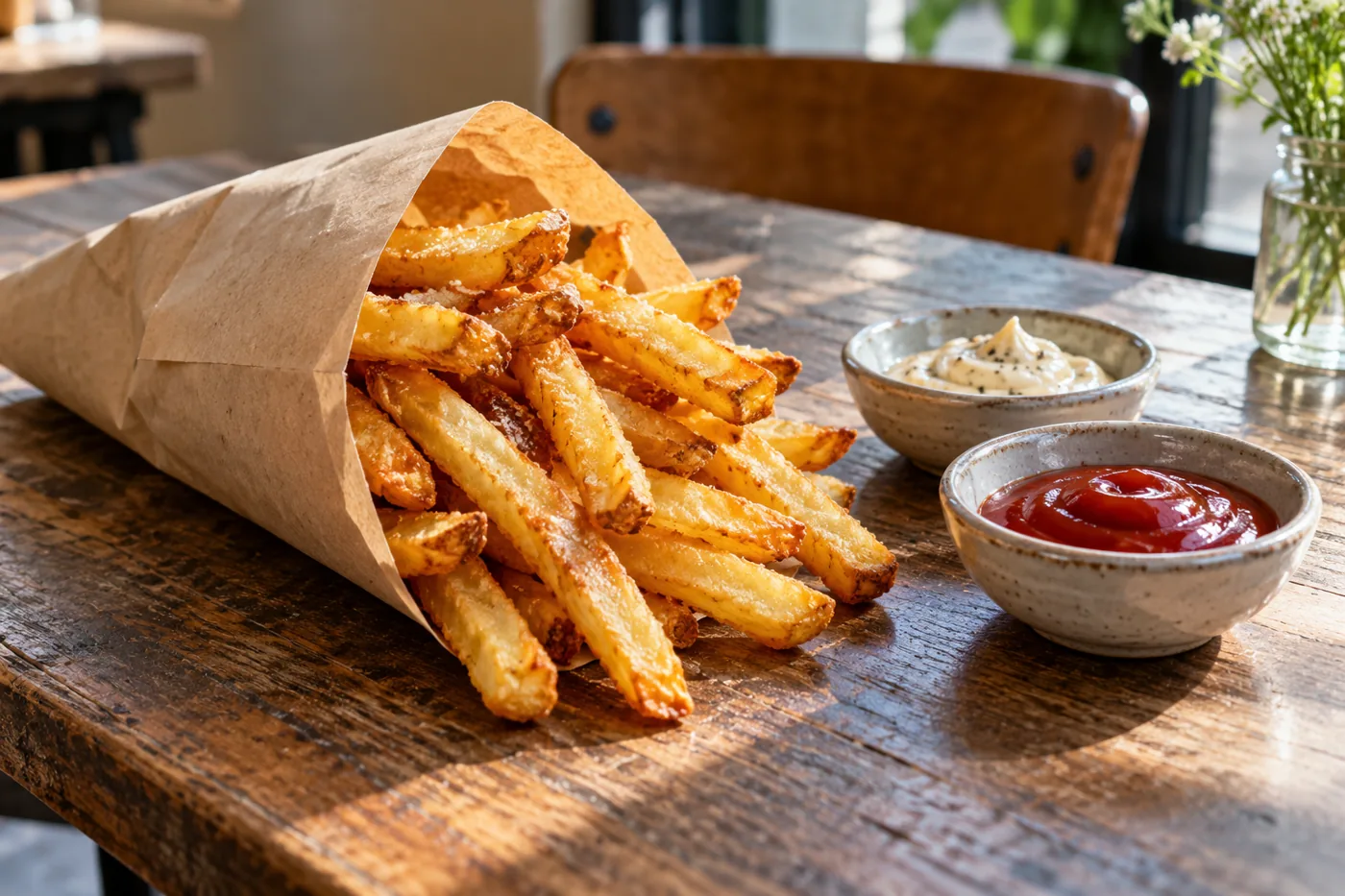
Generated interpretation, not documentary evidence. Golden fries in plain paper beside two sauces; an imagined modern serving, not a national-origin claim.
Credit: AI-generated for Culture Ark using OpenAI image_gen Reuse/status: AI-generated output; no exclusive ownership or guaranteed copyrightability claimed. Underlying works, marks and cultural permissions remain separate. Golden fries in plain paper beside two sauces; an imagined modern serving, not a national-origin claim. Neither the English name nor a national tradition settles priority of invention. The preserved late-eighteenth-century shorthand is not an exact founding date. Cuts, fats, sauces and serving customs vary. The image is a modern interpretation, not a recipe, nutrition claim or proof of one authentic version.
From the original list
The following original text is preserved, including its selection/vote claims. Preservation is not independent verification of every assertion.
Why: Fried potato strips eaten everywhere.
What to preserve: Recipe
Year and origin: late 18th century · Belgium / France
Vote: 7/9 (historian 2 · future kid 3 · curator 2)
Learn more: French fries on Wikipedia
Supplemental context
French fries are recognizable through their cut shape, fried surface and flexible role as snack or accompaniment. Their apparent simplicity hides a history of sellers, local names and arguments about belonging. Belgium's fry-shop trade association itself describes the origin as uncertain and rejects the popular claim that the English name began only with First World War soldiers. That is a useful reminder that a food can be central to a community without its earliest invention being securely established there. Future readers could study the ordinary spaces where people buy and share fries, as well as the national stories attached to them.
Creator/community: Potato growers, cooks, street vendors and diners; strong Belgian and French food traditions Place/era: Europe and worldwide; eighteenth- and nineteenth-century histories with disputed origins
Context and limits
Neither the English name nor a national tradition settles priority of invention. The preserved late-eighteenth-century shorthand is not an exact founding date. Cuts, fats, sauces and serving customs vary. The image is a modern interpretation, not a recipe, nutrition claim or proof of one authentic version.
Where to learn more
- https://apiarybee.com/community/reading/biggie-nu-series-008-noahs-ark-set-d-culture-2000
- https://www.navefri-unafri.be/en/the-belgian-frietkot-culture/the-uncertain-origin-of-fries
Apiary library | Original Culture Ark article
Public ID and individual routes: pending publisher allocation. Internal source ID: D-0651
Part of the Culture Ark: 2,000 things people should still be able to see in 2,000 years, picked by AI research teams. This page keeps the original list entry for D-0651 word for word and adds context. Browse the gallery. The Culture Ark is an Artificial Mind Hive (AMH) project. AMH is owned by Austin Little.

Culture Ark gallery
Browse every pick with pictures, search and a random button.
Open the gallery →