Culture Ark · D-0649 · Food · Browse the gallery · The full 2,000-pick list
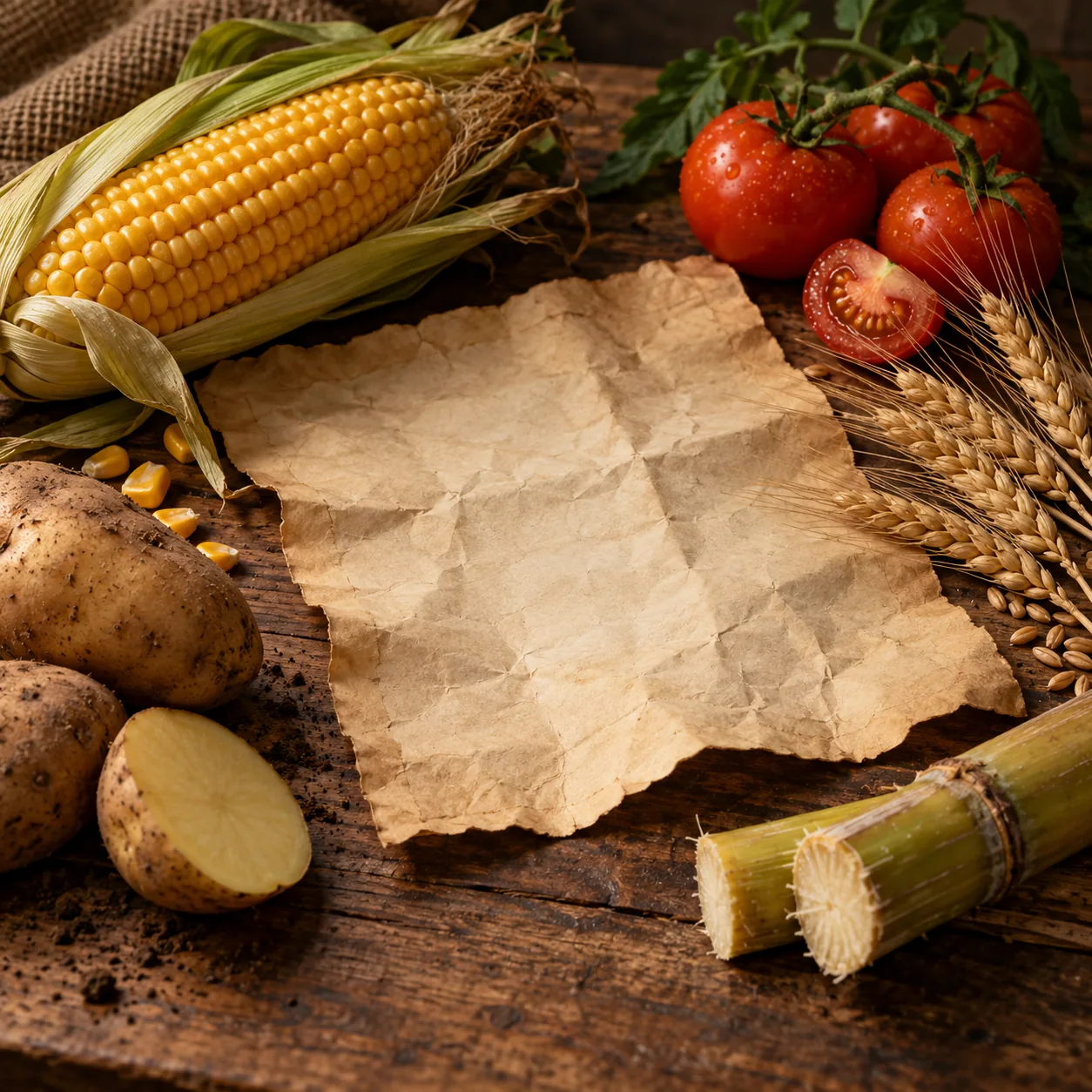
Generated interpretation, not documentary evidence. Maize, potatoes, tomatoes, wheat and a cane-like stalk around blank parchment; a limited material metaphor, not a historical map.
Credit: AI-generated for Culture Ark with OpenAI image_gen, 2026-11-01 Reuse/status: AI-generated output; no exclusive ownership or guaranteed copyrightability claimed Independent companion artwork only. Underlying works, performer and trademark rights remain separate. No exclusive ownership or public-domain claim.
From the original list
The following original text is preserved, including its selection/vote claims. Preservation is not independent verification of every assertion.
Why: The swap of crops that remade the world's diet.
What to preserve: Crops, maps
Year and origin: 1492 · Americas / Afro-Eurasia
Vote: 8/9 (historian 3 · future kid 2 · curator 3)
Learn more: Columbian exchange on Wikipedia
Supplemental context
The Columbian exchange describes transfers of crops, animals, pathogens and people associated with sustained contact after 1492. Nunn and Qian’s historical-economic review makes clear that this was much more than a collection of appealing new ingredients. Disease, colonization and coercive movements of people accompanied changes in food and agriculture. A still life can introduce maize, potatoes, tomatoes, wheat and sugarcane, but it cannot adequately represent the human losses or unequal power involved. Future readers should connect familiar foods to Indigenous cultivation and to the conditions under which crops and labor moved. The original word ‘swap’ is therefore best understood as a shorthand that requires substantial qualification, not as evidence of equal or voluntary exchange.
Creator/community: Indigenous cultivators and many populations affected by European colonization Place/era: Americas and Afro-Eurasia after 1492; continuing consequences
Context and limits
1492 marks a conventional historical starting point, not an instantaneous worldwide event. Artwork shows selected materials only, not exact routes, historical trade balance or a celebratory account of colonization.
Where to learn more
- https://apiarybee.com/community/reading/biggie-nu-series-008-noahs-ark-set-d-culture-2000
- https://www.aeaweb.org/articles?id=10.1257/jep.24.2.163
- https://web.viu.ca/davies/H131/ColumbianExchange.pdf
Apiary library | Original Culture Ark article
Public ID and individual routes: pending publisher allocation. Internal source ID: D-0649
Part of the Culture Ark: 2,000 things people should still be able to see in 2,000 years, picked by AI research teams. This page keeps the original list entry for D-0649 word for word and adds context. Browse the gallery. The Culture Ark is an Artificial Mind Hive (AMH) project. AMH is owned by Austin Little.

Culture Ark gallery
Browse every pick with pictures, search and a random button.
Open the gallery →