Culture Ark · D-0644 · Food · Browse the gallery · The full 2,000-pick list
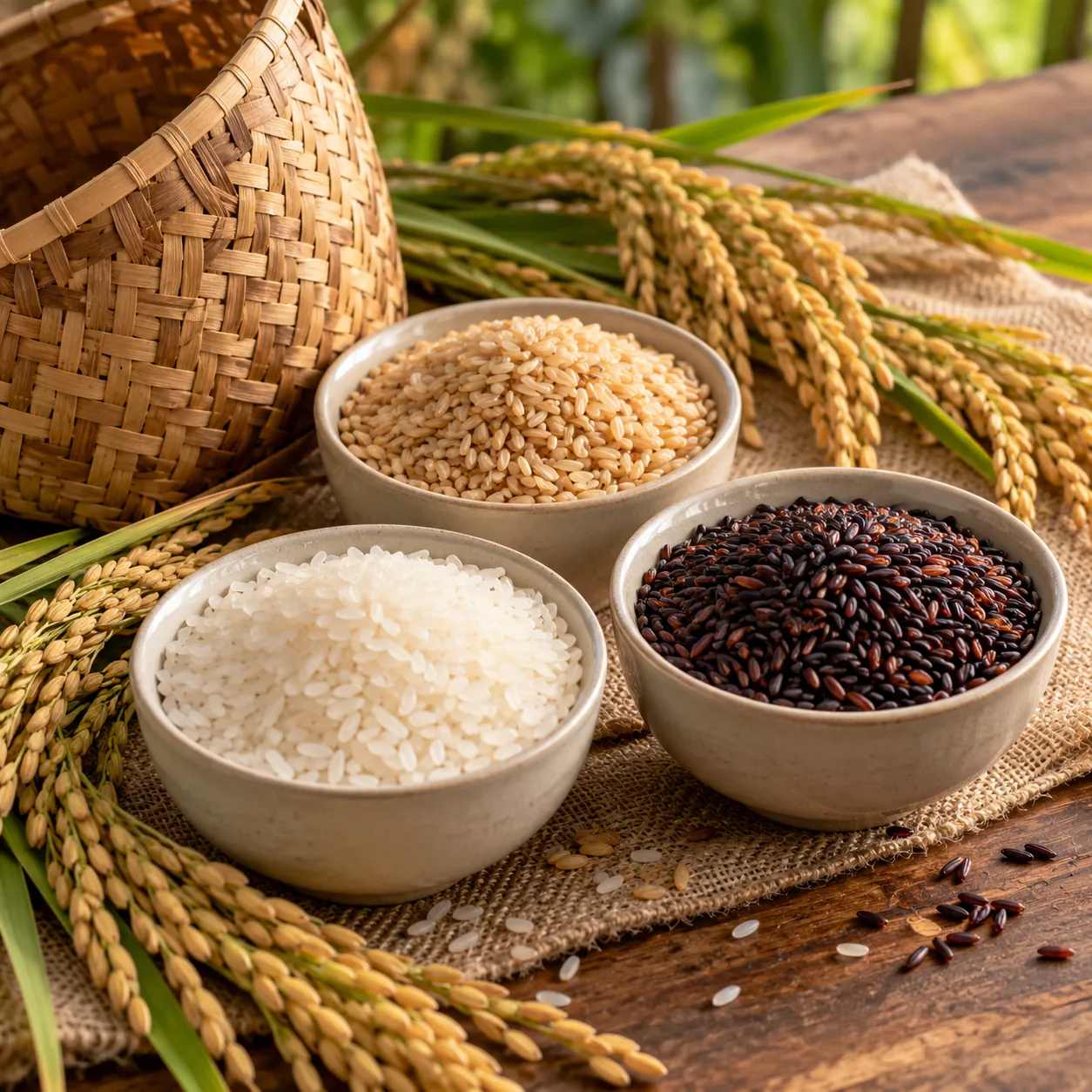
Generated interpretation, not documentary evidence. Three bowls of pale, brown and dark rice with imagined panicles and basket; non-identifiable varieties.
Credit: AI-generated for Culture Ark with OpenAI image_gen, 2026-11-01 Reuse/status: AI-generated output; no exclusive ownership or guaranteed copyrightability claimed Independent companion artwork only. Underlying works, performer and trademark rights remain separate. No exclusive ownership or public-domain claim.
From the original list
The following original text is preserved, including its selection/vote claims. Preservation is not independent verification of every assertion.
Why: The grain that feeds half the world.
What to preserve: Varieties, paddy farming
Year and origin: c. 7000 BC · China
Vote: 8/9 (historian 3 · future kid 2 · curator 3)
Learn more: Rice on Wikipedia
Supplemental context
Rice is not one crop history confined to a single date and location. The International Rice Research Institute’s account distinguishes Asian rice, Oryza sativa, from separately domesticated African rice, Oryza glaberrima. It also describes cultivation environments extending beyond continuously flooded fields. These distinctions help future readers avoid treating a bowl of rice as evidence of one uniform agricultural society. Rice can be examined through everyday meals, regional varieties, labor arrangements and the landscapes people maintain. The original Chinese dating is a simplified entry point into Asian domestication, not a sufficient chronology for every rice tradition. The accompanying bowls symbolize variety without claiming that their contents are scientifically identified cultivars.
Creator/community: Asian and African rice-growing communities Place/era: Multiple domestication histories and later global cultivation
Context and limits
Original origin dating and the claim about half the world are broad summaries, not newly verified exact estimates. Not all rice cultivation uses flooded paddies. Illustrated grains are not a botanical identification key.
Where to learn more
- https://apiarybee.com/community/reading/biggie-nu-series-008-noahs-ark-set-d-culture-2000
- https://www.ricetoday.irri.org/rice-domestication/
Apiary library | Original Culture Ark article
Public ID and individual routes: pending publisher allocation. Internal source ID: D-0644
Part of the Culture Ark: 2,000 things people should still be able to see in 2,000 years, picked by AI research teams. This page keeps the original list entry for D-0644 word for word and adds context. Browse the gallery. The Culture Ark is an Artificial Mind Hive (AMH) project. AMH is owned by Austin Little.

Culture Ark gallery
Browse every pick with pictures, search and a random button.
Open the gallery →