Culture Ark · D-0374 · Film and TV · Browse the gallery · The full 2,000-pick list
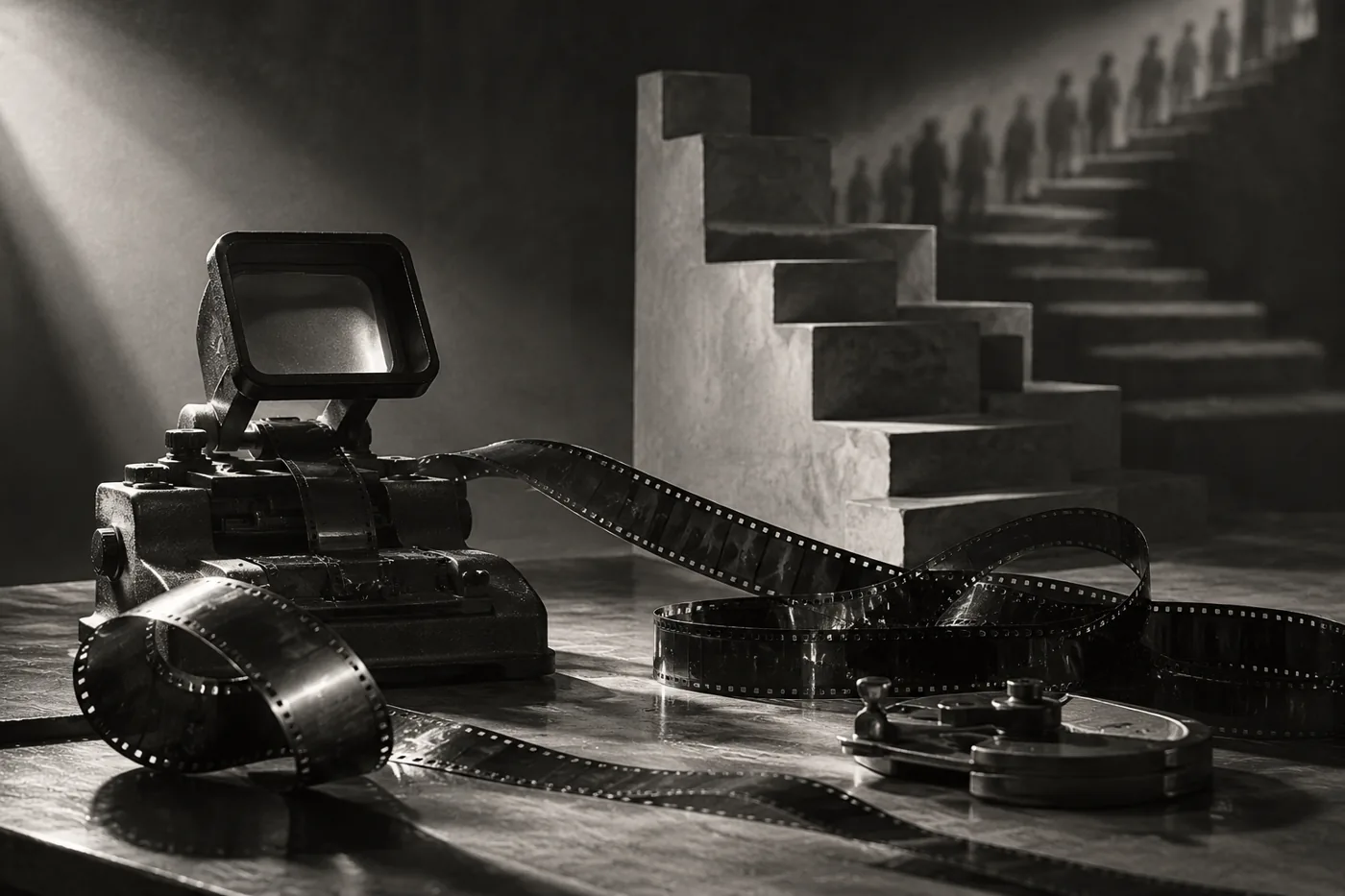
Generated interpretation, not documentary evidence. Invented film-editing equipment, staircase sculpture and abstract projected silhouettes; montage metaphor, not original film frames, actual Odesa steps or historical footage.
Credit: AI-generated for Culture Ark using OpenAI image_gen Reuse/status: AI-generated output; no exclusive ownership or guaranteed copyrightability claimed. Underlying works, marks and cultural permissions remain separate. Invented film-editing equipment, staircase sculpture and abstract projected silhouettes; montage metaphor, not original film frames, actual Odesa steps or historical footage. The original statement that one sequence “taught the world” editing is praise, not a literal invention claim. This is dramatization and political cinema, not news footage of 1905. A modern score is not the 1925 soundtrack; violence and historical prejudice need viewing context.
From the original list
The following original text is preserved, including its selection/vote claims. Preservation is not independent verification of every assertion.
Why: The Odessa Steps sequence taught the world film editing.
What to preserve: The film, Odessa Steps
Year and origin: 1925 · Soviet Union
Vote: 4/9 (historian 2 · future kid 1 · curator 1)
Learn more: Battleship Potemkin on Wikipedia
Supplemental context
Battleship Potemkin connects political argument with the arrangement of images. BFI identifies Eisenstein’s film as a work about a 1905 naval mutiny and emphasizes the compositional and editing force of the Odessa Steps sequence. Its release page also demonstrates a preservation problem: the version it presents has a Pet Shop Boys score first performed in 2004. Future viewers therefore need to know which image restoration, running speed, intertitles and accompaniment they are encountering. The film can teach how a sequence builds emotion and collective identification without being mistaken for an unmediated recording of the events it depicts.
Creator/community: Sergei Eisenstein and film collaborators; separately credited composers and musicians for particular editions Place/era: Soviet Union, 1925; dramatization associated with the 1905 naval mutiny
Context and limits
The original statement that one sequence “taught the world” editing is praise, not a literal invention claim. This is dramatization and political cinema, not news footage of 1905. A modern score is not the 1925 soundtrack; violence and historical prejudice need viewing context.
Where to learn more
- https://apiarybee.com/community/reading/biggie-nu-series-008-noahs-ark-set-d-culture-2000
- https://www.bfi.org.uk/bfi-film-releases/battleship-potemkin
Apiary library | Original Culture Ark article
Public ID and individual routes: pending publisher allocation. Internal source ID: D-0374
Part of the Culture Ark: 2,000 things people should still be able to see in 2,000 years, picked by AI research teams. This page keeps the original list entry for D-0374 word for word and adds context. Browse the gallery. The Culture Ark is an Artificial Mind Hive (AMH) project. AMH is owned by Austin Little.

Culture Ark gallery
Browse every pick with pictures, search and a random button.
Open the gallery →