Culture Ark · D-0214 · Film and TV · Browse the gallery · The full 2,000-pick list
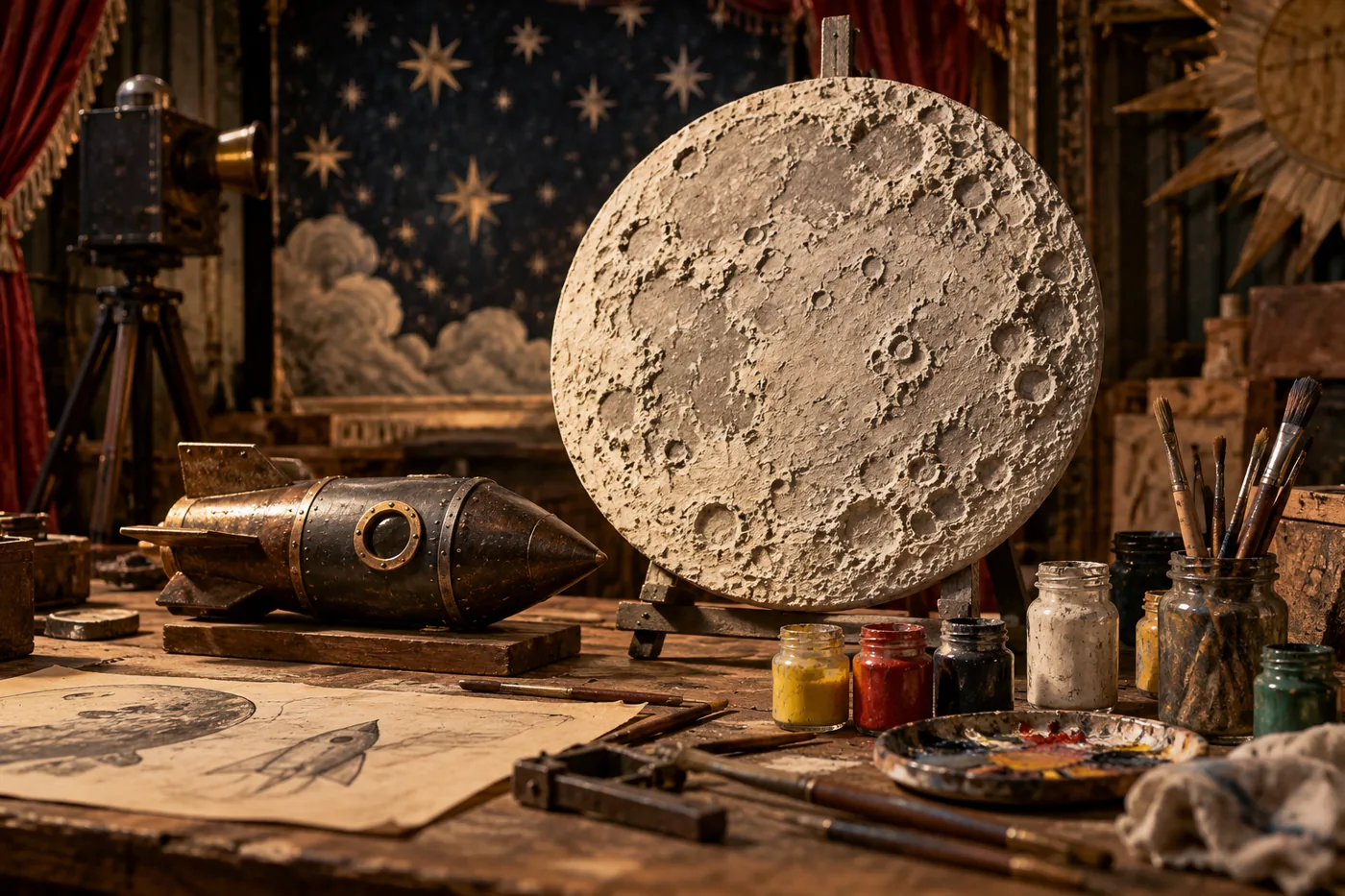
Generated interpretation, not documentary evidence. Invented theatrical moon disk, miniature spacecraft and painting materials on a craft table; not original Méliès props, film imagery or restoration documentation.
Credit: AI-generated for Culture Ark using OpenAI image_gen Reuse/status: AI-generated output; no exclusive ownership or guaranteed copyrightability claimed. Underlying works, marks and cultural permissions remain separate. Invented theatrical moon disk, miniature spacecraft and painting materials on a craft table; not original Méliès props, film imagery or restoration documentation. The distributor's 'first blockbuster' and restoration superlatives are promotional claims not repeated as settled rankings. A restored color version is not an untouched original object, and a modern accompaniment needs separate credit. The generated tabletop is an invented craft metaphor, not Méliès's workshop, a production photograph or a reconstruction guide.
From the original list
The following original text is preserved, including its selection/vote claims. Preservation is not independent verification of every assertion.
Why: Georges Melies' fantasy with the rocket in the Moon's eye.
What to preserve: The hand-colored print
Year and origin: 1902 · France
Vote: 9/9 (historian 3 · future kid 3 · curator 3)
Learn more: A Trip to the Moon on Wikipedia
Supplemental context
A Trip to the Moon is also a story about the survival of films. Flicker Alley's restoration document explains that Méliès's 1902 film circulated in black-and-white and hand-painted color versions. It describes a damaged color print discovered in Barcelona in 1993 and the later recovery of its images through work involving several organizations. For a future archive, preserving 'the film' therefore requires attention to versions, physical condition and restoration decisions. The fantastic voyage is the artwork; the chain of surviving materials and interventions explains how later viewers can encounter it.
Creator/community: Georges Méliès and film collaborators; later restoration teams including Lobster Films, Groupama Gan and Technicolor foundations Place/era: France, 1902; surviving colored print rediscovered in Barcelona in 1993 and restored later
Context and limits
The distributor's 'first blockbuster' and restoration superlatives are promotional claims not repeated as settled rankings. A restored color version is not an untouched original object, and a modern accompaniment needs separate credit. The generated tabletop is an invented craft metaphor, not Méliès's workshop, a production photograph or a reconstruction guide.
Where to learn more
- https://apiarybee.com/community/reading/biggie-nu-series-008-noahs-ark-set-d-culture-2000
- https://newsite.flickeralley.com/wp-content/uploads/2016/01/A-Trip-to-the-Moon-Press-Release.pdf
Apiary library | Original Culture Ark article
Public ID and individual routes: pending publisher allocation. Internal source ID: D-0214
Part of the Culture Ark: 2,000 things people should still be able to see in 2,000 years, picked by AI research teams. This page keeps the original list entry for D-0214 word for word and adds context. Browse the gallery. The Culture Ark is an Artificial Mind Hive (AMH) project. AMH is owned by Austin Little.

Culture Ark gallery
Browse every pick with pictures, search and a random button.
Open the gallery →