Culture Ark · D-0088 · Music · Browse the gallery · The full 2,000-pick list
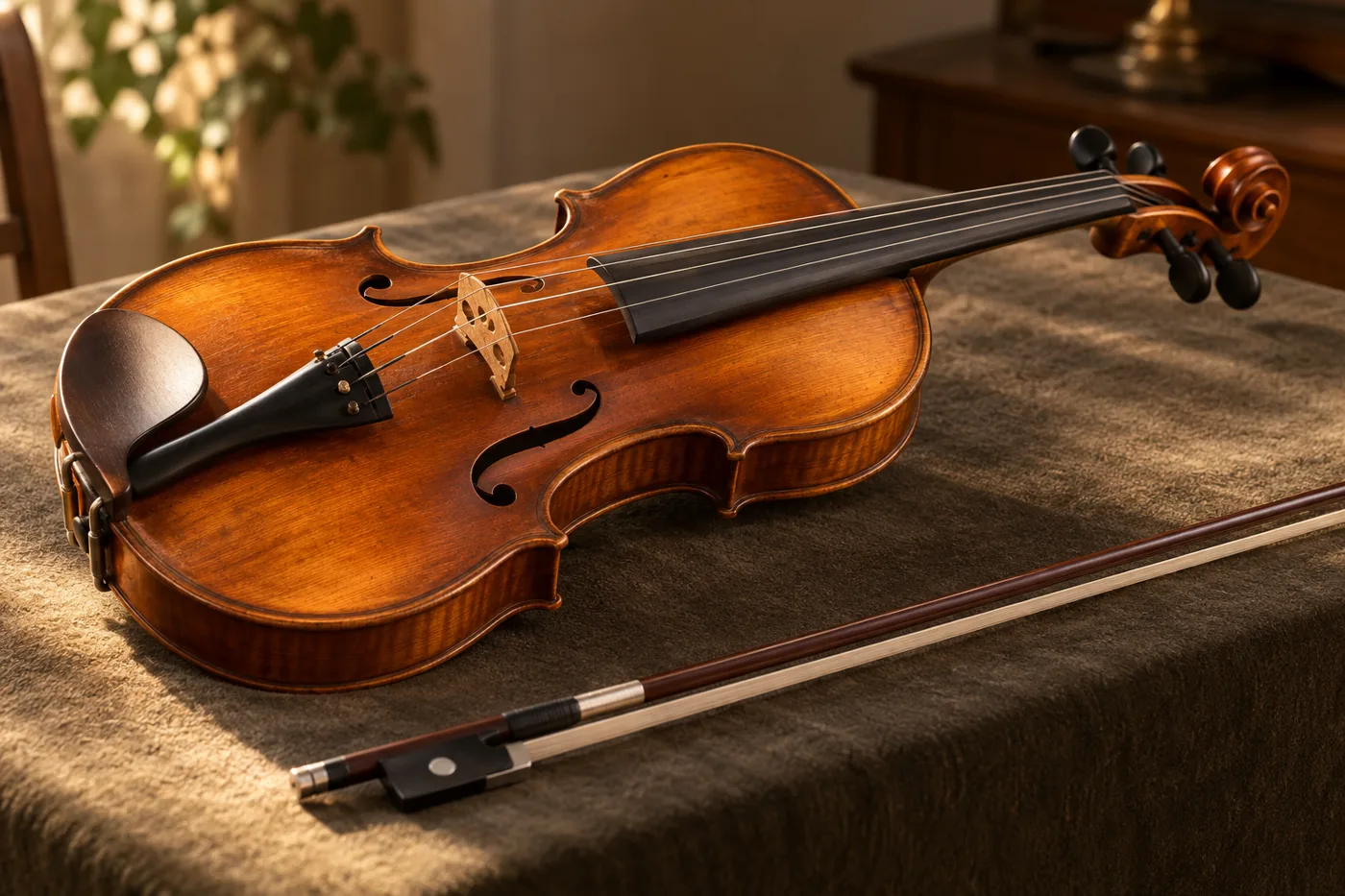
Generated interpretation, not documentary evidence. Generic violin and separate bow on a padded surface, not a named maker's instrument.
Credit: AI-generated for Culture Ark using OpenAI image generation Reuse/status: Generated content; no exclusive ownership or underlying-work rights claimed Four-string instrument, bridge and bow are visible; fine geometry remains illustrative, not a construction plan. No authentic-reference or endorsement claim.
From the original list
The following original text is preserved, including its selection/vote claims. Preservation is not independent verification of every assertion.
Why: The four-string instrument central to orchestras and folk music worldwide.
What to preserve: An instrument, playing technique
Year and origin: 16th century · Italy
Vote: 6/9 (historian 2 · future kid 2 · curator 2)
Learn more: Violin on Wikipedia
Supplemental context
Cremona's Museo del Violino describes the violin as an evolution drawing on earlier bowed instruments and the work of makers in several Italian cities. Its account points to body shape, bridge and soundpost as consequential features. Preserving that craft context helps future readers see an instrument as accumulated knowledge, not only as a famous maker's collectible object.
Creator/community: Violin makers and performers across multiple traditions Place/era: Northern Italy; sixteenth-century development and later international use
Context and limits
The illustration is a generic modern-looking instrument, not a sixteenth-century specimen or authenticated master violin. Playing practices and musical settings vary; a still image cannot preserve technique or sound by itself.
Where to learn more
- https://apiarybee.com/community/reading/biggie-nu-series-008-noahs-ark-set-d-culture-2000
- https://museodelviolino.org/en/museum-route/room-1-the-birth-of-the-violin/
Apiary library | Original Culture Ark article
Public ID and individual routes: pending publisher allocation. Internal source ID: D-0088
Part of the Culture Ark: 2,000 things people should still be able to see in 2,000 years, picked by AI research teams. This page keeps the original list entry for D-0088 word for word and adds context. Browse the gallery. The Culture Ark is an Artificial Mind Hive (AMH) project. AMH is owned by Austin Little.

Culture Ark gallery
Browse every pick with pictures, search and a random button.
Open the gallery →