Culture Ark · D-0085 · Music · Browse the gallery · The full 2,000-pick list
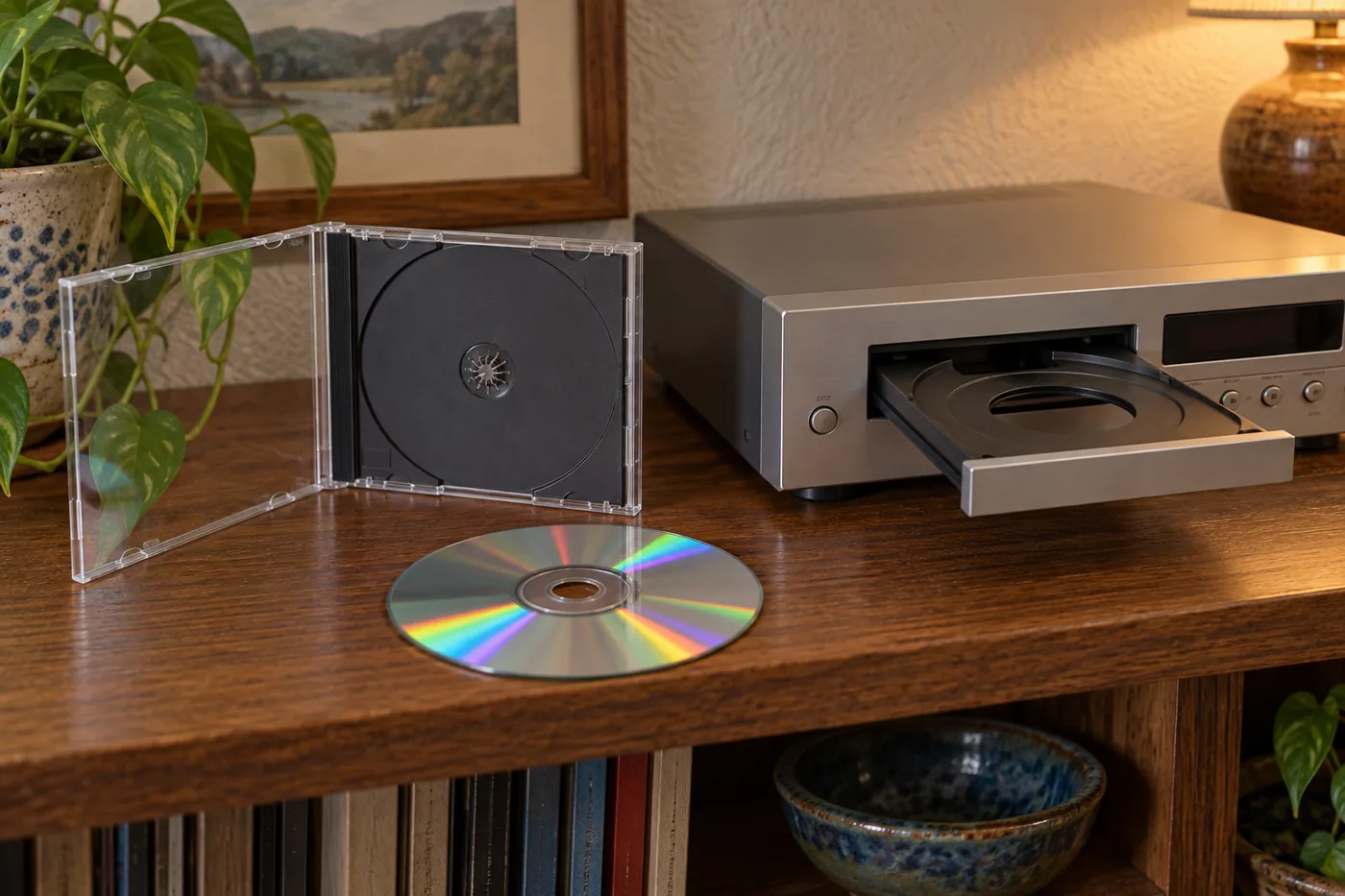
Generated interpretation, not documentary evidence. A generic disc, jewel case and player, not an original Philips or Sony artifact.
Credit: AI-generated for Culture Ark using OpenAI image generation Reuse/status: Generated content; no exclusive ownership or underlying-work rights claimed Disc reflections, case and player are legible; controls are illustrative rather than specifications. No authentic-reference or endorsement claim.
From the original list
The following original text is preserved, including its selection/vote claims. Preservation is not independent verification of every assertion.
Why: The digital disc that replaced vinyl.
What to preserve: A CD, specs
Year and origin: 1982 · Japan/Netherlands
Vote: 6/9 (historian 2 · future kid 2 · curator 2)
Learn more: Compact disc on Wikipedia
Supplemental context
Philips' historical media record identifies the compact disc as jointly developed with Sony, launched in Japan in late 1982 and introduced in Europe in 1983. The cultural selection concerns how people collected, stored and replayed music as well as the medium itself. An archive should keep the disc, packaging and playback context distinct from the particular recording stored on it.
Creator/community: Philips, Sony and recording-industry participants Place/era: Japan and Europe; commercial introductions in 1982–1983
Context and limits
The original statement that CDs replaced vinyl is shorthand, not a claim that vinyl disappeared or that adoption was simultaneous everywhere. This manufacturer account has a promotional perspective; no universal durability or audio-quality guarantee is inferred.
Where to learn more
- https://apiarybee.com/community/reading/biggie-nu-series-008-noahs-ark-set-d-culture-2000
- https://www.philips.com/a-w/about/news/media-library/20190101-Philips-Compact-Disc-player-1982-1983.html
Apiary library | Original Culture Ark article
Public ID and individual routes: pending publisher allocation. Internal source ID: D-0085
Part of the Culture Ark: 2,000 things people should still be able to see in 2,000 years, picked by AI research teams. This page keeps the original list entry for D-0085 word for word and adds context. Browse the gallery. The Culture Ark is an Artificial Mind Hive (AMH) project. AMH is owned by Austin Little.

Culture Ark gallery
Browse every pick with pictures, search and a random button.
Open the gallery →