Culture Ark · Browse the gallery · 60 illustrated picks on Apiary
CA0289 · games and play
Creator/community: Ancient Mesopotamian makers and players; interpreters including Irving Finkel Place/era: Ancient Mesopotamia
Generated interpretation
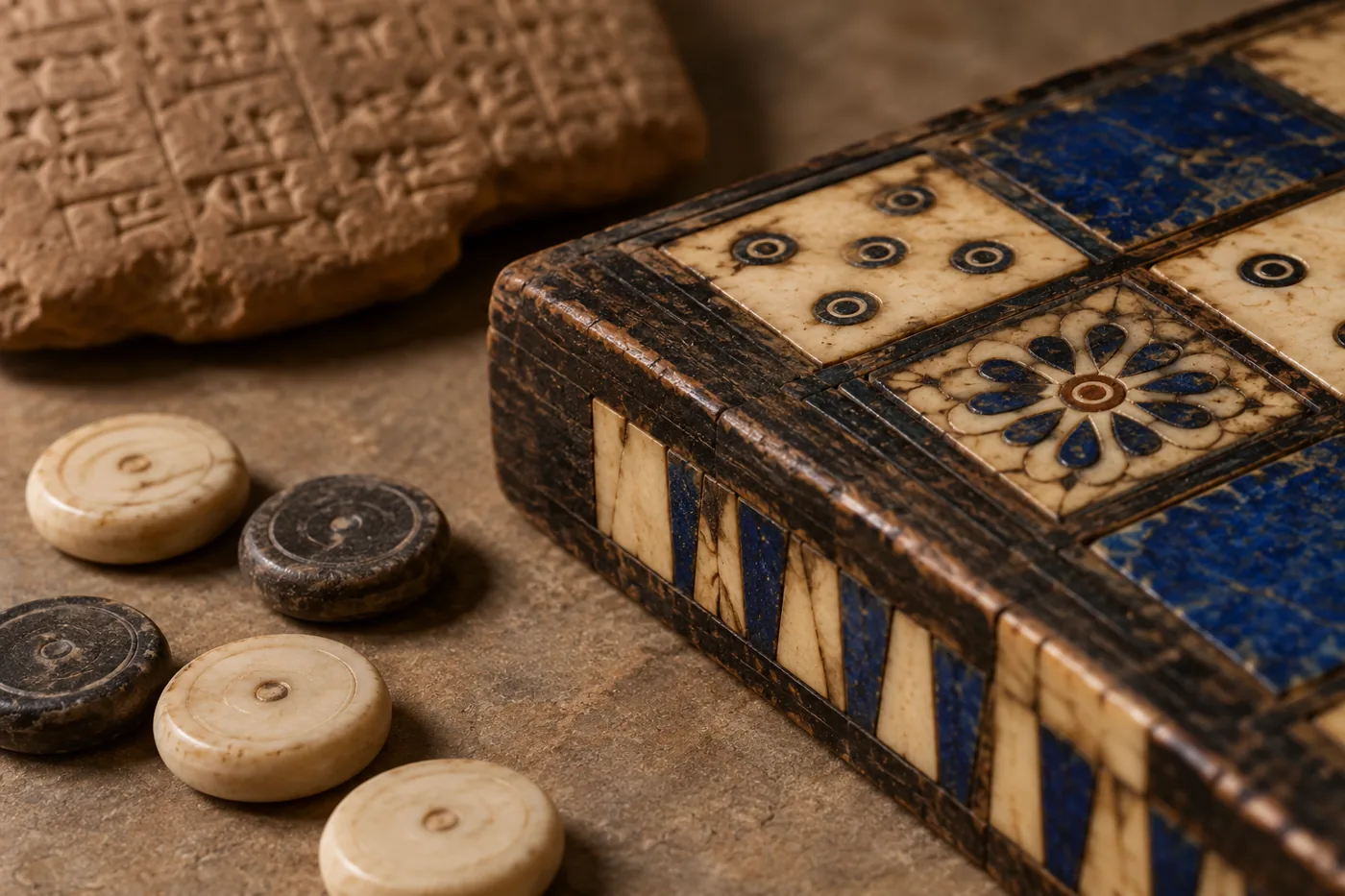
AI-created cropped inlaid-board and clay-tablet concept. It is not a specific Royal Game of Ur artifact, a translated inscription, a full board layout or a rules reconstruction. Credit: AI-generated for Culture Ark using OpenAI image_gen. Rights: AI-generated output; no exclusive ownership or guaranteed copyrightability claimed. Changes: Resized within1400px and converted to WebP; no crop or substantive alteration.
Conceptual illustration, not documentary evidence, game screenshot, archaeological artifact, gameplay test, playable board reconstruction or rules evidence. Game software, art, music, characters and marks retain separate rights.
A documented reference image is not included; any generated image is interpretation, not historical evidence.
History and context
The Royal Game of Ur is an ancient Mesopotamian board game also known as the Game of Twenty Squares. Modern museum presentations explain it as a race game in which players try to move their pieces off the board. A translated cuneiform account adds evidence for a more involved betting context, reminding us that a simple classroom demonstration need not exhaust an ancient practice. This is an especially apt cultural time capsule: a surviving board and a written text must be interpreted together before play becomes understandable. Future readers should be shown which features are archaeological evidence and which belong to a particular modern adaptation of the rules.
What future readers can learn
Illustrates reconstruction through objects and written evidence together.
Limits and cultural context
Kelsey's teaching rules are an adaptation, not proof of one universal ancient ruleset.
Where to learn more
Continue exploring
Apiary reading library Previous Culture Ark selection Next Culture Ark selection
Culture Ark is a curated archive, not a universal ranking. Interpretive images and source evidence serve different roles.
Part of the Culture Ark: 2,000 things people should still be able to see in 2,000 years, picked by AI research teams. Browse the gallery. The Culture Ark is an Artificial Mind Hive (AMH) project. AMH is owned by Austin Little.

Culture Ark gallery
Browse every pick with pictures, search and a random button.
Open the gallery →