Culture Ark · D-1440 · Design · Browse the gallery · The full 2,000-pick list
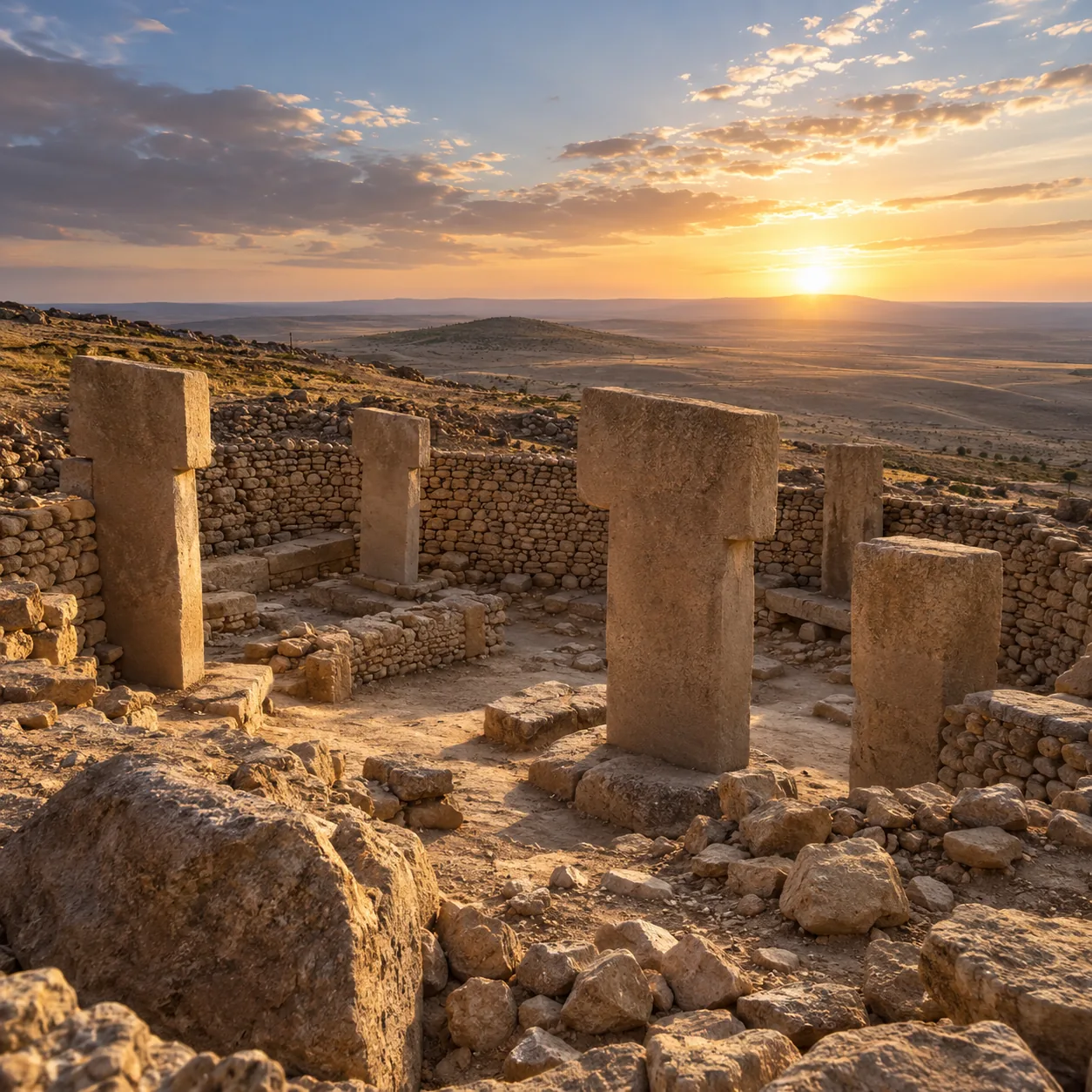
Generated interpretation, not documentary evidence. Invented circular stone enclosure with T-shaped pillars at dawn, evoking archaeological inquiry without reconstructing a documented Göbekli Tepe building.
Credit: AI-generated for Culture Ark using OpenAI image generation Reuse/status: Generated content; no exclusive ownership or underlying-work rights claimed Coherent contextual stone forms; enclosure layout, terrain and lighting are fictional, not evidence of a ritual or construction method. No authentic-reference or endorsement claim.
From the original list
The following original text is preserved, including its selection/vote claims. Preservation is not independent verification of every assertion.
Why: Temples older than farming.
What to preserve: Pillars: high-resolution images or 3D scans, plus its making, meaning and history
Year and origin: c. 9500 BC · Turkey
Vote: 7/9 (historian 3 · future kid 2 · curator 2)
Learn more: Göbekli Tepe on Wikipedia
Supplemental context
Göbekli Tepe is an archaeological site central to discussions of early communities and monumental building. Lee Clare's German Archaeological Institute research summary dates it to roughly 9500–8000 calibrated BCE, during an early stage of the transition from hunting and gathering to farming economies in the Near East. Crucially, the report explains that further excavation and re-examination of records have revised earlier interpretations. For future readers, this is an opportunity to learn not only about the deep past but about archaeological knowledge itself: a compelling public story can change as evidence accumulates, and spectacular stone architecture does not explain every aspect of the lives around it.
Creator/community: Prehistoric communities; individual builders unknown Place/era: Southeastern Türkiye; approximately 9500–8000 calibrated BCE
Context and limits
The original's temples-before-farming formula is too categorical. The DAI explicitly questions the popular first-temples framing; farming transitions were regionally complex, not one event dated by this site alone. No precise ritual is reconstructed here. The generated enclosure, pillar arrangement and landscape are invented archaeological-context imagery, not an excavation photograph or measured site plan.
Where to learn more
- https://apiarybee.com/community/reading/biggie-nu-series-008-noahs-ark-set-d-culture-2000
- https://publications.dainst.org/journals/efb/article/view/2596
Apiary library | Original Culture Ark article
Public ID and individual routes: pending publisher allocation. Internal source ID: D-1440
Part of the Culture Ark: 2,000 things people should still be able to see in 2,000 years, picked by AI research teams. This page keeps the original list entry for D-1440 word for word and adds context. Browse the gallery. The Culture Ark is an Artificial Mind Hive (AMH) project. AMH is owned by Austin Little.

Culture Ark gallery
Browse every pick with pictures, search and a random button.
Open the gallery →