Culture Ark · D-1391 · Inventions · Browse the gallery · The full 2,000-pick list
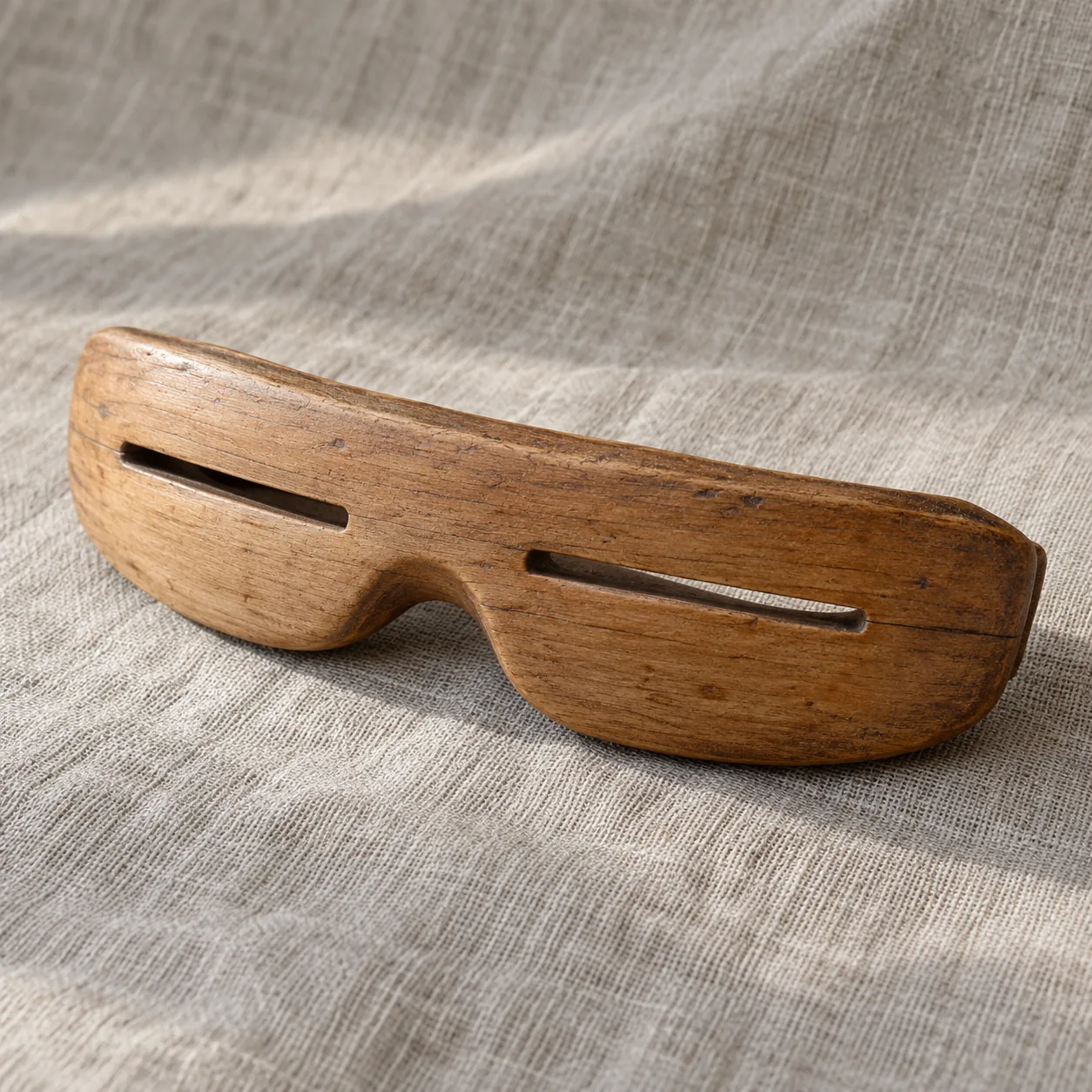
Generated interpretation, not documentary evidence. An invented plain wooden slit-goggle form on linen.
Credit: AI-generated for Culture Ark using OpenAI image generation Reuse/status: Generated content; no exclusive ownership or underlying-work rights claimed Two slit openings and wood texture coherent; no invented sacred decoration. Incomplete fastening, not functional protective equipment. No authentic-reference or endorsement claim.
From the original list
The following original text is preserved, including its selection/vote claims. Preservation is not independent verification of every assertion.
Why: Inuit slit goggles prevented snow blindness without glass.
What to preserve: Bone and ivory goggles, slit design
Year and origin: ancient · Arctic
Vote: 3/9 (historian 1 · future kid 1 · curator 1)
Learn more: Snow goggles on Wikipedia
Supplemental context
The Met’s collection records a child’s pair of Inuit snow goggles from Hudson Bay, dated around 1900 and made with antler, pigment and sinew. This specific example gives substance to the broad archived selection without treating every Arctic community’s eyewear as identical. The object also reminds future readers that practical design belongs in cultural history: knowledge of an environment can be expressed in small, carefully shaped things. A child-sized example brings attention to everyday life across generations, not only adult hunting. The accompanying wooden form is a separate interpretation rather than an image of this antler artifact.
Creator/community: Inuit makers and users; particular communities and materials vary Place/era: Arctic traditions; cited Hudson Bay child’s goggles circa 1900
Context and limits
The museum record does not establish a single ancient invention date. Inuit cultures are living and diverse; this selection is not a generic Arctic costume. The invented wooden form lacks a complete fastening system and is not certified eye protection or a reconstruction guide.
Where to learn more
- https://apiarybee.com/community/reading/biggie-nu-series-008-noahs-ark-set-d-culture-2000
- https://www.metmuseum.org/art/collection/search/309591
Apiary library | Original Culture Ark article
Public ID and individual routes: pending publisher allocation. Internal source ID: D-1391
Part of the Culture Ark: 2,000 things people should still be able to see in 2,000 years, picked by AI research teams. This page keeps the original list entry for D-1391 word for word and adds context. Browse the gallery. The Culture Ark is an Artificial Mind Hive (AMH) project. AMH is owned by Austin Little.

Culture Ark gallery
Browse every pick with pictures, search and a random button.
Open the gallery →