Culture Ark · D-1378 · Inventions · Browse the gallery · The full 2,000-pick list
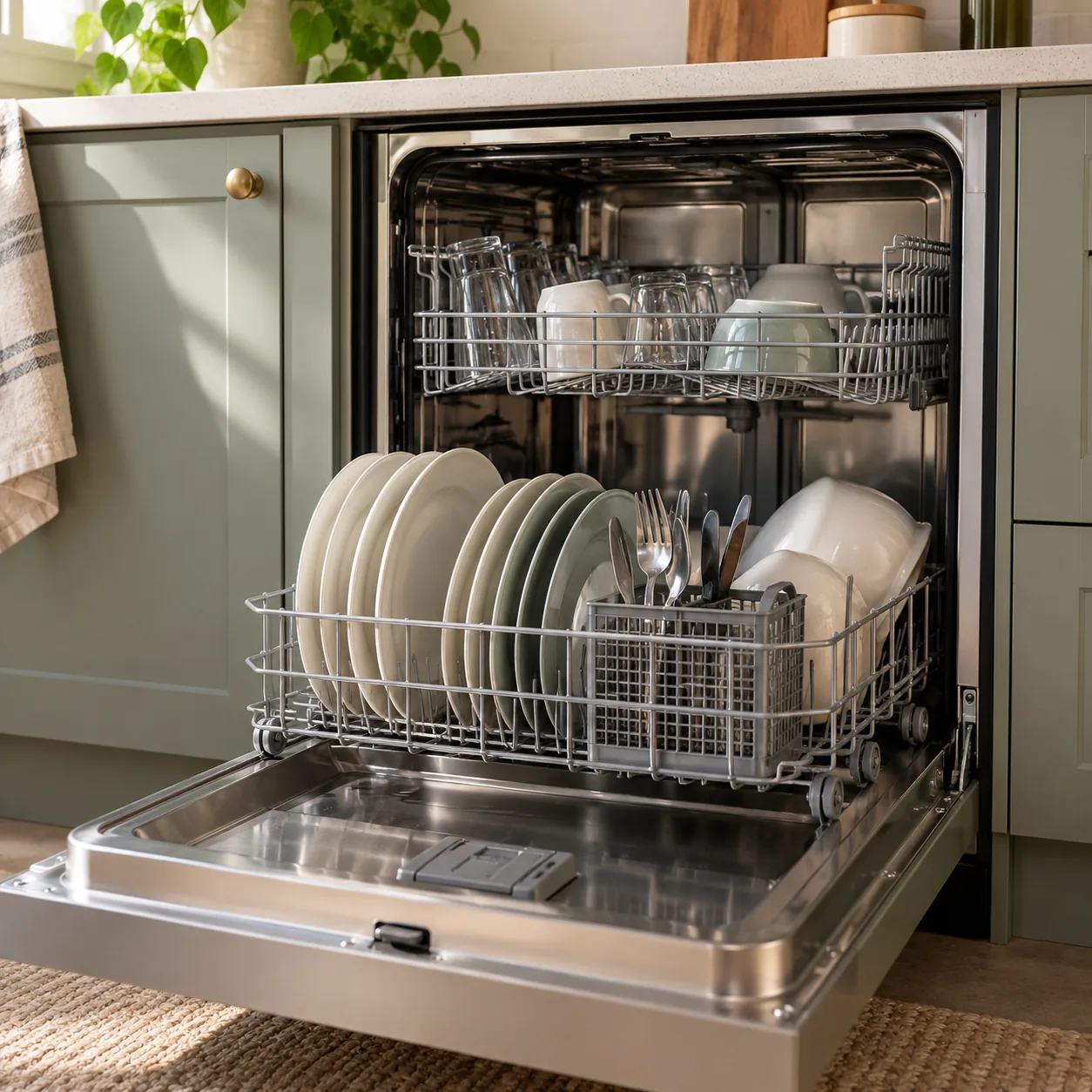
Generated interpretation, not documentary evidence. An invented open household dishwasher with ordinary plates, cups and cutlery.
Credit: AI-generated for Culture Ark using OpenAI image generation Reuse/status: Generated content; no exclusive ownership or underlying-work rights claimed Coherent racks and dishes; arrangement is contextual, not optimal loading or authentic Cochrane machinery. No authentic-reference or endorsement claim.
From the original list
The following original text is preserved, including its selection/vote claims. Preservation is not independent verification of every assertion.
Why: Josephine Cochrane's machine for washing dishes faster than her servants.
What to preserve: Cochrane patent, loading debates, modern racks
Year and origin: 1886 · United States
Vote: 3/9 (historian 1 · future kid 1 · curator 1)
Learn more: Dishwasher on Wikipedia
Supplemental context
MIT’s Lemelson account identifies Josephine Cochrane’s dishwasher as a commercially successful development, while noting an earlier hand-cranked patent from 1850. Her design was patented in 1886 and attracted restaurants and hotels; cost and hot-water requirements complicated household adoption. The object thus illustrates a difference between inventing an appliance and making it fit ordinary domestic circumstances. Future readers can examine washing-up as labour shaped by infrastructure, money and expectations, rather than an inconvenience that vanished the moment a patent was granted. The pictured racks belong to a generic contemporary-looking machine, not Cochrane’s original design.
Creator/community: Josephine Cochrane and subsequent manufacturers, kitchen workers and household users Place/era: United States, 1886 patent milestone and later commercial and domestic adoption
Context and limits
The archived comparison with servants is an anecdotal simplification, not a verified speed trial. The linked institutional biography also recounts origin anecdotes, so they are not used here as proof of motive. No universal energy-saving claim, ideal loading arrangement or operating instructions are supplied.
Where to learn more
- https://apiarybee.com/community/reading/biggie-nu-series-008-noahs-ark-set-d-culture-2000
- https://lemelson.mit.edu/resources/josephine-cochrane
Apiary library | Original Culture Ark article
Public ID and individual routes: pending publisher allocation. Internal source ID: D-1378
Part of the Culture Ark: 2,000 things people should still be able to see in 2,000 years, picked by AI research teams. This page keeps the original list entry for D-1378 word for word and adds context. Browse the gallery. The Culture Ark is an Artificial Mind Hive (AMH) project. AMH is owned by Austin Little.

Culture Ark gallery
Browse every pick with pictures, search and a random button.
Open the gallery →