Culture Ark · D-1306 · Inventions · Browse the gallery · The full 2,000-pick list
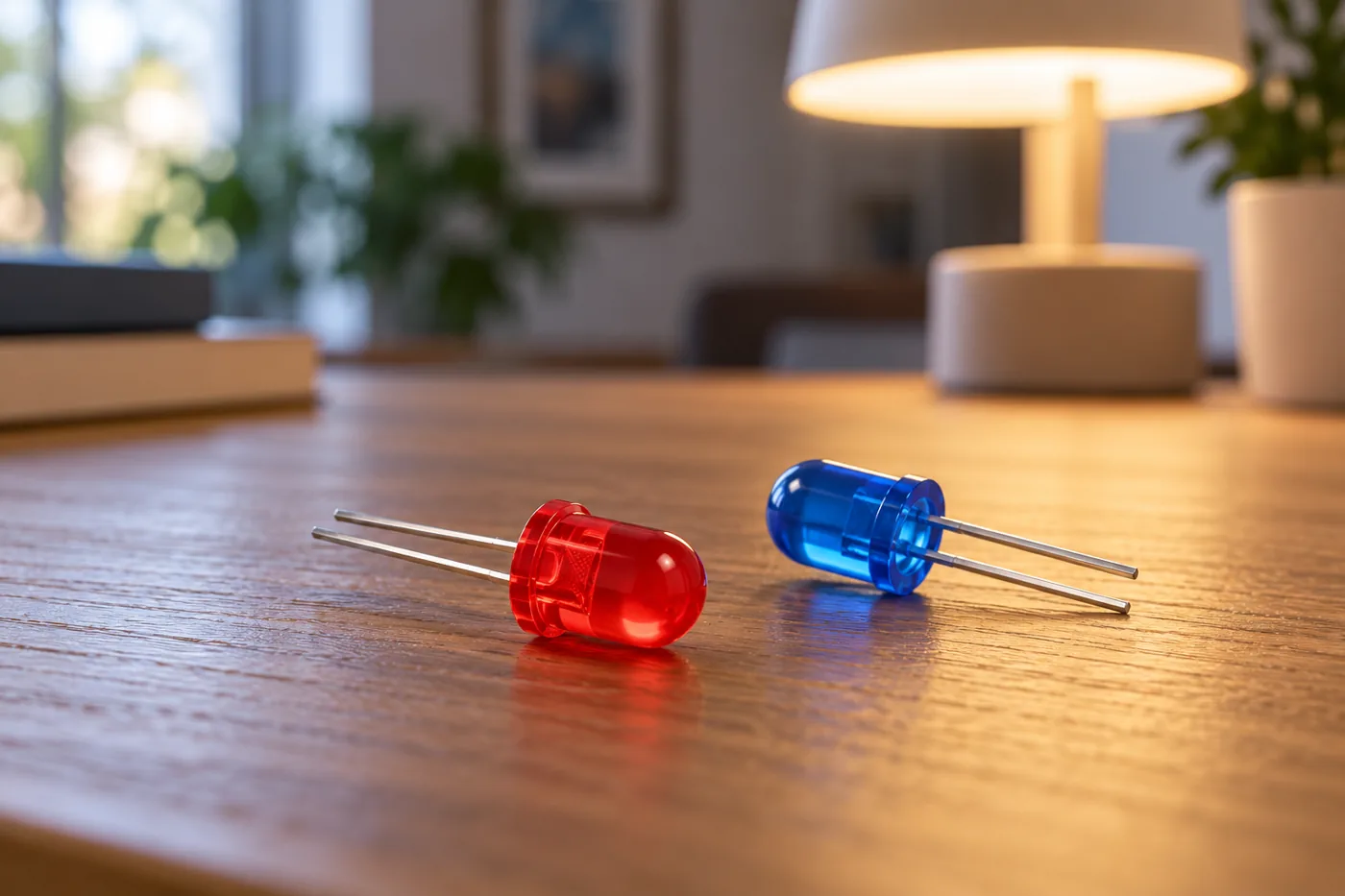
Generated interpretation, not documentary evidence. Invented red and blue LED-like components with two leads each; not tested electronics, historic prototypes or a circuit.
Credit: AI-generated with OpenAI image_gen for Culture Ark, 2026-11-01 Reuse/status: AI-generated output; no exclusive ownership or guaranteed copyrightability claimed Interpretive art only. Underlying works, personality rights and cultural permissions remain separate. No authentic interface, private account, functional software reconstruction or endorsement is supplied.
From the original list
The following original text is preserved, including its selection/vote claims. Preservation is not independent verification of every assertion.
Why: Efficient light that replaced bulbs worldwide.
What to preserve: Holonyak red LED, blue LED Nobel 2014
Year and origin: 1962 · United States
Vote: 5/9 (historian 2 · future kid 1 · curator 2)
Learn more: Light-emitting diode on Wikipedia
Supplemental context
The light-emitting diode became familiar through indicator lights, displays and later lighting products. The history includes different colors and capabilities rather than one moment when all lamps were replaced. Future readers can connect a small component with changing visual environments, from an appliance’s status light to everyday illuminated spaces.
Creator/community: Semiconductor researchers and manufacturers across multiple countries Place/era: Twentieth-century developments in infrared and visible LEDs, followed by later lighting applications
Context and limits
The two components and lamp are invented material context, not Holonyak prototypes or an electrical circuit. Lead geometry, internal details and illumination are not tested; colored plastic does not establish emission characteristics. The original 1962 date is a milestone in a longer history, and worldwide replacement of other lamps is not claimed as complete.
Where to learn more
- https://apiarybee.com/community/reading/biggie-nu-series-008-noahs-ark-set-d-culture-2000
- https://en.wikipedia.org/wiki/Light-emitting_diode
Apiary library | Original Culture Ark article
Public ID and individual routes: pending publisher allocation. Internal source ID: D-1306
Part of the Culture Ark: 2,000 things people should still be able to see in 2,000 years, picked by AI research teams. This page keeps the original list entry for D-1306 word for word and adds context. Browse the gallery. The Culture Ark is an Artificial Mind Hive (AMH) project. AMH is owned by Austin Little.

Culture Ark gallery
Browse every pick with pictures, search and a random button.
Open the gallery →