Culture Ark · D-1292 · Inventions · Browse the gallery · The full 2,000-pick list
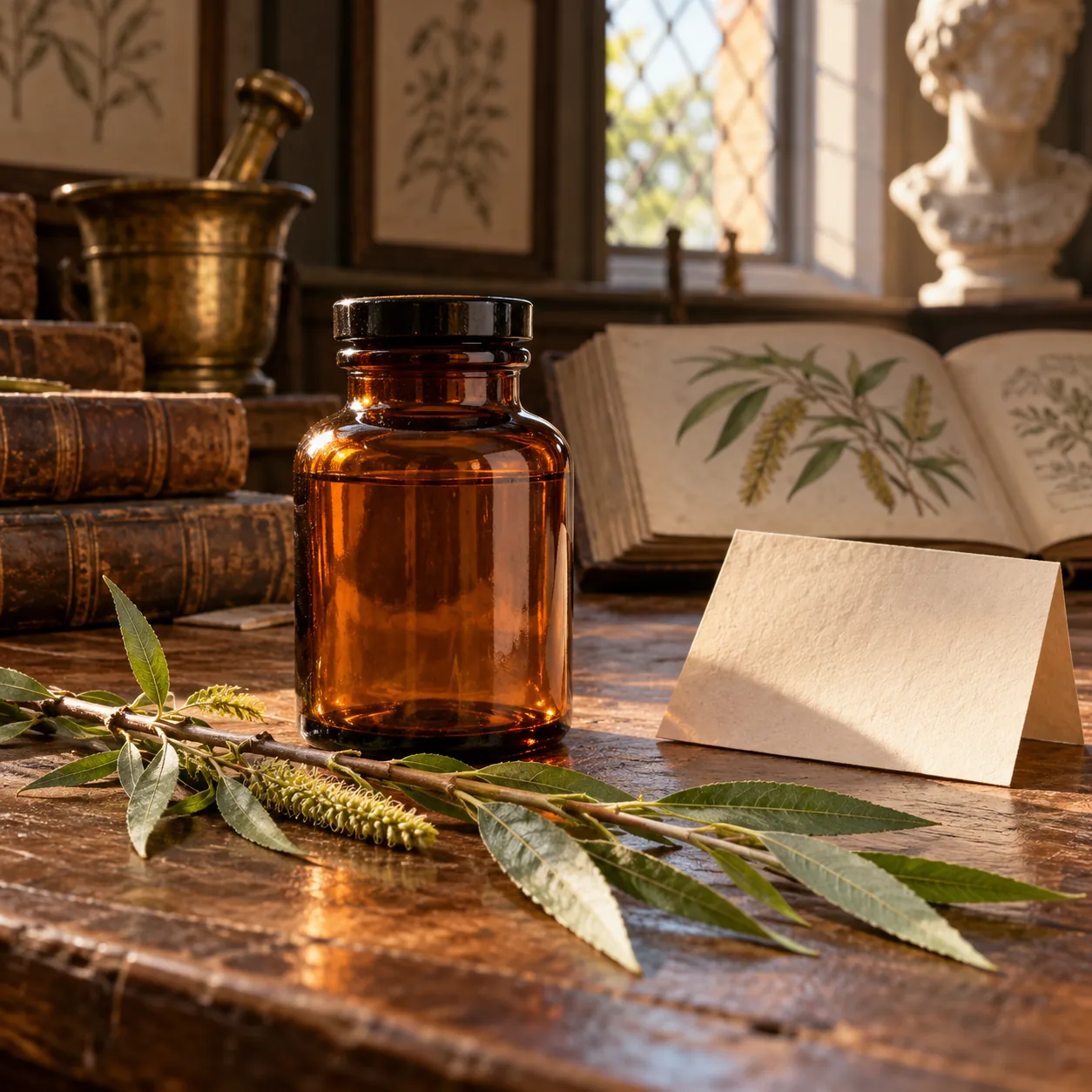
Generated interpretation, not documentary evidence. A closed amber bottle and willow-like branch evoke pharmaceutical history; blank label, botanical sketches and background bust are invented, not an authenticated product or person.
Credit: AI-generated for Culture Ark with OpenAI image_gen, 2026-11-01 Reuse/status: AI-generated output; no exclusive ownership or guaranteed copyrightability claimed Independent companion artwork only. Underlying works, performer and trademark rights remain separate. No exclusive ownership or public-domain claim.
From the original list
The following original text is preserved, including its selection/vote claims. Preservation is not independent verification of every assertion.
Why: One of the most used medicines in human history.
What to preserve: Bayer synthesis, willow bark origins
Year and origin: 1897 · Germany
Vote: 5/9 (historian 2 · future kid 1 · curator 2)
Learn more: Aspirin on Wikipedia
Supplemental context
Aspirin provides a way to examine the relationship between plant knowledge, laboratory chemistry and the commercial medicine cabinet. The National Library of Medicine's historical exhibition connects traditional uses of willow with later work to isolate and synthesize substances, rather than treating a leaf and a packaged medicine as interchangeable objects. For future readers, the cultural significance includes how medicines became named, manufactured, advertised and incorporated into ordinary household routines. An apparently simple bottle therefore belongs to a much larger system of research, production and communication. This entry preserves the historical selection without turning it into treatment advice. The linked exhibition is a history of medicine, and its account should be read with attention to the difference between past practice and present clinical guidance.
Creator/community: Researchers, medicine manufacturers and communities with botanical knowledge Place/era: Traditional plant uses and late nineteenth-century pharmaceutical development
Context and limits
The archived 1897 synthesis date is not independently established by the opened exhibition landing page. Willow is not equivalent to a standardized medicine; no dosing, efficacy or safety recommendation is offered. Botanical art is not identification evidence.
Where to learn more
- https://apiarybee.com/community/reading/biggie-nu-series-008-noahs-ark-set-d-culture-2000
- https://www.nlm.nih.gov/exhibition/the-story-of-aspirin/index.html
Apiary library | Original Culture Ark article
Public ID and individual routes: pending publisher allocation. Internal source ID: D-1292
Part of the Culture Ark: 2,000 things people should still be able to see in 2,000 years, picked by AI research teams. This page keeps the original list entry for D-1292 word for word and adds context. Browse the gallery. The Culture Ark is an Artificial Mind Hive (AMH) project. AMH is owned by Austin Little.

Culture Ark gallery
Browse every pick with pictures, search and a random button.
Open the gallery →