Culture Ark · D-0971 · Internet culture · Browse the gallery · The full 2,000-pick list
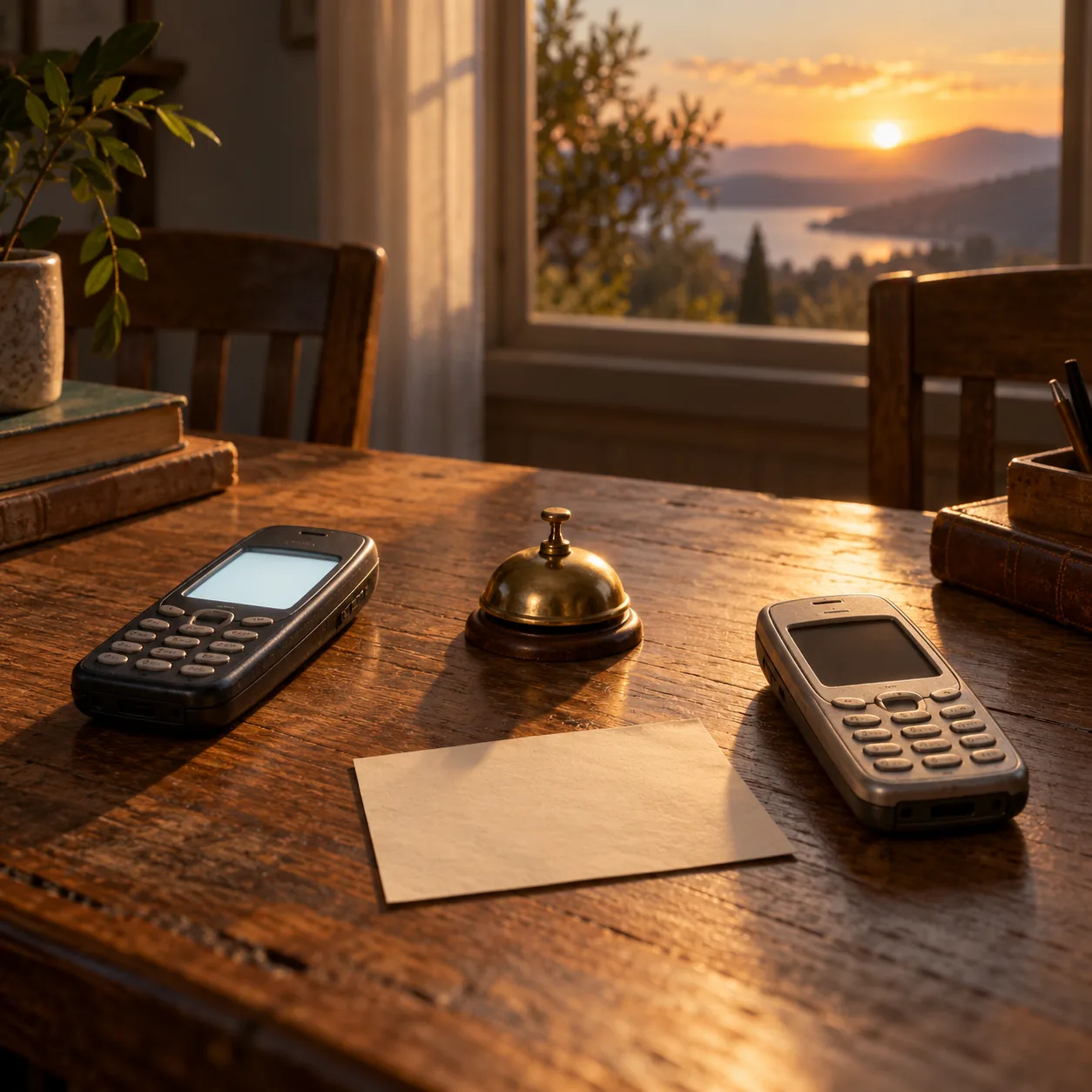
Generated interpretation, not documentary evidence. Two imagined older mobile phones, a small brass bell and a blank note symbolize negotiated one-ring communication; the bell is not network equipment.
Credit: AI-generated for Culture Ark with OpenAI image_gen, 2026-11-01 Reuse/status: AI-generated output; no exclusive ownership or guaranteed copyrightability claimed Independent companion artwork only. Underlying works, performer and trademark rights remain separate. No exclusive ownership or public-domain claim.
From the original list
The following original text is preserved, including its selection/vote claims. Preservation is not independent verification of every assertion.
Why: Ringing once to send a free message became a language of its own.
What to preserve: uses in India and Africa, marketing
Year and origin: 2000 · India
Vote: 4/9 (historian 1 · future kid 1 · curator 2)
Learn more: Missed call on Wikipedia
Supplemental context
A deliberately unanswered mobile call can carry meaning without a spoken conversation. Jonathan Donner’s research on beeping describes interviews with small-business owners and university students in Rwanda, identifying requests to call back, prearranged practical signals, and gestures that sustain relationships. The important cultural object is therefore not simply a telephone: it is an agreement between people about what a ring means. Cost, access to airtime, expectations of reciprocity, and familiarity with the caller can all shape that agreement. Preserving this practice helps future readers understand how users adapted communication systems through social convention rather than a new device or application. The illustration offers a symbolic pair of phones, not a reconstruction of the study.
Creator/community: Mobile-phone users and their social networks Place/era: Late twentieth- and early twenty-first-century mobile communication; locally negotiated practices
Context and limits
The original 2000 India marker is preserved, but this research does not establish an exclusive invention date or country. Meanings and billing arrangements vary; an unanswered call is not a universally free or unambiguous message.
Where to learn more
- https://apiarybee.com/community/reading/biggie-nu-series-008-noahs-ark-set-d-culture-2000
- https://onlinelibrary.wiley.com/doi/abs/10.1111/j.1083-6101.2007.00383.x
Apiary library | Original Culture Ark article
Public ID and individual routes: pending publisher allocation. Internal source ID: D-0971
Part of the Culture Ark: 2,000 things people should still be able to see in 2,000 years, picked by AI research teams. This page keeps the original list entry for D-0971 word for word and adds context. Browse the gallery. The Culture Ark is an Artificial Mind Hive (AMH) project. AMH is owned by Austin Little.

Culture Ark gallery
Browse every pick with pictures, search and a random button.
Open the gallery →