Culture Ark · D-0893 · Internet culture · Browse the gallery · The full 2,000-pick list
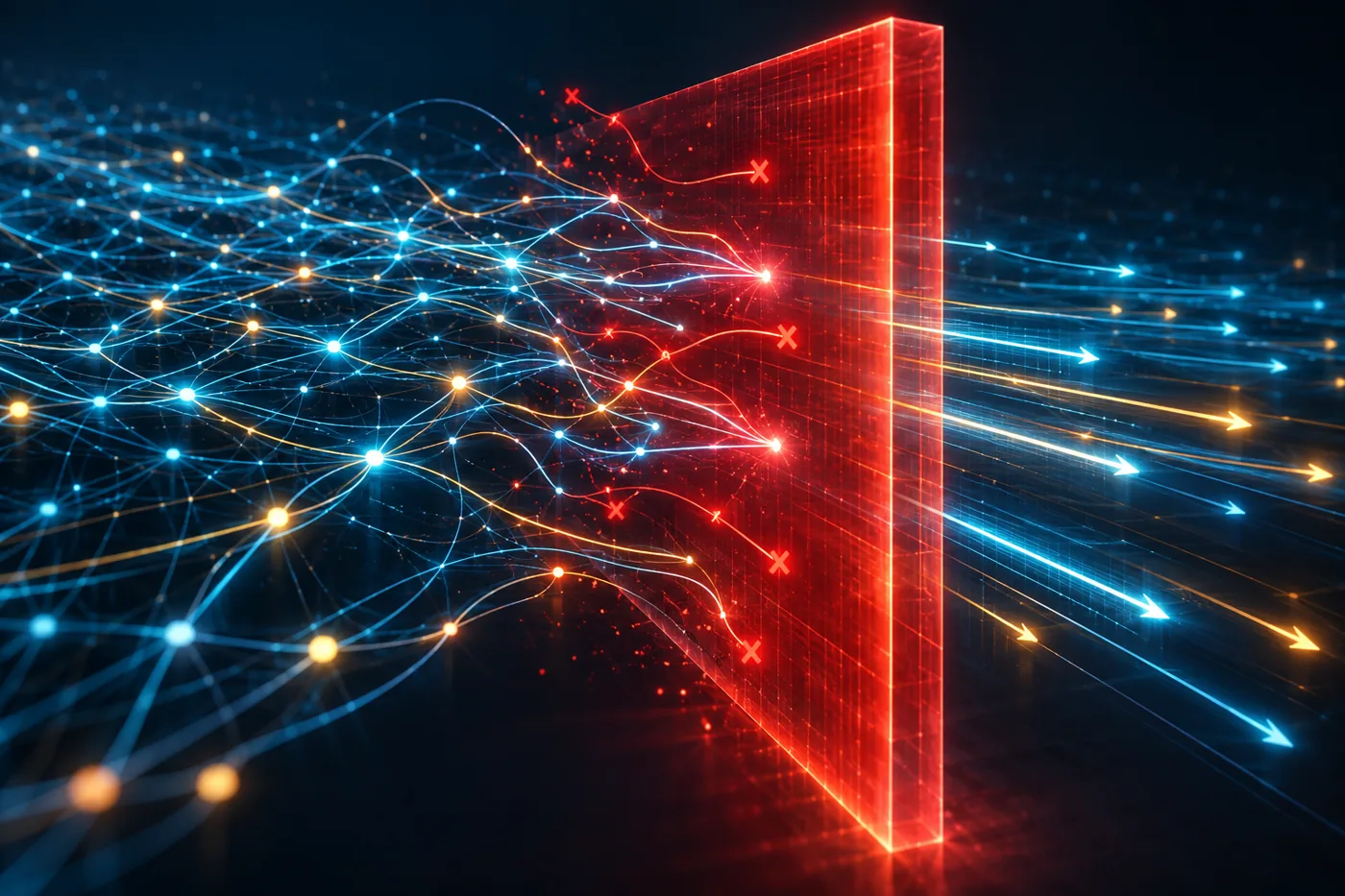
Generated interpretation, not documentary evidence. Conceptual network connections meeting a red filtering barrier; not a real installation, map or operational diagram.
Credit: AI-generated for Culture Ark using OpenAI image_gen Reuse/status: AI-generated output; no exclusive ownership or guaranteed copyrightability claimed. Underlying works, marks and cultural permissions remain separate. Conceptual network connections meeting a red filtering barrier; not a real installation, map or operational diagram. The checked 2024 paper does not establish 2003 as a definitive origin date; the original date remains unchanged but qualified. Network filtering is not identical to every form of platform moderation or surveillance. The image is a metaphor, not a topology diagram, current blocklist, technical reconstruction or circumvention guide.
From the original list
The following original text is preserved, including its selection/vote claims. Preservation is not independent verification of every assertion.
Why: China's system for controlling what can be seen online.
What to preserve: blocked sites, VPN use
Year and origin: 2003 · China
Vote: 6/9 (historian 3 · future kid 1 · curator 2)
Learn more: Great Firewall on Wikipedia
Supplemental context
The Great Firewall belongs in this collection as a condition shaping cultural access, not as a single object with one simple launch moment. The GFWeb researchers describe an evolving system of web filtering and explain why repeated measurement is necessary to understand it. Their study distinguishes observed blocking behavior from assumptions about a permanent, universal list. For future readers, the cultural issue is which conversations, archives and publications people can reach, and how that access is unevenly structured. The symbolic barrier in the illustration makes filtering visible without claiming to show real infrastructure. Preserving the topic also requires the experiences of affected users, rather than reducing a population to its government's policies.
Creator/community: Chinese state internet-control institutions and network operators; affected users and censorship researchers Place/era: Mainland China; evolving network censorship, studied here through a 2024 research publication
Context and limits
The checked 2024 paper does not establish 2003 as a definitive origin date; the original date remains unchanged but qualified. Network filtering is not identical to every form of platform moderation or surveillance. The image is a metaphor, not a topology diagram, current blocklist, technical reconstruction or circumvention guide.
Where to learn more
- https://apiarybee.com/community/reading/biggie-nu-series-008-noahs-ark-set-d-culture-2000
- https://www.usenix.org/conference/usenixsecurity24/presentation/hoang
Apiary library | Original Culture Ark article
Public ID and individual routes: pending publisher allocation. Internal source ID: D-0893
Part of the Culture Ark: 2,000 things people should still be able to see in 2,000 years, picked by AI research teams. This page keeps the original list entry for D-0893 word for word and adds context. Browse the gallery. The Culture Ark is an Artificial Mind Hive (AMH) project. AMH is owned by Austin Little.

Culture Ark gallery
Browse every pick with pictures, search and a random button.
Open the gallery →