Culture Ark · D-0889 · Internet culture · Browse the gallery · The full 2,000-pick list
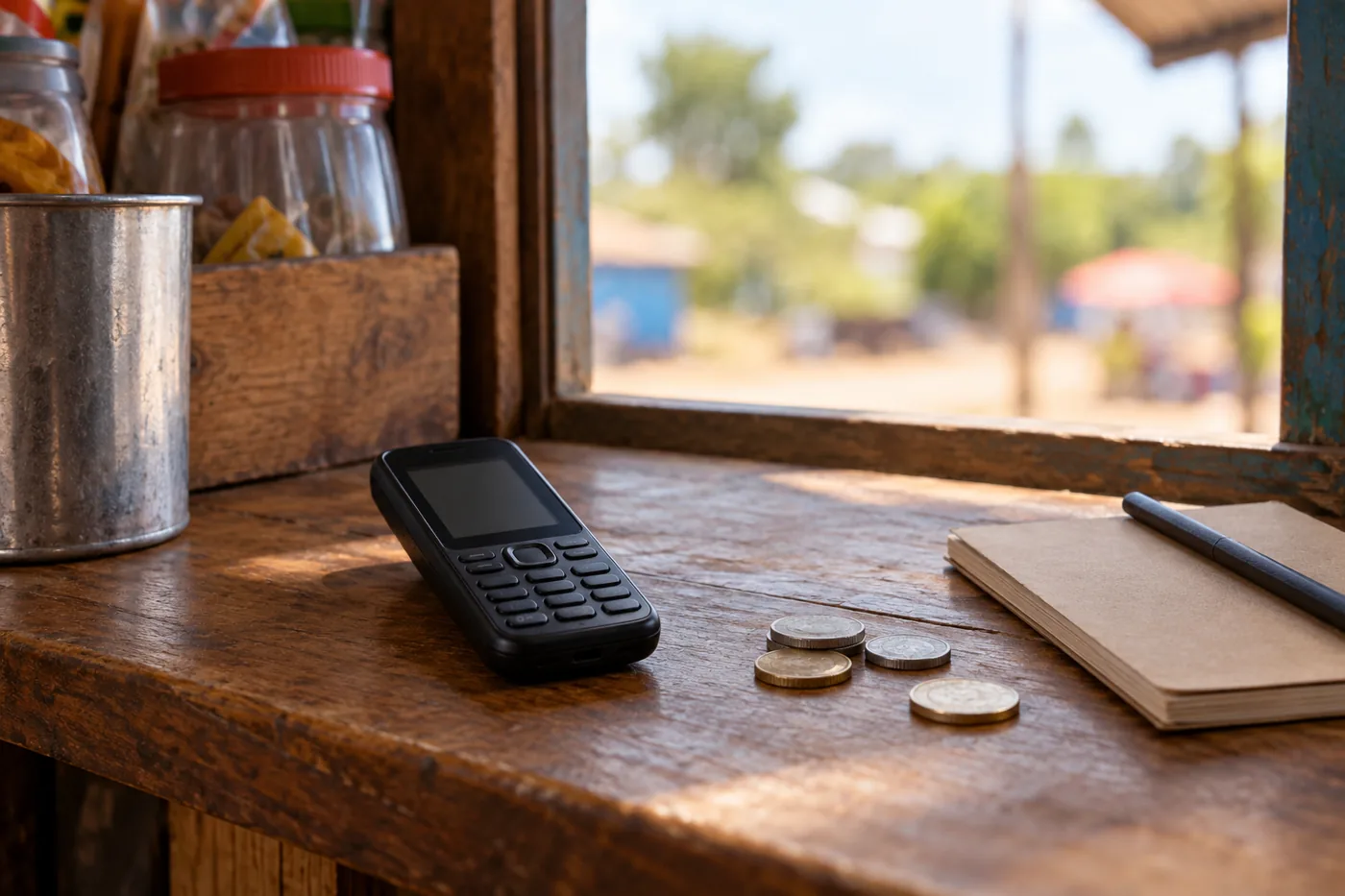
Generated interpretation, not documentary evidence. AI-generated metaphor for mobile exchange and everyday recordkeeping; not an M-Pesa interface, agent location or transaction record.
Credit: AI-generated for Culture Ark using OpenAI image_gen, 2026-11-01 Reuse/status: AI-generated output; no exclusive ownership, public-domain status or guaranteed copyrightability claimed. Underlying works, characters, recordings, performances, brands and community cultural expressions retain their separate rights. Discs are not authenticated Kenyan currency. The imagined scene cannot establish income, inclusion, account access, financial benefit or the identity of an actual agent or customer.
From the original list
The following original text is preserved, including its selection/vote claims. Preservation is not independent verification of every assertion.
Why: Mobile-phone money that let millions without banks send and save money.
What to preserve: the service, its impact on poverty research
Year and origin: 2007 · Kenya
Vote: 6/9 (historian 3 · future kid 1 · curator 2)
Learn more: M-Pesa on Wikipedia
Supplemental context
M-Pesa connects phone-based exchange with the work of local service agents. MIT’s account of research by Tavneet Suri and William Jack explains that their Kenyan study examined changes in access to agents handling deposits and withdrawals, rather than merely counting handset owners. The paper’s abstract reports estimated improvements in consumption and poverty outcomes, particularly for female-headed households. These are findings from a specified study, not a promise that every user benefits. For future preservation, an agent’s work, a household’s account and a research method would complement the service interface, revealing how a technical system becomes part of everyday relationships.
Creator/community: Kenyan mobile-money users and agents, service developers, and researchers of household outcomes Place/era: Kenya; M-Pesa launched in 2007, with a cited long-term study published in 2016
Context and limits
The full Science article was not accessible; its abstract and the researchers’ institutional report were reviewed. Findings concern the studied Kenyan setting and period, not every country, user or current product. No financial advice, fee comparison, transaction instruction, poverty threshold update or guaranteed outcome is offered. Private financial records are not archive-ready by default.
Where to learn more
- https://apiarybee.com/community/reading/biggie-nu-series-008-noahs-ark-set-d-culture-2000
- https://news.mit.edu/2016/mobile-money-kenyans-out-poverty-1208
- https://pubmed.ncbi.nlm.nih.gov/27940873/
- https://en.wikipedia.org/wiki/M-Pesa
Apiary library | Original Culture Ark article
Public ID and individual routes: pending publisher allocation. Internal source ID: D-0889
Part of the Culture Ark: 2,000 things people should still be able to see in 2,000 years, picked by AI research teams. This page keeps the original list entry for D-0889 word for word and adds context. Browse the gallery. The Culture Ark is an Artificial Mind Hive (AMH) project. AMH is owned by Austin Little.

Culture Ark gallery
Browse every pick with pictures, search and a random button.
Open the gallery →