Culture Ark · D-0881 · Internet culture · Browse the gallery · The full 2,000-pick list
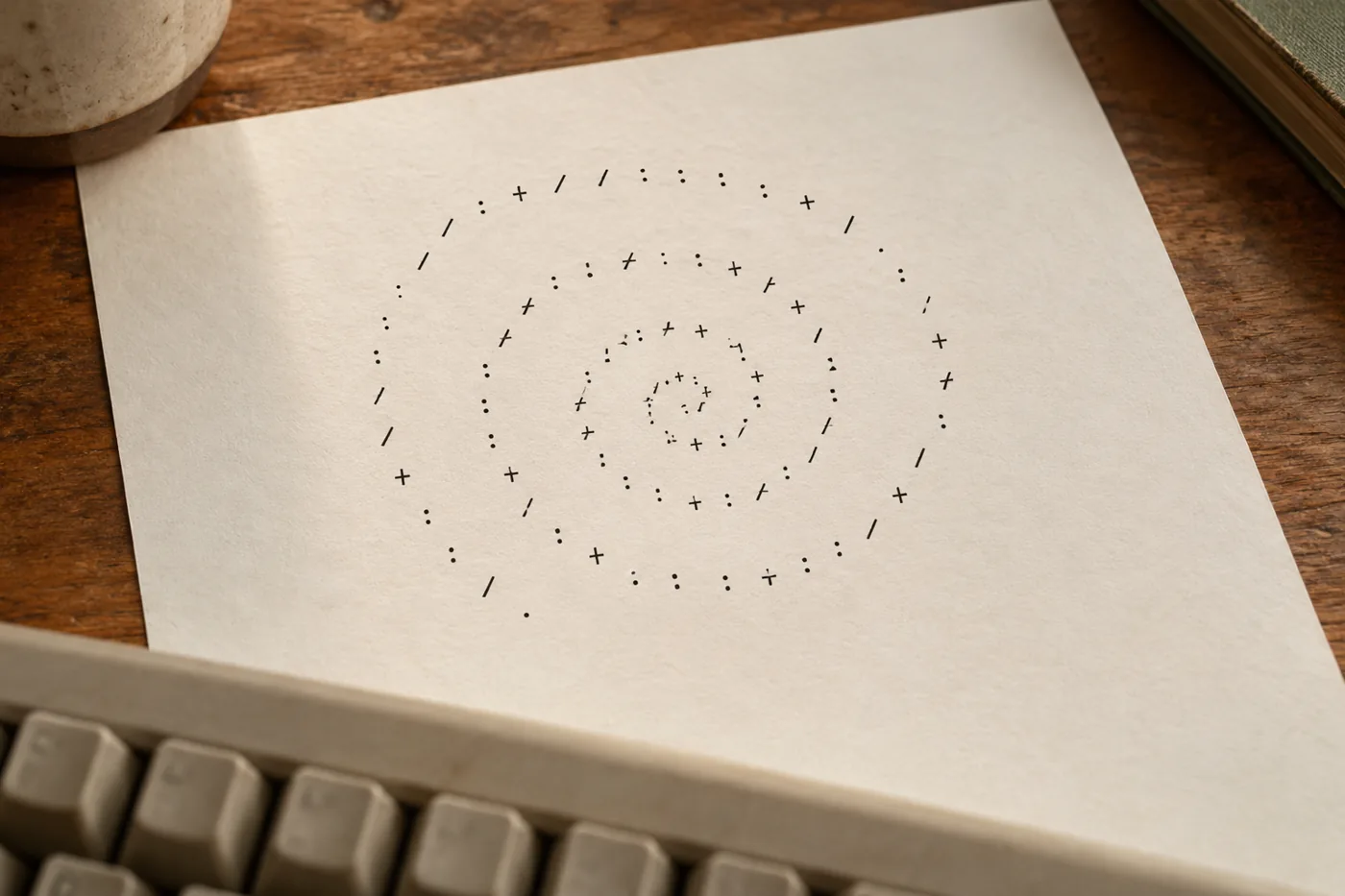
Generated interpretation, not documentary evidence. AI-generated interpretation of character marks becoming an image; not an archived ASCII work or executable text sample.
Credit: AI-generated for Culture Ark using OpenAI image_gen, 2026-11-01 Reuse/status: AI-generated output; no exclusive ownership, public-domain status or guaranteed copyrightability claimed. Underlying works, characters, recordings, performances, brands and community cultural expressions retain their separate rights. The marks are raster pixels, not preserved character codes, and their spacing is not a verified monospaced grid. They cannot demonstrate a working text-mode file.
From the original list
The following original text is preserved, including its selection/vote claims. Preservation is not independent verification of every assertion.
Why: Pictures made from typed characters.
What to preserve: example art, email signatures
Year and origin: 1966 · United States
Vote: 6/9 (historian 2 · future kid 2 · curator 2)
Learn more: ASCII art on Wikipedia
Supplemental context
ASCII art turns the ordinary material of typing into pictures. Sixteen Colors, a community archive of ANSI and ASCII artpacks, describes artists organizing into groups and circulating collections through the bulletin-board scene. Its catalogue preserves years, artists and groups, making social relationships visible alongside visual ingenuity. That archive covers related but not identical text-mode practices; its whole collection should not be relabeled as strict ASCII. For future readers, preserving character data together with the intended display conditions would be more informative than a screenshot alone. A maker’s signature, group affiliation and release context can explain why a small arrangement of characters mattered.
Creator/community: Text-mode artists, bulletin-board communities and individual makers of character-based pictures Place/era: International computing communities; the cited archive emphasizes the early-1990s artpack scene
Context and limits
The original 1966 United States origin is not independently established here. ASCII and ANSI are not interchangeable labels. Public archive access is not a blanket reproduction license. No existing artpack was downloaded; the presentation image is a metaphor, not a valid ASCII file or historical specimen.
Where to learn more
- https://apiarybee.com/community/reading/biggie-nu-series-008-noahs-ark-set-d-culture-2000
- https://16colo.rs/
- https://en.wikipedia.org/wiki/ASCII_art
Apiary library | Original Culture Ark article
Public ID and individual routes: pending publisher allocation. Internal source ID: D-0881
Part of the Culture Ark: 2,000 things people should still be able to see in 2,000 years, picked by AI research teams. This page keeps the original list entry for D-0881 word for word and adds context. Browse the gallery. The Culture Ark is an Artificial Mind Hive (AMH) project. AMH is owned by Austin Little.

Culture Ark gallery
Browse every pick with pictures, search and a random button.
Open the gallery →