Culture Ark · D-0878 · Internet culture · Browse the gallery · The full 2,000-pick list
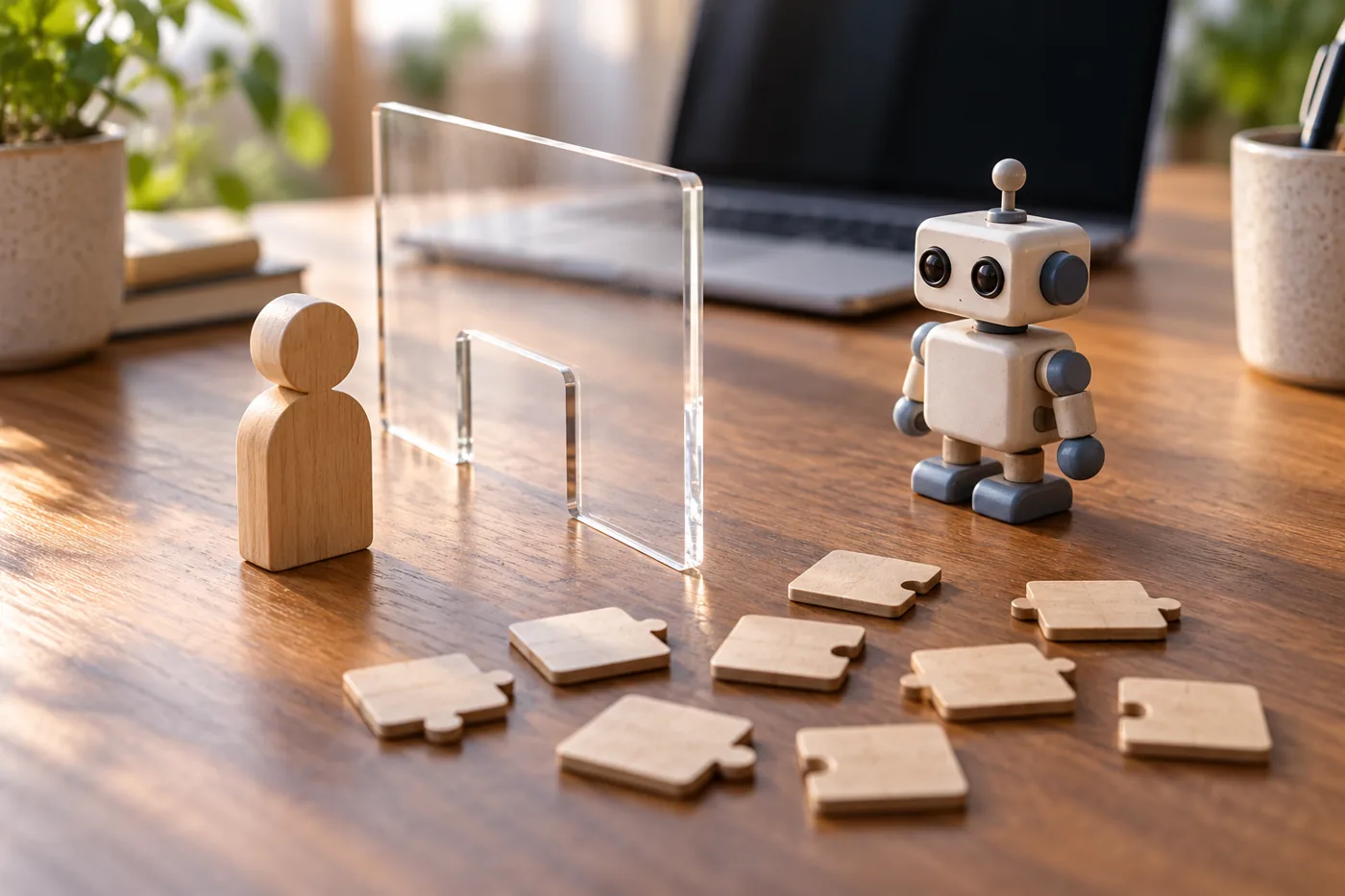
Generated interpretation, not documentary evidence. AI-generated wooden human token, toy robot, clear gate and puzzle pieces: a metaphor for web verification, not a working CAPTCHA.
Credit: AI-generated for Culture Ark using OpenAI image generation Reuse/status: Generated content; no exclusive ownership or underlying-work rights claimed Objects and clear gate are coherent; puzzle pieces are decorative, not a challenge grid. No interface, answer key or security instructions. No authentic-reference or endorsement claim.
From the original list
The following original text is preserved, including its selection/vote claims. Preservation is not independent verification of every assertion.
Why: Tests to prove you are human, a daily ritual of the web.
What to preserve: distorted text, image grids, the checkbox
Year and origin: 2003 · United States
Vote: 6/9 (historian 2 · future kid 2 · curator 2)
Learn more: CAPTCHA on Wikipedia
Supplemental context
CAPTCHA made a security task into a recurring experience of web use. In an early explanatory paper, von Ahn, Blum and Langford describe tests generated and graded by computers that most humans could pass but computer programs of that period could not. Their examples include distorted words, visual patterns and sound. Crucially, the authors frame this distinction in relation to contemporary capabilities, not an eternal boundary between people and machines. For future readers, CAPTCHA therefore records both the problem of automated abuse and a historical judgement about what kinds of perception were then difficult to automate.
Creator/community: Luis von Ahn, Manuel Blum, Nicholas Hopper, John Langford and later verification-system communities Place/era: Carnegie Mellon research and wider web practice; early-2000s research context
Context and limits
CAPTCHA and particular later reCAPTCHA products are not interchangeable names for one unchanging implementation. The original's 2003 marker should not imply all pictured test formats appeared together. No claim of perfect verification or universal accessibility is made. The toy gate illustration is not a real challenge, solution or bypass guide.
Where to learn more
- https://apiarybee.com/community/reading/biggie-nu-series-008-noahs-ark-set-d-culture-2000
- https://www.cs.cmu.edu/~biglou/captcha.pdf
- https://www.cmu.edu/engage/news-stories/alumni-hall-of-honor/bio-ahn
Apiary library | Original Culture Ark article
Public ID and individual routes: pending publisher allocation. Internal source ID: D-0878
Part of the Culture Ark: 2,000 things people should still be able to see in 2,000 years, picked by AI research teams. This page keeps the original list entry for D-0878 word for word and adds context. Browse the gallery. The Culture Ark is an Artificial Mind Hive (AMH) project. AMH is owned by Austin Little.

Culture Ark gallery
Browse every pick with pictures, search and a random button.
Open the gallery →