Culture Ark · D-0811 · Food · Browse the gallery · The full 2,000-pick list
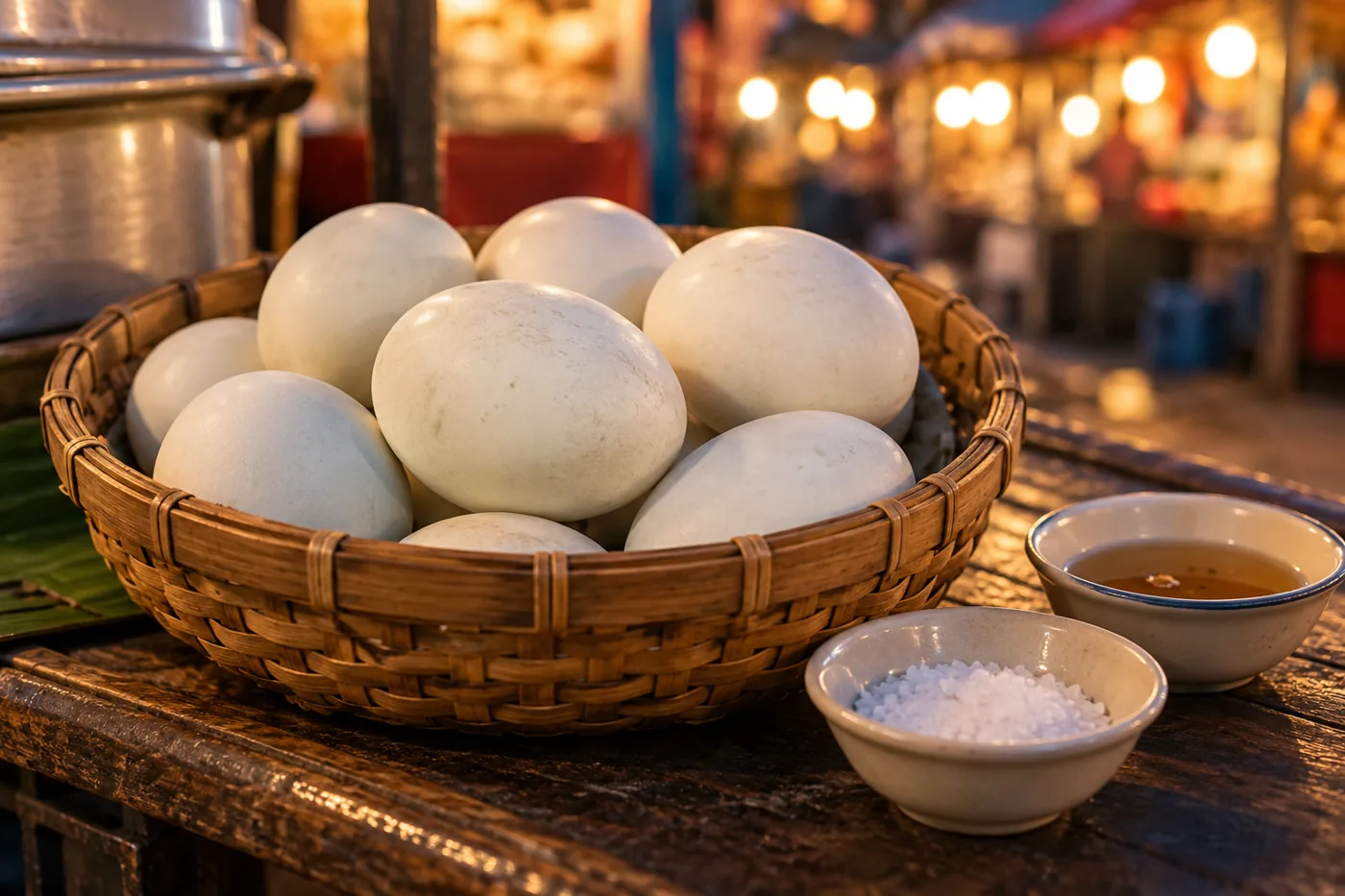
Generated interpretation, not documentary evidence. AI-generated contextual still life of closed duck eggs, salt and vinegar at an imagined evening stall; not a photograph or visible demonstration of balut contents.
Credit: AI-generated for Culture Ark using OpenAI image generation Reuse/status: Generated content; no exclusive ownership or underlying-work rights claimed Closed eggs, basket and condiments visually coherent; no exposed embryo or false anatomical reconstruction. Contextual association only. No authentic-reference or endorsement claim.
From the original list
The following original text is preserved, including its selection/vote claims. Preservation is not independent verification of every assertion.
Why: A fertilized duck egg.
What to preserve: Process
Year and origin: traditional · Philippines
Vote: 3/9 (historian 1 · future kid 1 · curator 1)
Learn more: Balut (food) on Wikipedia
Supplemental context
Balut connects duck raising, incubation, vending and eating in the Philippines. Alejandria and colleagues' 2019 research examines the food not merely as a surprising ingredient but as a cultural and economic practice. Their account describes incubated duck eggs, commonly around eighteen days, and asks how production and changing demand affect ideas of authenticity. For future readers, the important subject is the network of people who make a familiar snack possible. Treating balut only as an outsider's test of courage would obscure the livelihoods, preferences and local knowledge that the researchers investigate.
Creator/community: Philippine duck raisers, balut makers, vendors and eaters Place/era: Philippines; living food practice documented in 2019 research
Context and limits
The research is not a universal specification for every egg or seller. Incubation and preparation details here are cultural context, not food-safety instructions. The illustration deliberately shows closed eggs and vending context; their contents cannot be identified from the picture. Avoid disgust-based descriptions of other people's food.
Where to learn more
- https://apiarybee.com/community/reading/biggie-nu-series-008-noahs-ark-set-d-culture-2000
- https://link.springer.com/article/10.1186/s42779-019-0020-8
Apiary library | Original Culture Ark article
Public ID and individual routes: pending publisher allocation. Internal source ID: D-0811
Part of the Culture Ark: 2,000 things people should still be able to see in 2,000 years, picked by AI research teams. This page keeps the original list entry for D-0811 word for word and adds context. Browse the gallery. The Culture Ark is an Artificial Mind Hive (AMH) project. AMH is owned by Austin Little.

Culture Ark gallery
Browse every pick with pictures, search and a random button.
Open the gallery →